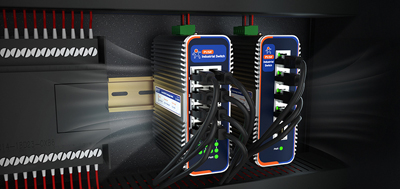
In the era of deep integration between Industry 4.0 and IoT technologies, industrial networks are undergoing a paradigm shift from single wired connections to wireless-wired hybrid networking. This transformation not only addresses the high wiring costs and limited flexibility of traditional wired networks but also achieves full-scenario device coverage and real-time data interaction through wireless technology supplementation. As the core device in hybrid networking, industrial Ethernet switches are evolving from mere data conduits into intelligent "neural centers" with decision-making capabilities, with their technological evolution and scenario adaptation capabilities becoming key determinants of industrial network efficiency.
1. Hybrid Networking: The Inevitable Choice for Industrial Network Upgrades
1.1 Limitations of Traditional Wired Networks
While traditional star-topology Ethernet is renowned for reliability, it reveals three key shortcomings in industrial scenarios:
High wiring costs: In large factories, equipment spacing often exceeds the 100-meter transmission limit of twisted-pair cables, necessitating fiber-optic relays or additional switch cascading, leading to exponential cost increases. For example, wiring costs accounted for 45% of total network investment in an automotive manufacturing plant.
Limited flexibility: Dynamic equipment like AGVs and mobile robots require frequent network reconfiguration, which wired networks struggle to accommodate.
Coverage blind spots: Wired networks struggle to achieve full coverage in complex workshop structures or open-pit mines, causing data collection interruptions.
1.2 Value Proposition of Wireless Technology
Wireless technology compensates for wired network limitations through:
Spatial freedom:
Wi-Fi 6/6E provides 300-meter radius coverage in 2.
4GHz/
5GHz bands, while
5G private networks support kilometer-scale low-latency transmission for mobile device connectivity.
Rapid deployment: An electronics factory reduced new production line networking time from 72 to 8 hours using a wireless AP + industrial switch solution.
Cost optimization: Hybrid networking reduces wired port requirements by 30%-50%, significantly lowering cabling and installation costs.
1.3 Hybrid Networking Architecture
Typical hybrid networks adopt a three-tier architecture:
Core layer: Gigabit industrial switches (e.g., USR-ISG-16G) handle data aggregation and routing decisions, supporting ERPS ring redundancy protocols for 50ms fault recovery.
Access layer: Fat APs (e.g., Huawei AP3010dn-AGN) connect directly to switches, enabling VLAN-based co-management of wired/wireless terminals within the same subnet to avoid cross-subnet communication delays.
Terminal layer: Fixed equipment (e.g., PLCs) uses wired connections for stability, while mobile devices (e.g., PDAs) employ
Wi-Fi 6 for real-time data synchronization.
2. Technological Evolution of Industrial Switches: From Conduits to Intelligence
2.1 Hardware Adaptations
Industrial switches incorporate these designs for harsh environments:
Wide temperature operation: Industrial-grade chips and heat dissipation structures enable stable operation from -40°C to 85°C, suitable for metallurgy and power applications.
Electromagnetic compatibility: Passing IEC 61000-4-6 interference tests ensures low error rates near frequency converters and welders.
Protection ratings: IP40 or higher standards prevent dust ingress, while metal casings and rail-mounted designs withstand vibrations.
2.2 Software Intelligence
Modern industrial switches feature basic intelligence:
Dynamic MAC learning: Self-learning algorithms build MAC address tables for precise unicast forwarding, reducing broadcast storm risks.
Intelligent traffic scheduling: Supporting port rate limiting and QoS policies prioritizes critical SCADA system data. For example, a chemical plant maintained DCS control command latency below 10ms through QoS settings.
Ring redundancy: ERPS-based dual-link redundancy enables 50ms failover to ensure production continuity.
2.3 Visual Management
Managed switches (e.g., USR-ISG-8G-M) offer:
Automatic topology discovery: LLDP protocol generates real-time network maps showing device connections and link quality.
Remote configuration: SNMP and web interfaces enable parameter adjustments from control rooms, reducing on-site maintenance.
Security protection: 802.1X authentication and ACL access control prevent unauthorized access. A machinery plant blocked 98% of unauthorized attempts through MAC binding.
3. Typical Application Scenarios
3.1 Smart Manufacturing Workshop: Network Support for Dynamic Production Lines
A hybrid networking solution in an automotive components factory achieved:
AGV navigation: A
5GHz dedicated network with switches and wireless APs provided 20ms latency and ±5mm positioning accuracy for 20 AGVs.
Equipment collaboration: Wired CNC machines and wireless inspection robots communicated via the same VLAN, improving product qualification rates to 99.2%.
Rapid model changeovers: VLAN reconfiguration and AP channel adjustments reduced changeover time from 8 to 1 hour without rewiring.
3.2 Smart Energy Station: Network Foundation for Unmanned Operations
A wind farm's hybrid networking addressed three challenges:
Extended coverage: Switch cascading and high-gain antennas achieved 1.5km wireless coverage for turbine monitoring.
Interference resistance: Frequency hopping and spread spectrum maintained over 95% communication success in crowded 2.
4GHz environments.
Edge computing: ARM-processor-equipped switches processed vibration sensor data locally, reducing cloud bandwidth usage by 30%.
3.3 Logistics Warehouse: High-Density Access Optimization
An e-commerce warehouse employed:
Multi-SSID isolation: Three SSIDs (management, staff, devices) physically isolated data flows, preventing DDoS attacks on core operations.
Load balancing: During peak periods (e.g., Singles' Day), switches distributed wireless traffic across four APs to prevent overload.
PoE power: 802.3af/at-compliant switches (e.g., USR-ISG-8P) powered APs and cameras via Ethernet, cutting power wiring costs by 40%.
4. Technical Challenges and Future Trends
4.1 Current Bottlenecks
Three challenges persist:
Latency jitter: Environmental interference causes ±50ms wireless latency fluctuations, unsuitable for precision control.
Security risks: Wireless signals are vulnerable to eavesdropping and tampering, requiring enhanced end-to-end encryption.
Standard fragmentation: Vendor-specific VLAN configurations and QoS policies complicate integration.
4.2 Future Directions
Key evolution areas include:
TSN time-sensitive networking: IEEE 802.1Qbv standards enable microsecond-level latency for motion control.
AI-driven operations: Machine learning predicts switch failures for preventive maintenance, such as 30-day optical module degradation warnings from traffic pattern analysis.
5G convergence: Integrating 5G UPFs into industrial switches creates a "wired+wireless+5G" architecture supporting AR remote collaboration.
Conclusion: From Connectivity Tools to Value Creators
Industrial Ethernet switches are transforming from data transmission devices into intelligent industrial internet infrastructure. In wireless-wired hybrid networks, they must not only ensure reliable, low-latency data forwarding but also enable "connection-to-empowerment" transitions through edge computing and AI operations. As TSN and 5G technologies converge, switches will become core engines driving manufacturing digital transformation, providing a robust network foundation for industrial internet ecosystems.