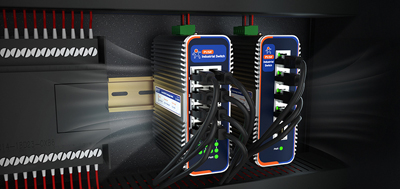
Integration of Industrial Routers and SD-WAN: Unlocking the Code to Reduce Enterprise Network Operation Costs by 30%
In the wave of Industry 4.0 and digital transformation, industrial networks are facing unprecedented challenges: a surge in the number of devices, explosive growth in data traffic, and an urgent need for multi-branch collaboration. Traditional network architectures, which rely on expensive dedicated lines, have high operational complexity, and poor scalability, result in soaring enterprise network operation costs. According to statistics, the proportion of network costs in manufacturing enterprises' total IT expenditures has climbed from 18% in 2018 to 32% in 2025, with dedicated line leasing, hardware maintenance, and on-site operations and maintenance accounting for over 60% of these costs. Against this backdrop, the integrated application of industrial routers and SD-WAN (Software-Defined Wide Area Network) is emerging as a key pathway for enterprises to break free from cost constraints.
Traditional industrial network architectures are "hardware-centric," relying on devices such as MPLS dedicated lines, dedicated firewalls, and load balancers to construct closed networks. This model presents three major cost pain points:
MPLS dedicated lines are billed based on bandwidth, with monthly rentals for transnational lines reaching tens of thousands of yuan. Moreover, capacity expansion can take several weeks. For example, a multinational manufacturing enterprise transmitting AI model data between its factories in China and the United States incurred annual costs exceeding 5 million yuan for its original MPLS dedicated line, and capacity expansion required a three-month lead time.
To ensure reliability, enterprises need to deploy primary and backup routers, firewalls, and other devices, with hardware procurement costs accounting for over 40% of total expenses. Additionally, the harsh industrial environment results in a device failure rate three times higher than that in commercial settings, with annual maintenance costs reaching 15% of the device's value.
Traditional networks rely on manual configuration, requiring engineers to conduct on-site debugging for new site deployments, with a single site activation taking over 8 hours. For instance, a automobile group needed a dedicated team of 20 personnel to manage the network operations and maintenance of its 400 4S stores nationwide, incurring annual labor costs exceeding 6 million yuan.
SD-WAN decouples the control plane from the data plane, software-defines network functions, and combines the hardware capabilities of industrial routers to achieve dynamic scheduling and intelligent optimization of network resources. Its core value is reflected in three dimensions:
SD-WAN supports multi-link hybrid networking, including MPLS, the Internet, and 4G/5G, and dynamically allocates traffic through intelligent routing algorithms. For example, an AIGC enterprise transmitted core training data via dedicated lines and non-sensitive data via optimized Internet transmission, reducing bandwidth costs by 60% and cutting transnational data transmission delays by over 60%.
Industrial routers play a pivotal role in this process. Take the USR-G806w as an example; it supports 4G LTE for all networks, dual-band Wi-Fi, dual Gigabit Ethernet ports, and is equipped with a built-in China Telecom eSIM card, enabling automatic switching among the three major operators. In an AGV scheduling scenario at a logistics warehouse, this device ensured uninterrupted communication in signal blind spots through dual-link backup of 4G and Wi-Fi relays, while also saving on dedicated line deployment costs.
SD-WAN's centralized management platform enables automation of network configuration, monitoring, and fault localization. In a network transformation project for a chemical group's gas stations, the SD-WAN controller facilitated visual operations and maintenance for 300 sites across the province, reducing fault localization time from 2 hours to 5 minutes and cutting operations and maintenance costs by 80%.
The remote management capabilities of industrial routers further amplify this advantage. The USR-G806w supports the URS Cloud platform, allowing operations and maintenance personnel to monitor device status, remotely configure parameters, and even perform one-click factory resets via a mobile app. An intelligent warehousing enterprise reported, "We used to climb ladders to adjust devices; now we can solve problems while sitting on the toilet, halving our labor costs."
SD-WAN maximizes the utilization of existing bandwidth through application-level traffic identification and dynamic path optimization. For example, after adopting SD-WAN, a cross-border e-commerce enterprise increased its link utilization from 50% to 80%, enabling it to handle three times the traffic at the same cost. Its core mechanisms include:
The hardware acceleration capabilities of industrial routers provide support for this. The USR-G806w features a dual-Qualcomm chip design, enhancing anti-interference capabilities by 50% and improving Wi-Fi signal penetration to meet the stable transmission requirements of complex industrial environments.
A multinational manufacturing enterprise needed to synchronize terabyte-scale AI models between its factories in China and the United States. The original MPLS dedicated line was costly and had a long capacity expansion cycle. By deploying SD-WAN and USR-G806w industrial routers, the enterprise achieved:
Ultimately, overall network operation costs decreased by 60%, transnational data transmission efficiency tripled, and the project's return on investment period was shortened to 6 months.
In a network transformation project for a large chemical group's gas stations, the traditional MSTP dedicated line incurred annual costs exceeding 5 million yuan, and payment transactions had to be routed through the headquarters' data center, resulting in inefficiencies. The integrated solution of SD-WAN and USR-G806w achieved:
After the transformation, the annual network cost per station dropped from 15,000 yuan to 6,000 yuan, saving 2.7 million yuan annually for 300 sites across the province and improving operations and maintenance efficiency by 80%.
A smart mining project required connecting 2,000 underground sensors. The traditional solution involved deploying dedicated APs and wired networks, costing over 10 million yuan. After adopting the USR-G806w industrial router, the project achieved:
The project's final cost was controlled within 3 million yuan, a 70% reduction compared to the traditional solution, and the devices operated stably for 14 months without failure.
Industrial sites are characterized by extreme conditions such as electromagnetic interference, dust, and vibration. The failure rate of ordinary commercial routers is three times higher than that of industrial-grade devices. When selecting devices, focus on:
SD-WAN's automated management capabilities rely on the router's remote configuration and cloud platform integration. When selecting devices, verify:
Industrial scenarios focus on stability, cost, and ease of use. Avoid paying a premium for "black technology." For example, the USR-G806w achieves automatic switching among the three major operators through the "Cloud Eagle Card." Although not the latest technology, it meets the needs of 90% of industrial scenarios and reduces costs by 40% compared to dual-SIM dual-standby solutions.
With the development of 5G, edge computing, and AIGC technologies, industrial networks are moving towards the era of "deterministic networks." The integration of SD-WAN and industrial routers will exhibit three major trends:
Large models will predict traffic peaks and pre-allocate resources, enabling "autonomous driving" of networks. For example, the New H3C AD-WAN solution already supports AI-based traffic prediction with an accuracy rate of 92%.
Combining SRv6 and QUIC protocols will achieve microsecond-level jitter control in wide area networks, meeting the needs of industrial control, remote surgery, and other scenarios.
SD-WAN will integrate zero-trust architectures and SASE security services, while industrial routers will need to support next-generation security technologies such as national cryptographic algorithms and quantum encryption.
The integration of industrial routers and SD-WAN represents not only a technological upgrade but also a paradigm shift in enterprise network architectures. Through three core capabilities—hybrid networking, automated operations and maintenance, and dynamic resource scheduling—enterprises can achieve a balance between network costs, reliability, and scalability. As AIGC, digital twins, and other technologies become more prevalent, industrial networks will become the core infrastructure for enterprise digital transformation, and the deep integration of SD-WAN and industrial routers is accelerating this process.