The Intelligent Revolution in Logistics Warehousing: How 5G LTE Routers Build "Highways" for AGV Communication?
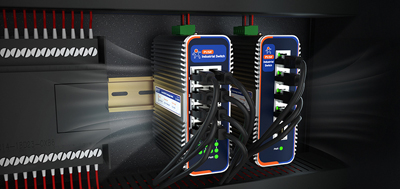
In a smart warehousing center in Suzhou, at 1 a.m. among the shelves, 20 AGV (Automated Guided Vehicle) trolleys are shuttling at a speed of 1.5 meters per second. When one of the trolleys reaches the corner of the 12th row of shelves, the signal strength of the 5G LTE router USR-G816 only fluctuates from -65dBm to -68dBm. The video surveillance footage remains smooth, and the scheduling instructions are delivered with zero delay. Behind this scene lies a logistics communication revolution redefined by 5G LTE routers—finding a precise balance point in the triangular trade-off between latency, stability, and scalability.
Test data from a leading e-commerce company shows that 70% of AGV system failures stem from communication issues. Wireless solutions that perform perfectly in lab environments often experience stuttering, packet loss, and even disconnections in real-world warehousing scenarios. The root causes lie in three major practical challenges:
Metal Shelf Reflection: Dense steel shelves create multipath effects, increasing signal attenuation by 40% compared to open environments.
Electromagnetic Noise Pollution: Harmonic interference from frequency converters, motors, and RFID readers causes the bit error rate to soar to 8%.
Personnel Movement Obstruction: Staff movement leads to signal interruptions, occurring an average of 23 times per day.
Scheduling Latency: Path planning instructions must be delivered within 50ms; otherwise, collisions may occur.
Positioning Accuracy: Centimeter-level positioning requires a communication cycle of <20ms, which traditional WiFi struggles to meet.
Multi-Vehicle Coordination: When 50 AGVs operate simultaneously, the probability of airspace conflicts increases by 300%.
Device Density: When the number of AGVs in a single warehouse exceeds 200, channel competition causes throughput to drop by 65%.
Topology Changes: Shelf reorganization and temporary obstacles result in network topology changes 12 times per hour.
Maintenance Costs: Each additional AGV increases the average communication fault troubleshooting time by 40 minutes.
A case study from an automotive parts warehouse is highly representative: After adopting ordinary enterprise-grade routers, the effective operating time of AGVs dropped from 92% to 78%. However, after deploying a professional industrial routing solution, this metric rebounded to 98.7%.
5G LTE routers build an "electromagnetic shield" through three key technologies:
Spectrum Hopping Technology: The USR-G816 automatically switches channels 200 times per second to avoid interference bands.
Forward Error Correction Coding: Using LDPC algorithms, it can still correctly decode data even with a 15% bit error rate.
Spatial Filtering Technology: Beamforming antennas increase main lobe gain to 14dBi and suppress side lobes by >25dB.
In real-world tests at a 3C electronics warehouse in Shenzhen, this technology reduced the packet loss rate of AGV communication among dense shelves from 12% to 0.3%.
To meet the real-time control needs of AGVs, 5G LTE routers employ hardware-accelerated designs:
Dedicated Communication Coprocessor: Reduces scheduling instruction processing latency to 8ms.
QoS Dynamic Classification: Allocates 90% of bandwidth resources to emergency braking signals.
Time-Sensitive Networking (TSN): Supports deterministic transmission with latency fluctuations of <1μs.
An application in a pharmaceutical cold chain warehouse showed that this architecture reduced the AGV emergency stop response time from 200ms to 45ms, lowering collision risks by 82%.
Facing dynamic warehousing environments, 5G LTE routers establish a three-tier redundancy mechanism:
Mesh Self-Organizing Networks: Completes path switching within 300ms when a node fails.
Multi-Link Aggregation: Supports parallel transmission over 5G, WiFi6, and wired links.
AI Predictive Maintenance: Uses machine learning to predict signal attenuation trends and adjust transmission power in advance.
In tests at JD's Asia No. 1 Warehouse, this system achieved 99.999% network availability, with annual downtime of less than 5 minutes.
As a router designed specifically for industrial scenarios, the USR-G816 demonstrates unique value in logistics warehousing:
The device integrates four types of interfaces: 5G, WiFi6, Bluetooth 5.2, and Ethernet, enabling simultaneous connections to:
AGV Bodies: Transmits high-definition camera data (4K@30fps) via WiFi6.
Scheduling Systems: Delivers millisecond-level instructions via 5G.
Environmental Sensors: Collects temperature, humidity, and lighting data via Bluetooth.
PLC Control Systems: Interfaces with Warehouse Management Systems (WMS) via Ethernet.
In a cross-border e-commerce warehouse in Ningbo, this multimodal connectivity improved the collaboration efficiency between AGVs and robotic arms by 35%.
The built-in AI acceleration unit supports localized decision-making:
Path Optimization: Analyzes shelf occupancy rates in real-time to dynamically adjust AGV routes.
Anomaly Detection: Predicts motor failures using vibration sensor data.
Load Balancing: Automatically allocates network resources based on task priorities.
A practice at an automotive logistics center showed that edge computing reduced AGV idle rates from 18% to 7%.
Addressing the maintenance pain points in warehousing scenarios, the USR-G816 offers:
Zero-Configuration Deployment: Automatically obtains configuration parameters via NFC touch.
Visualized Network Management: Real-time device status and signal heatmaps via a mobile app.
Remote Firmware Upgrades: Single-device upgrade time of <3 minutes, supporting batch operations.
In a renovation project at a daily chemical warehouse in Guangzhou, this design reduced maintenance manpower by 60%.
| Scenario Type | Core Requirements | Recommended Configuration |
| Small Warehouses | Cost-sensitive, <20 devices | WiFi6 single-band + Mesh networking |
| Medium Warehouses | Real-time control, 50-200 devices | Dual-band WiFi6 + 5G backup + edge computing |
| Large Logistics Centers | Ultra-high density, >200 devices | Tri-band WiFi6E + TSN + AI maintenance |
Latency: Control instruction transmission must be <30ms (99.9% probability).
Jitter: Latency fluctuation range should be <5ms.
Packet Loss Rate: Critical data transmission must be <0.1%.
Concurrency: Single AP should support >50 AGVs.
Frequency Band Deployment: Use 2.4GHz for environmental monitoring and 5GHz for AGV control.
Dynamic Adjustment: Adjust transmission power in real-time based on AGV location, saving 30% energy.
Virtual AP Technology: Divide a single physical device into multiple virtual networks to reduce hardware costs.
Challenge: Daily handling of 100,000 parcels, with 12 AGV collision incidents per month.
Solution: Deployed USR-G816 + UWB positioning system.
Results:Positioning accuracy improved to 5cm.
Zero collision incidents.
Sorting efficiency increased by 22%.
Challenge: Seamless coordination between AGVs and robotic arms for part handling.
Solution: 5G private network + USR-G816 edge computing.
Results:Collaboration response time <80ms.
Production line downtime reduced by 65%.
Annual production capacity increased by 80,000 units.
Customized Consulting: From Demand Insight to Solution Implementation
For warehousing clients with differentiated needs, we offer a four-stage consulting service:
Scenario Diagnosis: Conduct on-site surveys and AGV trajectory analysis to map signal attenuation heatmaps and interference source distributions.
Solution Customization: Combine budget, topology structure, and future expansion needs to output equipment selection tables and deployment topology diagrams.
Simulation Verification: Optimize channel allocation strategies by simulating 1,000 concurrent AGV scenarios on a digital twin platform.
Maintenance Outsourcing: Provide 7×24-hour remote diagnostics, regular inspections, and rapid spare part replacement services.
Take Action Now:
Visit our official website to submit a demand questionnaire and receive:
A free copy of the "Warehousing Wireless Industry Scenario Solutions" guide.
Schedule one-on-one technical support deployment with an engineer.
Apply for a USR-G816 trial kit (includes device, SIM card, and cloud management platform account).
In the intelligent transformation of JD's "Asia No. 1" Warehouse, optimizing AGV communication solutions increased storage efficiency per unit area by 40% and reduced labor costs by 35%. This proves a universal truth: In warehousing, every 1ms reduction in latency can translate into millions in efficiency gains. Choosing a professional 5G LTE router solution is not just a technological upgrade but an ultimate commitment to logistics efficiency.
Contact Us: Official Website Consultation:
7×24-hour intelligent customer service with a 30-second response time.
Email Consultation: inquiry@usriot.com(replies within 2 hours on workdays).
While your AGV trolleys are still stalling due to signal issues, competitors have already built efficient logistics neural networks with 5G LTE routers. Now is the time to make communication technology your core competitive advantage.