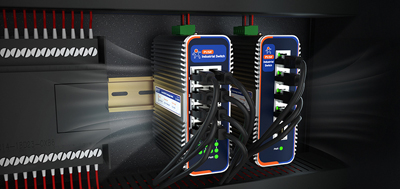
Edge Computing Functionality of Industrial Gateway: Unlocking a New Paradigm for Local Preprocessing of Equipment Data
In the wave of Industry 4.0 and intelligent manufacturing, the industrial gateway, serving as a bridge connecting physical equipment to the digital world, has its edge computing capabilities emerging as a core engine for enterprises to achieve a leap in data value. In traditional industrial scenarios, the massive amounts of data generated by equipment need to be uploaded to the cloud for processing. However, issues such as network latency, bandwidth costs, and data security have become bottlenecks restricting real-time decision-making. Edge computing, by decentralizing data processing capabilities to the gateway side, enables local preprocessing of equipment data, providing a "low-latency, high-reliability, and low-cost" solution for industrial scenarios. This article will deeply analyze the core technical paths of edge computing in industrial gateway and, using typical products like the USR-M300, explore how local preprocessing can empower the intelligent upgrading of industrial scenarios.
Data generated by industrial field equipment (such as PLCs, sensors, robots, etc.) is characterized by high frequency, volume, and heterogeneity. Taking an automotive manufacturing production line as an example, a welding robot can generate over 1,000 sets of vibration, temperature, and current data per second. Uploading all this data to the cloud not only consumes a significant amount of bandwidth but also leads to delayed control command responses due to network latency. Edge computing, by deploying computing resources on the industrial gateway side, prepositions tasks such as data cleaning, aggregation, and analysis, transforming the gateway into a "micro data center" and enabling "data to stay within the factory and decisions to be made locally."
Cost Reduction and Efficiency Enhancement: Practical tests on Robustel's edge computing gateway show that data compression rates can exceed 70%, reducing bandwidth costs by 50%-90%.
Real-time Response: Local processing latency can be controlled within 10 milliseconds, meeting the millisecond-level scenario requirements of AGV cart obstacle avoidance and equipment failure warnings.
Security Enhancement: Sensitive data (such as process parameters and equipment status) is desensitized locally before being uploaded, reducing the risk of privacy breaches.
Industrial field data often contains invalid values, null values, or out-of-range data due to electromagnetic interference, sensor failures, etc. Edge gateways automatically identify and filter abnormal data based on preset rules, for example:
Invalid Value Removal: For null values caused by a disconnected temperature sensor, the gateway can automatically fill in the last valid value or a default value.
Noise Smoothing: A moving average algorithm is used to filter high-frequency interference signals from vibration sensors, improving data quality.
Duplicate Data Discarding: For periodically collected unchanged data (such as equipment status codes), the gateway only reports changes, reducing redundant transmissions.
Case Study: A photovoltaic power plant used the USR-M300 edge gateway to clean inverter data, filtering out duplicate data caused by communication interruptions. This resulted in a 60% reduction in data transmission volume and a 45% decrease in cloud storage costs.
In industrial scenarios, high-frequency collected data (such as vibration signals collected 1,000 times per second) would occupy a significant amount of bandwidth if uploaded directly. Edge gateways achieve data aggregation through the following methods:
Time Window Aggregation: Calculate statistical measures such as averages, maximums, and minimums based on time granularity (e.g., minutes, hours). For example, aggregating 1,000 sets of vibration data collected per second into a spectral feature package per minute reduces data volume by over 99%.
Spatial Aggregation: Perform centralized calculations on data from related equipment or areas. For example, calculating total production line energy consumption or average workshop temperature.
Lossless/Lossy Compression: Use techniques such as Delta encoding and floating-point precision adjustment to compress data volume while ensuring critical information is not lost.
Technical Comparison:
| Compression Method | Applicable Scenario | Compression Rate | Computational Complexity |
| Delta Encoding | Time-series data (e.g., temperature, pressure) | 50%-70% | Low |
| Floating-point Precision Adjustment | Floating-point data (e.g., vibration amplitude) | 30%-50% | Medium |
| Wavelet Transform | Image/spectral data | 70%-90% | High |
Industrial field equipment protocols are highly fragmented (e.g., Modbus, CAN, Profibus, OPC UA, etc.). Edge gateways need to act as "interpreters," converting different protocols into a unified format (such as JSON, MQTT) before uploading. For example:
The USR-M300 supports over 20 industrial protocols, including Modbus RTU/TCP, OPC UA, and S7comm, and can directly collect data from equipment such as Siemens S7-1200 PLCs and Mitsubishi FX series PLCs.
Protocol Conversion Efficiency: Practical tests show that the USR-M300 can convert Modbus TCP protocol to MQTT protocol with a latency of less than 50ms, meeting real-time requirements.
Some edge gateways (such as the USR-M300) already have the capability to deploy lightweight machine learning models, enabling local realization of:
Fault Feature Extraction: Identifying early-stage bearing faults through vibration spectrum analysis.
Defect Detection: Real-time analysis of product surface images to identify scratches, cracks, and other defects.
Performance Degradation Prediction: Establishing predictive maintenance models based on equipment operation data to provide early fault warnings.
Case Study: An automotive parts manufacturer deployed a vibration analysis model on the USR-M300 edge gateway, reducing bearing fault identification time from 72 hours to 2 hours and reducing downtime losses by 80%.
Edge gateways can not only process data but also execute local control commands based on preset rules. For example:
Threshold Alarming: When the temperature exceeds a set value, the gateway automatically triggers an alarm and activates ventilation equipment.
Linked Control: Automatically adjust air conditioning, lighting, and other equipment based on combinations of multiple sensor states (such as temperature + humidity + light).
Lightweight Computing: Calculate equipment OEE (Overall Equipment Effectiveness), energy efficiency, and other metrics locally to reduce cloud computing pressure.
USR-M300 Special Features:
Supports graphical programming (Node-RED), allowing users to design complex logic by dragging and dropping modules.
Built-in 2 DI (digital inputs), 2 DO (digital outputs), and 2 AI (analog inputs), directly connectable to buttons, relays, temperature sensors, and other equipment for local closed-loop control.
Among numerous edge gateway products, the USR-M300 stands out as an ideal choice for local preprocessing in industrial scenarios due to its high performance, scalability, and ease of deployment.
Processor: 1.2GHz ARM Cortex-A7 with Linux kernel, ensuring high-speed operation.
Networking: Supports 4GG, WiFi, and Ethernet, with dual networks running simultaneously and network switching latency of less than 1s.
Interfaces: 2 RS485 ports, 2 DI ports, 2 DO ports, and 2 AI ports, supporting the expansion of 6 extension units (each with 8 IO ports), enabling up to 50 IO ports.
Storage: Built-in 2GB storage space, supporting offline data transmission and configurable data retention periods.
Protocol Support: Over 20 industrial protocols, including Modbus RTU/TCP, OPC UA, S7comm, and FINS, compatible with mainstream PLCs from Siemens, Mitsubishi, Omron, etc.
Intelligent Manufacturing: Collect data from injection molding machines, CNC machine tools, and other equipment to monitor production progress and optimize process parameters.
Smart Energy: Monitor the status of photovoltaic inverters, energy storage batteries, and other equipment for energy efficiency analysis and fault warnings.
Smart Buildings: Collect data from air conditioning, lighting, elevators, and other equipment for energy consumption management and equipment linked control.
Environmental Monitoring: Connect sensors for temperature, humidity, PM2.5, noise, etc., for real-time environmental data reporting and alarms.
Requirements: Incompatible protocols among production line equipment (such as SMT placement machines and AOI inspection equipment), preventing centralized data analysis.
Solution: Deploy USR-M300 edge gateways to collect equipment data and convert it to MQTT protocol for uploading to a private cloud platform.
Results:
Equipment interconnection time reduced from 2 weeks to 3 days.
Data transmission bandwidth occupancy decreased by 65%.
Local logic control enabled automatic equipment shutdown in case of abnormalities, improving product yield by 12%.
Whether it's the intelligent transformation of traditional manufacturing enterprises or innovative applications in emerging industrial scenarios, the edge computing capabilities of industrial gateways have become key to enhancing competitiveness. If you are facing the following challenges:
Severe data silos among equipment, preventing centralized analysis.
Insufficient network bandwidth and high data transmission costs.
Significant cloud processing delays, unable to meet real-time control requirements.
High data security risks, requiring local protection of sensitive information.
The wave of Industry 4.0 has arrived, and edge computing is redefining the value of industrial data. Let's join hands with innovative products like the USR-M300 to jointly embark on a new chapter in industrial intelligent upgrading!