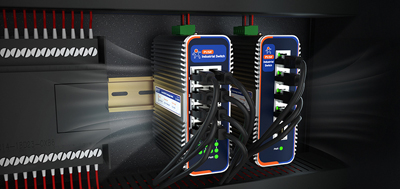
Cross-Regional Networking for Cellular Modem: The Dilemma and Solution Between VPN and Private Networks
In the wave of the Industrial Internet of Things (IIoT), cross-regional networking has become a core requirement for enterprises to achieve interconnection of devices and data exchange. However, when faced with two mainstream solutions—VPN (Virtual Private Network) and private networks—enterprises often find themselves in a dilemma, torn between technical parameters and practical scenarios: Should they choose a cost-effective VPN with questionable stability or invest in a highly reliable but expensive private network? This article provides enterprises with a scientific decision-making framework from three dimensions—technical principles, scenario adaptation, and cost-effectiveness—combined with real-world cases and industry insights. It also reveals how to obtain customized network architecture designs through one-on-one expert consultations.
A VPN constructs a logically dedicated channel on a public network (such as the Internet) through encrypted tunneling technology, enabling secure communication between remote devices and central servers. Its core advantages lie in its low cost and flexibility: Enterprises do not need to lay physical dedicated lines and can achieve cross-regional networking by simply paying basic network fees. For example, an oil company connected its oil well monitoring equipment distributed across the country via a VPN, reducing networking costs by 60%.
However, the "virtual nature" of VPNs also introduces inherent drawbacks:
Stability risks: Bandwidth fluctuations and latency jitter in public networks may affect data transmission quality. A smart manufacturing enterprise once experienced a two-hour production line shutdown due to an operator network failure, resulting in direct losses exceeding 500,000 yuan.
Security challenges: Although VPN tunnels are encrypted, the openness of public networks can still serve as an entry point for attacks. In 2024, an energy company suffered a data breach due to a VPN configuration vulnerability, losing over 100,000 pieces of sensitive information.
Private networks achieve independent communication between devices through physical dedicated lines (such as optical fibers and microwaves) or dedicated frequency bands allocated by operators. Their core value lies in high reliability and strong security:
Stability assurance: Private networks offer exclusive bandwidth and are unaffected by public network congestion. A power company used a private network to connect wind farms to its control center, maintaining data transmission latency within 10ms to meet real-time monitoring requirements.
Security reinforcement: Physical isolation and dedicated frequency bands significantly reduce the risk of external attacks. A military enterprise transmitted classified data via a private network and experienced no security incidents for five consecutive years.
However, private networks also have notable shortcomings:
High costs: The cost of laying dedicated lines can reach tens of thousands of yuan per kilometer, and long-term maintenance costs are also required.
Limited scalability: Adding new nodes requires replanning the wiring, limiting flexibility.
Enterprises need to assign weights to these four dimensions based on their business needs. For example:
High stability priority: Scenarios such as power monitoring and smart manufacturing require private networks or VPN solutions with dual-link backup.
High security priority: Sensitive industries such as finance and energy are better suited for private networks or VPNs supporting two-way certificate verification (such as the SSL/TLS encryption of USR-G771).
Low-cost priority: Non-critical scenarios such as agricultural monitoring and environmental monitoring can opt for VPN solutions using dynamic domain name resolution (DDNS).
High scalability priority: Scenarios with dynamically changing nodes, such as logistics tracking and retail chains, require VPN or SD-WAN solutions that support flexible expansion.
Project requirements: Connect 200 hydrological monitoring stations across the country, with data collection frequency set at once every five minutes and allowing brief delays.
Selection decision: A VPN was chosen for networking for the following reasons:
Cost sensitivity: The cost of laying a private network exceeded ten million yuan, while the VPN solution cost only tens of thousands of yuan.
Controllable stability: Through dual-operator SIM card backup and heartbeat packet mechanisms, the packet loss rate was controlled within 0.1%.
Flexible expansion: New monitoring stations could be added without replanning the wiring, requiring only Cellular Modem parameter configuration for access.
Project requirements: Connect 500 PLC devices in the workshop for millisecond-level real-time control with zero data loss.
Selection decision: A private network was chosen for networking for the following reasons:
Stability rigidity: The public network latency of VPNs could not meet real-time control requirements.
Security rigidity: Production data involved trade secrets and required physical isolation protection.
Long-term cost-effectiveness: Although the initial investment in a private network was high, it could avoid production losses caused by network failures.
In the competition between VPNs and private networks, the choice of cellular modem is also crucial. Taking the USR-G771 launched by USIOT as an example, its design philosophy perfectly aligns with the balanced needs of "stability, security, and cost":
Network adaptability: Supports Cat-1 networks from three major operators while being compatible with 2G backup, ensuring stable transmission even in remote areas or scenarios with insufficient network coverage.
Security protection: Built-in SSL/TLS encryption and two-way certificate verification, supporting MQTT protocol transparent transmission, enabling quick access to standard IoT platforms such as Alibaba Cloud, and meeting data security compliance requirements.
Industrial-grade design: Wide voltage power supply (9-36V), IP30 protection level, and EMC Level 4 anti-interference, adapting to harsh environments such as high temperatures, humidity, and electromagnetic interference.
Cost optimization: Comes with eight years of data traffic (100M/month) upon purchase, reducing long-term operating costs.
An agricultural IoT project achieved remote monitoring of greenhouse temperature and humidity data through the USR-G771, with the following networking solution:
Transmission layer: The Cellular Modem uploads data to the cloud via 4G networks.
Application layer: The cloud platform pushes data to management terminals via a VPN tunnel.
This solution leverages the flexibility of VPNs while ensuring stable data transmission through the industrial-grade design of the USR-G771, ultimately reducing annual operation and maintenance costs by 40%.
The Solution: The Value of One-on-One Expert Consultations
Faced with complex networking needs, enterprises often fall into the misconception of "technical parameter competition": blindly pursuing high bandwidth and multi-protocol support while ignoring core pain points in practical scenarios. For example, an enterprise once selected a Cellular Modem supporting 200 protocols but found that 80% of the functions were idle because the on-site equipment only required the Modbus RTU protocol, and data loss occurred due to complex protocol conversion.
Accurate demand diagnosis: Through in-depth communication, uncover hidden needs not explicitly stated by the enterprise (such as expansion plans for the next three years and compliance requirements).
Customized solutions: Design hybrid networking solutions combining "VPN + private network" based on on-site environments, device types, and network conditions (e.g., core businesses using private networks and non-critical businesses using VPNs).
Risk anticipation: Identify potential issues in advance (such as operator network coverage blind spots and device compatibility conflicts) and provide solutions.
Long-term cost optimization: Compare the total cost of ownership (TCO) of different solutions through simulation to avoid "low-price traps."
In the profound transformation of the Industrial Internet of Things, cross-regional networking has evolved from a single technical decision to a systematic strategic plan. Enterprises need to transcend the binary opposition of "VPN vs. private network" and build a network architecture that meets their business needs.
Contact us:
Submit a demand form: Visit our official website and fill in key information such as project scale, device type, and network environment.
Receive an expert report: Within 72 hours, receive a detailed plan including technical selection, networking topology, and cost comparison.
Free prototype testing: Apply for a trial of cellular modem such as the USR-G771 to verify the feasibility of the solution.
Case study visit reservation: Visit typical customer sites to learn about equipment operation in person.
Selection is not the endpoint but the starting point for efficient operation and maintenance. Through one-on-one expert consultations, enterprises can not only obtain适配 (appropriate) solutions for high-quality products such as the USR-G771 but also build a scalable and evolvable network architecture, laying a solid foundation for digital transformation.