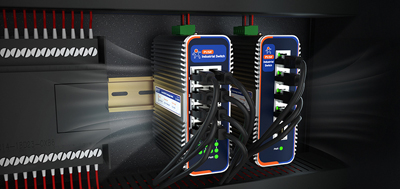
The Synergy Art of Industrial LTE Modem in Industrial Wireless Coverage: Solving the Challenge of Interconnecting Multi-Protocol Devices
In the wave of intelligent manufacturing, industrial wireless coverage has become a core infrastructure for enterprise digital transformation. However, when enterprises attempt to connect industrial devices using different protocols, such as Wi-Fi and ZigBee, to the same network, they often fall into the dilemma of "protocol barriers": Wi-Fi devices offer high transmission rates but consume significant power, ZigBee devices are low-power but have limited bandwidth, and traditional DTUs can only support a single protocol, preventing interoperability between devices. How can multi-protocol devices achieve synergy through industrial LTE modem? How can an efficient, stable, and low-cost industrial wireless coverage network be constructed? This article will provide an in-depth analysis of the synergy mechanisms of industrial LTE modem in wireless coverage and offer practical integration solutions.
The diversity of device protocols in industrial settings far exceeds expectations:
Wi-Fi devices: Such as smart cameras and HMI touchscreens, rely on high bandwidth for transmitting video and interactive data but consume significant power, requiring continuous power supply.
ZigBee devices: Such as temperature and humidity sensors and pressure transmitters, feature low-power designs suitable for long-term deployment but have a transmission rate of only 250 kbps, making it difficult to carry large amounts of data.
Modbus devices: Such as PLC controllers and frequency converters, use serial communication with closed protocols, requiring dedicated gateway conversion.
One automotive manufacturing enterprise attempted to cover the entire factory with a single Wi-Fi network, resulting in a 30% loss rate of environmental monitoring data due to interference with ZigBee sensor signals. Another chemical enterprise, failing to adapt to the Modbus protocol, was forced to maintain a separate wired network, increasing annual maintenance costs by 500,000 yuan. Protocol fragmentation has become the biggest bottleneck in industrial wireless coverage.
To achieve seamless synergy among multi-protocol devices, the following requirements must be met:
Protocol conversion: Convert non-standard protocols such as ZigBee and Modbus into standard protocols like Wi-Fi or TCP/IP.
Data aggregation: Unify scattered device data for upload to cloud or local servers, avoiding data silos.
Intelligent scheduling: Dynamically allocate network resources (such as bandwidth and priority) based on device type to ensure real-time transmission of critical data.
Industrial LTE modems are the key tool for solving this challenge—their built-in protocol parsing engines and multi-link management capabilities enable "language interoperability" and "resource collaboration" among different protocol devices.
The protocol parsing capabilities of industrial LTE modems consist of two levels:
Hardware layer: Directly connect Modbus devices through multi-serial port designs (such as RS232/RS485) while integrating Wi-Fi/4G modules for physical interface compatibility.
Software layer: Built-in protocol stack libraries support industrial protocols like Modbus RTU/TCP, DNP3.0, and IEC 60870-5-104, as well as wireless protocols like ZigBee and LoRa for parsing and conversion.
Taking the USR-G786 as an example, it supports 7-mode full-network 4G and dual-band 2.4GHz/5GHz Wi-Fi, allowing simultaneous connection of Wi-Fi cameras, ZigBee sensors, and Modbus PLCs. Through configuration tools, users can customize protocol conversion rules (such as mapping ZigBee temperature values to Modbus holding register addresses) without writing code for device adaptation.
The data aggregation function of industrial LTE modems involves three steps:
Data collection: Receive device data through serial ports or wireless modules.
Protocol conversion: Convert non-standard protocol data into universal formats like JSON or XML.
Data upload: Send data to cloud or local servers via protocols like MQTT or HTTP.
An electronics manufacturing enterprise used the USR-G786 to uniformly upload data from 300 ZigBee sensors and 20 Modbus PLCs to the Alibaba Cloud platform, reducing data collection latency from seconds to milliseconds and eliminating the need for additional gateways, cutting hardware costs by 60%.
The intelligent scheduling capabilities of industrial LTE modems can resolve bandwidth competition among multiple devices:
Priority management: Assign high-priority channels to critical devices (such as PLCs) to ensure real-time transmission of control instructions.
Bandwidth allocation: Dynamically adjust bandwidth based on data type (e.g., high bandwidth for video streams and low bandwidth for sensor data).
Load balancing: Automatically switch to 4G networks when Wi-Fi signals are congested to ensure data continuity.
In a steel enterprise's practice, the USR-G786 improved the transmission success rate of blast furnace monitoring data from 75% to 99.8% by automatically switching to 4G when Wi-Fi signals were weak, preventing production accidents caused by network interruptions.
Among numerous industrial LTE modems, the USR-G786 stands out with its extreme flexibility and powerful synergy capabilities, making it the top choice for industrial wireless coverage scenarios:
Protocol library: Built-in parsing engines for industrial protocols like Modbus, DNP3.0, and IEC 60870-5-104, as well as wireless protocols like ZigBee and LoRa.
Custom protocols: Supports Lua script development for parsing vendor-specific protocols (such as Siemens S7-200's PPI protocol).
Transparent transmission: Offers both network transparent transmission and protocol transparent transmission (UDC) modes without modifying the original communication logic of devices.
A photovoltaic enterprise used the Lua script function of the USR-G786 to convert its inverter's proprietary protocol (including 16-bit CRC checks) into MQTT format, enabling real-time upload of power station data to the Alibaba Cloud with a data parsing accuracy rate of 99.99%.
Wi-Fi capabilities: Supports dual-band 2.4GHz/5GHz, avoiding interference in the 2.4GHz band commonly found in industrial settings and improving transmission rates by three times.
4G capabilities: 7-mode full-network compatibility (China Mobile/China Unicom/China Telecom) with support for private network APNs to ensure stable connectivity in remote areas.
Dual-link backup: Both Wi-Fi and 4G can be online simultaneously, with automatic switching to the backup link when the primary link is interrupted, ensuring zero data transmission interruptions.
A logistics enterprise used the dual-link backup function of the USR-G786 to automatically switch to 4G when warehouse Wi-Fi signals were weak, reducing the transmission delay of AGV cart scheduling instructions from 2 seconds to 200 ms and improving scheduling efficiency by 80%.
Protection level: IP30 protection for dust and moisture resistance, adaptable to extreme temperatures ranging from -35°C to 75°C.
Electrical isolation: RS485 interfaces feature 2KV electrical isolation to shield against electromagnetic interference and ensure data stability.
Remote management: Supports remote firmware upgrades, parameter configuration, and fault diagnosis to reduce on-site maintenance costs.
A chemical enterprise used the remote management function of the USR-G786 to complete protocol upgrades for 30 devices without sending engineers to the site, reducing the upgrade cycle from 2 weeks to 2 days.
The synergy capabilities of industrial LTE modems depend not only on product performance but also on deep customization based on enterprise-specific scenarios. We offer 1-on-1 expert consultations covering the following core services:
Protocol packet capture analysis: Use tools like Wireshark to capture raw data packets from devices and parse protocol structures.
Scenario research: Evaluate device types, communication distances, data volumes, and other factors to design optimal synergy solutions.
Cost estimation: Provide detailed budgets for hardware selection, network deployment, and maintenance costs.
Protocol conversion rule design: Customize JSON/XML mapping templates based on device protocol fields.
Script development guidance: Offer Lua script development training and code templates for proprietary protocols.
Network architecture planning: Design Wi-Fi coverage ranges, 4G base station locations, and device connection topologies.
Simulated environment testing: Verify protocol conversion accuracy and network stability in laboratory simulations of industrial settings.
On-site deployment support: Dispatch engineers to debug devices on-site to ensure real-time data upload.
7×24-hour operation and maintenance: Provide remote fault diagnosis and firmware upgrade services to ensure long-term system stability.
Contact Us:
Submit a requirement form: Visit our official website to fill in key information such as device types, protocol types, and coverage ranges.
Receive a diagnostic report: Get a detailed solution within 48 hours, including protocol parsing difficulty assessments and development cost estimates.
Free sample testing: Apply for a USR-G786 trial to verify multi-protocol synergy effects.
Case study appointment: Visit typical customer sites to observe device operation in person.