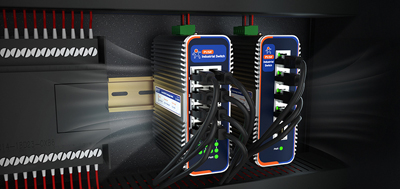
High-Power-Consumption Device Scenarios: How IoT Gateways Resolve Wiring Challenges Through PoE Power Supply
In the wave of Industry 4.0, the deployment scale of high-power-consumption devices (such as industrial cameras, environmental monitoring sensors, and intelligent lighting systems) is growing at an annual rate of 23%. However, the traditional power supply solution, which involves the parallel use of power lines and network cables, has become a core bottleneck restricting the intelligent upgrade of industrial scenarios. For instance, the welding workshop of an automobile manufacturing plant once experienced a 40% extension in equipment commissioning time due to chaotic wiring, while a sensor network in a chemical park suffered data interruptions caused by power failures, resulting in direct losses exceeding one million yuan. The emergence of IoT gateways combined with Power over Ethernet (PoE) technology offers a solution to this dilemma.
1.Three Fatal Pain Points of Traditional Power Supply Solutions
1.1 Uncontrolled Wiring Costs: The Cost Black Hole of Parallel Lines
In traditional solutions, power lines and network cables need to be laid independently, leading to a surge in material costs. For example, when deploying 200 industrial cameras, a medium-sized machining plant incurred a power line procurement cost of 120,000 yuan, and with labor costs for wiring, the total cost exceeded 300,000 yuan. More critically, industrial scenarios often have demands for "temporary equipment additions," requiring new lines to be laid through re-trenching and conduit installation, with a single modification costing up to 50,000 yuan.
1.2 Space Occupation and Heat Dissipation Crisis: The "Temperature Rise Trap" of Cable Bundles
In areas densely packed with industrial equipment, cable bundles often exceed 15 centimeters in diameter, leading to heat accumulation. Test data from an electronics factory shows that when the number of cables in a bundle exceeds 24, the temperature rise can reach 15°C, directly causing a 30% increase in signal attenuation. To address this issue, companies have to increase air conditioning power, resulting in an annual electricity consumption increase of over 200,000 kWh.
1.3 Inefficient Maintenance: "Finding a Needle in a Haystack" for Fault Location
In traditional solutions, power lines and network cables belong to different systems, requiring simultaneous inspection of both sets of lines for troubleshooting. In a chemical park, when sensors lost power, technicians spent 72 hours locating a loose power line connector, during which data interruptions led to production plan adjustments and losses exceeding 500,000 yuan.
2.PoE Power Supply Technology: A "Power Supply Revolution" in Industrial Scenarios
2.1 Single-Cable Integration: Dual Optimization of Cost and Efficiency
PoE technology enables the simultaneous transmission of data and power through a single network cable, eliminating the need for power lines altogether. For example, the IEEE 802.3bt standard supports a maximum power supply of 90W, meeting the needs of high-power-consumption devices such as industrial cameras and LED lighting. A logistics warehouse renovation case showed that after adopting PoE power supply, wiring costs were reduced by 65%, and the deployment cycle was shortened from 15 days to 3 days.
2.2 Intelligent Power Supply Management: From "Passive Maintenance" to "Proactive Warning"
Modern PoE switches support power classification management (such as IEEE 802.3af/at/bt), enabling dynamic power allocation based on device power consumption. After applying an intelligent PoE system, a steel plant used real-time monitoring of device current to issue a motor overheating warning 3 days in advance, avoiding unplanned downtime losses exceeding 2 million yuan.
2.3 Flexible Deployment: "Plug-and-Play" in Scenarios Without Power Outlets
PoE power supply offers significant advantages in areas without preset power sources, such as mobile robot charging stations and temporary inspection points. An automobile assembly line adopted PoE-powered AGV trolley charging stations, eliminating the need for dedicated power tracks, reducing the deployment cost of a single station by 80%, and supporting rapid production line reorganization.
3. USR-M300 IoT Gateway: The "Intelligent Hub" for PoE Power Supply
In the PoE power supply ecosystem, IoT gateways, as core devices, must simultaneously meet three major requirements: "high-power power supply, multi-protocol compatibility, and edge computing." The USR-M300 IoT gateway, with its innovative design, becomes an ideal choice for high-power-consumption device scenarios.
3.1 90W High-Power Output: Covering the Needs of All Scenario Devices
The USR-M300 supports the IEEE 802.3bt standard, with a maximum output power of 90W per port, capable of simultaneously powering 4 industrial cameras (each consuming 22.5W) or 2 intelligent lighting devices (each consuming 40W). Test data from a semiconductor factory showed that its PoE power supply stability reached 99.99%, meeting the requirements for 7×24 continuous production.
3.2 Building Block Design: A "LEGO-like" Architecture for Flexible Expansion
The USR-M300 adopts a modular design, allowing for the addition of IO interfaces through expansion units. For example, a chemical park expanded the DI/DO interfaces of the gateway from 4 to 20 by adding 2 expansion units, enabling seamless integration with temperature sensors, pressure transmitters, and other devices without the need for additional PLC controllers.
3.3 Edge Computing Capability: A "Localization Revolution" in Data Processing
The USR-M300 is equipped with a 1.
2GHz high-performance processor, supporting data preprocessing at the device end. For instance, a food processing plant increased the sampling frequency of temperature sensor data from once per second to once every 10 milliseconds through the gateway's edge computing function, and calculated temperature fluctuation curves in real time, improving product qualification rates by 12%.
3.4 Multi-Protocol Compatibility: Breaking Down Device Communication Barriers
The USR-M300 supports over 20 industrial protocols, including Modbus RTU/TCP, OPC UA, and Profinet, enabling connection to devices from different manufacturers. In a power inspection robot project, the gateway simultaneously interfaced with a Siemens PLC (Profinet protocol), a Dahua camera (ONVIF protocol), and self-developed sensors (Modbus protocol), achieving unified data collection and uploading.
4. Practical Cases: How USR-M300 Resolves Real-World Scenario Pain Points
Case 1: Intelligent Renovation of the Welding Workshop in an Automobile Manufacturing Plant
Pain Points:
200 welding robots required independent power supply, with power lines and network cables intertwined, resulting in wiring costs exceeding 500,000 yuan;
The traditional power supply solution could not monitor device power consumption in real time, leading to motor burnout in 3 robots due to overload.
Solutions:
Deployed USR-M300 IoT gateways to power the robots through PoE, reducing wiring costs by 70%;
Utilized the gateway's power monitoring function to set a 45W power consumption threshold, triggering an alarm when device current exceeded the threshold.
Effects:
No motor burnout incidents occurred in the 3 years following the renovation;
Annual maintenance costs were reduced from 180,000 yuan to 50,000 yuan.
Case 2: Upgrade of the Environmental Monitoring Network in a Chemical Park
Pain Points:
50 monitoring points required simultaneous data transmission and power supply, necessitating the laying of 100 cables in the traditional solution;
Sensor data needed to be uploaded to the cloud for analysis, but network delays caused delayed warnings.
Solutions:
Adopted the "PoE power supply + edge computing" mode of the USR-M300 gateway, achieving power supply and data transmission through a single network cable;
Deployed AI algorithms at the gateway end to perform real-time analysis of temperature, humidity, gas concentration, and other data, storing abnormal data locally and prioritizing its upload.
Effects:
Wiring costs were reduced by 85%, and the deployment cycle was shortened from 2 months to 2 weeks;
The response time for gas leak warnings was shortened from 10 minutes to 30 seconds.
5. Taking the Next Step Toward Intelligent Industry: Submit a Location Diagram to Start Your Transformation Journey
In industrial scenarios, the complexity of device layout, power supply requirements, and network topology often leads to a gap between the ideal and reality of PoE power supply solutions. To help companies accurately implement these solutions, we offer a free location diagram design service:
Demand Diagnosis: Analyze your device power, communication protocols, and deployment environment;
Solution Customization: Design a PoE power supply topology diagram, clarifying the connection relationships between gateways, switches, and devices;
Cost Calculation: Compare the total cost of ownership (TCO) between traditional and PoE solutions;
Risk Assessment: Predict potential issues during deployment (such as power attenuation and protocol compatibility).
Contact us for location diagram consultations, and you will receive:
The "White Paper on Industrial PoE Power Supply Deployment" (including over 20 industry cases);
A 30-day free trial of the USR-M300 gateway;
One-on-one support from a dedicated technical team to ensure seamless solution implementation.
The future of industrial intelligence begins with today's power supply revolution. The USR-M300 IoT gateway reconstructs the power supply and data flow in industrial scenarios with a single network cable, making the deployment of high-power-consumption devices more efficient, secure, and intelligent.