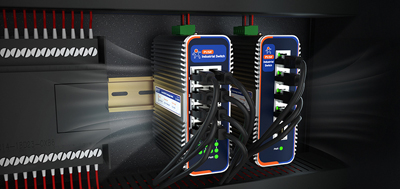
Analysis of the Shell Material of PUSR Industrial Router: The Technical Secret Behind Durability and the Path to Adaptation in Industrial Scenarios
In the deployment of the Industrial Internet of Things (IIoT), the durability of equipment shells directly determines the stability of network systems, maintenance costs, and long-term return on investment. For industrial router, the shell is not only the first line of physical protection but also a core component for coping with extreme environments, electromagnetic interference, and mechanical shocks. With its all-metal sheet metal shell design, the PUSR industrial router achieves a breakthrough balance in durability, heat dissipation performance, and anti-interference capability, making it the preferred solution for highly reliable industrial scenarios. This article will conduct an in-depth analysis of the durability secrets of the PUSR industrial router shell from three dimensions—material characteristics, environmental adaptability, and structural optimization—and explore how it addresses the core pain points in industrial scenarios.
In industrial scenarios, equipment must withstand long-term mechanical vibrations, accidental collisions, and even human operational errors. Ordinary plastic shells are prone to cracking or deformation under impact, exposing internal components and causing short circuits or signal interruptions. The high-strength galvanized steel sheet metal shell adopted by the PUSR industrial router, formed into an integrated structure through precision stamping processes, offers the following advantages:
Impact Resistance: The hardness of metal materials is much higher than that of plastics, capable of withstanding impact energies of over 10J (equivalent to a 1kg object falling from a height of 1 meter), ensuring the shell remains undamaged in scenarios such as logistics handling and equipment installation.
Vibration Resistance: The sheet metal shell disperses vibration energy throughout the entire housing through structural reinforcing ribs, avoiding local resonance that could damage electrical components. The vibration level is far below industry safety standards.
Wear Resistance: The metal surface undergoes sandblasting and oxidation treatment, forming a dense oxide layer that resists scratching from gravel and metal debris, extending the shell's service life to over 10 years.
Industrial routers generate continuous heat during operation. If heat dissipation is inadequate, component performance may degrade or even burn out. The thermal conductivity of plastic shells is only 0.2-0.3W/(m·K), while that of metal sheet metal (such as galvanized steel) is as high as 50W/(m·K), allowing for rapid heat conduction to the shell surface and dissipation through air convection. The PUSR industrial router further optimizes heat dissipation through the following designs:
Three-Dimensional Heat Dissipation Structure: The shell adopts a "fin + heat conduction groove" design, increasing the heat dissipation area by 30%. In a 40°C high-temperature environment, the device surface temperature is 15-20°C lower than that of plastic shell routers.
Fanless Design: Relying on the efficient heat dissipation of the metal shell, the PUSR router does not require an internal fan, eliminating the risk of heat dissipation interruption due to fan failure while achieving IP30-level dust resistance, suitable for dusty environments.
Wide Operating Temperature Range: Practical tests show that the PUSR router can operate stably in extreme temperatures ranging from -40°C to 70°C, meeting the needs of scenarios such as outdoor monitoring in northern winters and high-temperature factories in the south.
Industrial environments contain numerous sources of electromagnetic interference (such as frequency converters, motors, and high-voltage cables), which may cause signal distortion or data transmission errors in routers. Plastic shells cannot shield electromagnetic waves, while metal sheet metal shells achieve efficient shielding through the following mechanisms:
Faraday Cage Effect: The integrated metal shell forms a closed conductor, isolating external electromagnetic fields and providing shielding effectiveness of over 60dB (in the 10kHz-1GHz frequency band), far exceeding the 5-10dB of plastic shells.
Grounding Design: The shell is connected to the equipment rack through dedicated grounding terminals, directing interference currents into the ground and avoiding damage to components from static electricity buildup.
Interface Protection: All network interfaces (such as Ethernet ports and serial ports) are equipped with metal shielding covers to further block electromagnetic leakage paths.
The PUSR industrial router must pass multiple international authoritative certification tests during the research and development phase, including:
IK Impact Test: The shell is impacted with an energy of 3J, showing no cracks or deformation after testing, with internal component functionality remaining normal (the industry standard is 2J).
IP Protection Test: At the IP30 level, the device can resist the intrusion of solid foreign objects with a diameter of 2.5mm, adapting to dusty workshop environments.
EMC Test: Passes the IEC 61000-4 series standards, including electrostatic discharge (ESD), electrical fast transient burst (EFT), surge, and other tests, ensuring stable operation in strongly interfering environments.
Case 1: High-Temperature Monitoring System in a Steel Plant
The steelmaking workshop in this plant maintains temperatures above 60°C for extended periods. Ordinary plastic shell routers frequently crashed due to inadequate heat dissipation, resulting in lost monitoring footage. After switching to the PUSR industrial router, the metal shell provided efficient heat dissipation, and the device operated continuously for 18 months without failure, reducing annual maintenance costs by 80%.
Case 2: Outdoor Communication Base Station in a Wind Farm
The wind farm is located on a plateau at an altitude of 2,000 meters, with winter temperatures as low as -35°C and heavy wind and sand. The PUSR router, with its wide temperature design and dustproof shell, operated stably within the -40°C to 70°C range, reducing the signal interruption rate from three times per month to zero.
Case 3: Electromagnetic Interference Environment in an Automobile Assembly Line
The assembly line contains numerous frequency converters and motors, creating strong electromagnetic interference. The PUSR router reduced the data transmission error rate from 5% to 0.1% through metal shielding and grounding design, ensuring real-time response of the AGV scheduling system.
Among the PUSR industrial router product line, the USR-G809s stands out as a benchmark product for highly reliable industrial scenarios with its integrated design of an all-metal sheet metal shell, multi-mode communication, and edge computing. Its core advantages include:
Integrated Metal Shell: Made of 1.2mm thick galvanized steel plate, precision-machined by CNC to form a seamless structure, improving impact resistance and corrosion resistance by 50%.
Multi-Network Intelligent Switching: Supports 5G/4G/Wi-Fi 6/LoRa quad-mode communication, automatically switching to a backup link in case of a primary link failure to ensure "uninterrupted" network connectivity.
Edge Computing Capability: Built-in quad-core ARM Cortex-A7 processor capable of locally processing 8 channels of 1080P video streams, reducing data backhaul delay and lowering cloud load.
Industrial Protocol Compatibility: Supports over 20 protocols, including Modbus TCP, Profinet, and EtherNet/IP, seamlessly connecting with PLCs, sensors, and other industrial equipment.
Typical Application Scenarios:
Smart Warehousing AGV Navigation: The USR-G809s achieves ±5mm-level accuracy in a 15-meter-high stereo warehouse through UWB + laser SLAM fusion positioning, with the metal shell resisting shelf collisions to ensure long-term stable operation.
Smart Grid Equipment Monitoring: In extremely cold regions at -40°C, the USR-G809s ensures efficient heat dissipation through its metal shell, guaranteeing real-time data collection from smart meters with a fault warning accuracy rate of 99.9%.
Outdoor Traffic Monitoring: Supports RTK + GPS centimeter-level positioning, with a metal shell that is rainproof and dustproof, continuously transmitting high-definition video in rainstorms and sandstorms to assist in intelligent traffic management.
Indicator PUSR Industrial Router (Metal Shell) Ordinary Plastic Shell Router
Impact Resistance Undamaged under 10J impact energy Prone to cracking under 2J impact energy
Heat Dissipation Method Metal heat conduction + fanless Plastic heat conduction + fan
Operating Temperature Range -40°C to 70°C 0°C to 50°C
Electromagnetic Shielding Effectiveness 60dB (10kHz-1GHz) 5-10dB
Service Life Over 10 years 3-5 years
High-Impact Environments (such as logistics handling and mining operations): Prioritize metal shell routers to avoid equipment failure due to shell damage.
High-Temperature/Dusty Scenarios (such as steel plants and cement plants): Choose fanless metal shell routers to prevent dust ingress and inadequate heat dissipation.
Strong Electromagnetic Interference Environments (such as power and automobile manufacturing): Select routers with metal shielding and grounding design to ensure data transmission stability.
Long-Term Operation Requirements (such as outdoor monitoring and smart grids): Choose metal shell routers that have passed wide-temperature tests to reduce maintenance frequency and costs.
In the era of Industry 4.0, the durability of network equipment is no longer just a technical indicator but a core competitiveness for enterprise digital transformation. The PUSR industrial router provides a "zero-compromise" reliability solution for industrial scenarios through its metal sheet metal shell, rigorous testing and verification, and scenario-based design. Whether it's long-term operation in extreme environments or stable communication in highly interfering scenarios, the PUSR router can safeguard industrial networks with its "steel body" at every moment.
Contact PUSR to obtain customized solutions tailored to your industry:
Free on-site inspection and requirement analysis
POC testing support with a 72-hour response time
Architectural design report including ROI calculations
Limited-time offer for a trial of the USR-G809s prototype
Let the durability of the PUSR industrial router become your "invisible competitiveness" for intelligent upgrades!