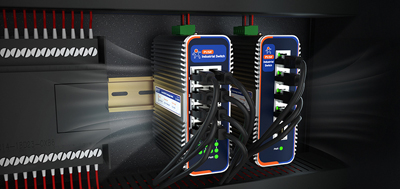
In-Depth Analysis of the Thermal Design of PUSR 5G Cellular Router: Ensuring Reliability from Principle to Practice
In industrial IoT scenarios, the 5G cellular router serves as the core hub for data transmission, with its thermal performance directly determining the device's stability and lifespan in extreme environments. According to statistics, approximately 40% of industrial electronic device failures are related to poor heat dissipation, with issues such as solder joint cold joints, chip performance degradation, and shortened component lifespans caused by high temperatures being particularly prominent. The PUSR 5G cellular router employs a multi-dimensional thermal design system to keep the device's operating temperature within safe thresholds, providing industrial customers with highly reliable communication solutions.
5G cellular routers are often deployed in complex environments with high temperatures, humidity, and strong electromagnetic interference, such as:
High-temperature environments: Metallurgical workshops can reach temperatures above 60°C, where traditional consumer-grade routers are prone to performance degradation or crashes due to overheating;
High-humidity environments: Aquaculture monitoring scenarios maintain humidity levels above 80%RH for extended periods, where ordinary routers are susceptible to short circuits caused by internal condensation;
High-dust environments: Coal mining sites have excessive dust concentrations, where blocked cooling vents can lead to localized temperature spikes in devices.
Thermal design for 5G cellular routers requires balancing three major contradictions:
Thermal efficiency vs. protection level: Increasing cooling vents improves air circulation but reduces the IP protection level (e.g., from IP65 to IP30);
Active cooling vs. reliability: While fans can accelerate heat dissipation, long-term operation can lead to increased failure rates due to dust accumulation;
Miniaturization vs. thermal management: Compact designs limit the heat dissipation area, necessitating material innovations to address high thermal density issues.
The PUSR 5G cellular router adopts a hybrid cooling strategy that prioritizes passive cooling supplemented by active cooling, constructing a full-lifecycle thermal management system through three technological paths: material selection, structural optimization, and intelligent temperature control.
PUSR employs a layered thermal conduction design in key heat source areas:
Chip-level cooling: The main control chip and 4G/5G modules use tungsten-copper alloy heat sinks with a thermal conductivity of 190 W/(m·K), three times higher than traditional aluminum heat sinks;
Module-level cooling: Thermal conductive silicone grease (thermal conductivity ≥ 5 W/(m·K)) is filled between the power module and RF module to eliminate thermal resistance caused by air gaps;
Enclosure-level cooling: The enclosure is made of die-cast aluminum alloy (thermal conductivity of 180 W/(m·K)), with fin structures expanding the heat dissipation area by 40%.
Taking the USR-G816 5G cellular router as an example, its shark fin die-cast enclosure design increases the heat dissipation area by 37% compared to traditional flat enclosures, with a casing temperature not exceeding 45°C under full load at a 35°C room temperature, 15-20°C lower than similar products.
PUSR optimizes internal air ducts through fluid dynamics simulations:
Passive cooling structures:
Bottom hollow design: A 10mm gap is reserved at the bottom of the device, forming natural convection channels with rubber pads at the four corners;
Hot-cold zone layout: High-heat-generating components (e.g., power modules) are separated from low-heat-generating components (e.g., storage chips) to avoid thermal cross-interference;
Guide channel design: Guide channels are set on the inner side of the enclosure to direct airflow along the fin direction, improving heat dissipation efficiency.
Active cooling enhancement:
Intelligent temperature-controlled fans: Dual ball bearing fans automatically start when power consumption ≥ 15W, achieving a balance between noise and heat dissipation through PWM speed control;
Dust prevention design: The fan air intake uses a detachable dust screen (filtration precision of 50μm), supporting an IP5X dust protection level and extending maintenance intervals.
The PUSR 5G cellular router is equipped with a self-developed intelligent temperature control algorithm:
Temperature monitoring: Real-time monitoring of key component temperatures such as the CPU, 4G module, and power supply through NTC thermistors;
Dynamic frequency adjustment: When the temperature exceeds the threshold, the CPU clock speed is automatically reduced (e.g., from 1.2GHz to 800MHz) to reduce heat generation;
Network load balancing: In high-temperature environments, critical business traffic is prioritized, and non-essential functions (e.g., guest network, USB sharing) are suspended;
Fault warning: When the temperature continues to exceed standards, alerts are pushed via WeChat/SMS/email through the PUSR Cloud platform, prompting operational and maintenance personnel to intervene.
The PUSR 5G cellular router has undergone rigorous testing to verify its thermal performance:
High-temperature aging test: Continuous operation for 72 hours at 75°C with no crashes or restarts, and the CPU temperature stabilized below 85°C;
High-humidity test: Continuous operation for 168 hours at 85%RH and 60°C with no internal condensation and electrical performance meeting IEC 60529 standards;
Dust test: Operation for 240 hours in a dust concentration of 1000mg/m³ environment with a cooling vent blockage rate below 5% and fan speed fluctuations < 3%.
Smart factory scenario: A USR-G816 router deployed on an automotive assembly line operated stably at a workshop temperature of 55°C in summer, with an AGV scheduling system packet loss rate < 0.01%;
Outdoor monitoring scenario: A USR-G806 4G router used at a water conservancy monitoring station operated normally at -30°C in winter and 40°C in summer, with remote temperature monitoring and fan speed control via the UIOT Cloud platform;
Energy industry application: PUSR routers used in a wind farm achieved an MTBF (mean time between failures) of 80,000 hours through thermal optimization in a strong electromagnetic interference (EMI ≥ 40dBμV) environment.
As PUSR's flagship product, the USR-G816 achieves multiple breakthroughs in thermal design:
Dual-mode 5G high-speed: Supports SA/NSA dual-mode 5G networks with a download speed of up to 700Mbps, meeting real-time control requirements with low latency;
Wide operating temperature range: Certified for operation from -35°C to 75°C, suitable for extremely cold and high-temperature environments;
Intelligent thermal management: Integrates temperature sensors and intelligent fans to dynamically adjust cooling strategies based on load;
Industrial-grade protection: IP30 dust protection level and three-proof coating to resist dust and moisture erosion.
In a smart grid project, the USR-G816 achieved a 99.99% data transmission success rate, with its thermal design enabling stable operation even when the outdoor cabinet temperature reached 60°C in summer, avoiding communication interruptions caused by overheating.
From material selection to intelligent temperature control, PUSR constructs a full-process thermal design system covering design, production, and operational maintenance, ensuring stable performance over a 10-year lifecycle.
Customized thermal designs are provided for different industrial scenarios:
High-dust environments: Optional fanless cooling versions are available, achieving passive cooling by increasing the heat dissipation area;
Compact deployments: Three-dimensional heat dissipation structures are used to achieve efficient thermal management in limited spaces;
Outdoor applications: Integrated cabinet air conditioning interfaces support external cooling equipment to cope with extreme high temperatures.
Thermal optimization reduces device failure rates and on-site maintenance costs:
Energy consumption reduction: Intelligent frequency adjustment technology reduces device power consumption by 15% compared to similar products;
Lifespan extension: The aging rate of components caused by high temperatures is slowed, extending the device lifespan to over 8 years;
Simplified operational maintenance: The UIOT Cloud platform supports remote temperature monitoring and fan speed control, reducing on-site inspection frequencies.
Conclusion: Thermal Design, the Cornerstone of Industrial Communication Reliability
In the "reliability race" of industrial IoT, thermal design has become a critical variable determining success. The PUSR 5G cellular router elevates thermal efficiency to industry-leading levels through the synergistic effects of material innovation, structural optimization, and intelligent temperature control, providing industrial customers with highly stable communication solutions. Whether in high-temperature workshops, outdoor base stations, or dusty environments, PUSR ensures continuous device operation with excellent thermal performance, helping enterprises achieve zero-interruption digital transformation goals.
Act now and usher in a new era of highly reliable industrial communication!
Contact us to obtain detailed technical solutions and on-site demonstration invitations for the USR-G816 5G cellular router, and witness firsthand how thermal design forges the "steel body" of industrial communication.