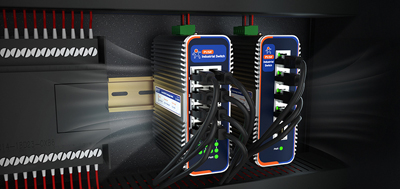
Hybrid Plugging of Gigabit Electrical and Optical Ports in Industrial Switche: The Path to Stable Transmission Beyond the 100-Meter Cabling Distance Limit
In the wave of industrial automation and intelligent manufacturing, scenarios such as video surveillance, equipment networking, and data acquisition impose stringent requirements on the stability, real-time performance, and bandwidth of network transmission. However, traditional copper Ethernet is limited to a transmission distance of 100 meters. In large factories, cross-campus deployments, or complex environments, it often faces challenges such as signal attenuation, packet loss, and latency. How to achieve ultra-long-distance stable transmission through hybrid plugging technology of gigabit electrical and optical ports has become a core proposition for upgrading industrial networks.
According to the ANSI/TIA-568 standard, the channel distance for twisted-pair copper cables is strictly limited to 100 meters (including 90 meters of permanent link + 10 meters of patch cord). This limitation stems from the signal attenuation characteristics of copper cables: as the distance increases, insertion loss (signal energy loss) and propagation delay (signal transmission time) rise exponentially, leading to a sharp increase in packet error rates. For example, in an automobile manufacturing plant where the production line exceeds 150 meters in length, if copper cables are used for direct connection, surveillance videos may experience stuttering, mosaics, or even device disconnections.
In industrial scenarios, harsh conditions such as electromagnetic interference (EMI), voltage fluctuations, high temperatures, and high humidity further exacerbate the transmission risks of copper cables. For instance, near blast furnaces in steel plants, electromagnetic noise generated by frequency converters can reduce the signal-to-noise ratio (SNR) of copper cables by more than 30 dB, directly causing communication interruptions.
To overcome the 100-meter limit, enterprises are often forced to adopt the following solutions:
Increasing switch cascading: Each additional level of switch increases latency by 50-100 μs and doubles the number of fault points.
Deploying fiber optic transceivers: Additional electrical-to-optical port conversion equipment is required, increasing costs by more than 40%.
Using wireless backhaul: In metal-dense environments, Wi-Fi signals experience severe attenuation, resulting in insufficient stability.
A case study in a chemical park shows that copper cable distance exceedances cause an average of 12 network failures per year, with each repair taking an average of 4 hours and direct losses exceeding 500,000 yuan.
By hybrid plugging gigabit electrical ports (RJ45) and optical ports (SFP) into the same industrial switch, a hybrid topology of "electrical port near-end access + optical port long-distance transmission" can be constructed. Its core values lie in:
Distance breakthrough: Optical ports transmit through optical fibers, with single-mode fibers reaching up to 40 kilometers and multi-mode fibers supporting 550 meters (at 1000 Mbps).
Enhanced interference immunity: Optical fibers transmit signals as light, making them completely immune to electromagnetic interference and improving stability by 90% in strong interference scenarios such as substations and mines.
Bandwidth guarantee: Gigabit electrical ports meet the low-latency requirements of near-end devices (such as PLCs and sensors), while optical ports provide high-bandwidth backbone links to avoid bottlenecks.
High-end industrial switche are equipped with built-in optoelectronic signal adaptive modules that can automatically identify the type of connected device (electrical or optical port) and dynamically adjust transmission parameters. For example, when an electrical port is connected to a camera, the switch prioritizes low-latency mode (latency < 5 μs); when an optical port is connected to a core switch, it automatically switches to high-bandwidth mode (backplane bandwidth ≥ 10 Gbps).
For electrical port transmission, forward error correction (FEC) and adaptive equalization technologies are used to compensate for signal attenuation. In a subway tunnel surveillance project, the FEC algorithm extended the electrical port transmission distance from 100 meters to 150 meters, with a bit error rate below 10^-12.
Supports link aggregation (LAG) and spanning tree protocol (STP), allowing multiple optical ports to be bound to form redundant links. When the primary link fails, the backup link automatically switches within 50 ms to ensure business continuity. After adopting this technology in a power dispatching center, network availability increased to 99.999%.
The USR-ISG series industrial switche are optimized for hybrid topologies, with core features including:
Port flexibility: Provides an "8-gigabit electrical port + 2-SFP optical port" combination, supporting full-gigabit electrical port access and optical port expandability up to 10 Gbps.
Industrial-grade protection: IP40 protection rating, -40°C to 85°C wide temperature operation, and 6000V lightning protection, adapting to extreme environments such as outdoors and explosion-proof areas.
Redundant power supply: Supports 9.6-60V DC wide voltage input, dual power hot backup, and an MTBF (mean time between failures) exceeding 100,000 hours.
An automobile parts factory adopted the USR-ISG to build its production line network, achieving stable networking for over 200 devices:
Electrical port connection: Near-end robots and PLCs are directly connected via electrical ports with latency < 3 μs, meeting motion control requirements.
Optical port transmission: Data is transmitted back to the monitoring center via optical fibers over a distance of 2 kilometers, with bandwidth utilization exceeding 90%.
Reduced failure rate: The hybrid architecture reduces cascading nodes, lowering the failure rate from an average of 12 times per year to 1 time.
In a 500kV substation, the USR-ISG solved transmission challenges under strong electromagnetic interference:
Interference immunity: Optical port transmission completely isolates electromagnetic noise, ensuring smooth video surveillance.
PoE power supply: Electrical ports support IEEE 802.3af/at standards, directly powering cameras and reducing cabling costs by 30%.
Remote management: Remote configuration is achieved through optical ports, improving maintenance efficiency by 50%.
A subway line adopted the USR-ISG to build its onboard video surveillance system:
Anti-vibration design: Rail-mounted installation resists train vibrations, ensuring stable optical port connections.
Wide voltage input: Adapts to vehicle voltage fluctuations of 12-48V DC, with power supply reliability reaching 99.9%.
Zero-interruption transmission: Redundant link design ensures zero data loss for video in tunnels.
| Parameter | Key Indicators | USR-ISG Advantages |
| Port Configuration | Full-gigabit electrical ports + optical port expandability | 8 electrical ports + 2 SFP optical ports, supporting 10G SFP+ |
| Switching Capacity | ≥ 2 × port bandwidth (full-duplex) | 10 Gbps backplane bandwidth, non-blocking transmission |
| Protection Rating | IP40 or higher | IP40 + all-metal casing, dustproof and shockproof |
| Operating Temperature | -40°C to 85°C | Industrial-grade wide temperature design, adapting to extreme environments |
| Redundancy Design | Power and link redundancy | Dual power + LAG aggregation, availability of 99.999% |
Beware of "pseudo-gigabit": Some manufacturers label products as "full-gigabit" but actually mix "100Mbps electrical ports + gigabit optical ports," resulting in insufficient near-end bandwidth.
Confirm PoE standards: Must support IEEE 802.3af/at, with single-port power ≥ 30W to avoid device damage.
Verify industrial certifications: Choose products certified by IEC 61000-4-2/4/5 (anti-static, surge) to ensure reliability.
As Industry 4.0 deepens, hybrid switches are evolving toward higher performance and greater intelligence:
TSN (Time-Sensitive Networking): Achieves microsecond-level latency synchronization through the IEEE 802.1AS protocol, supporting real-time applications such as motion control.
Edge Computing Integration: Built-in AI acceleration modules support localized intelligent decision-making such as video analysis and predictive maintenance.
PoE++ Power Supply: Future models may integrate 60W high-power PoE to directly power high-consumption devices (such as PTZ cameras).