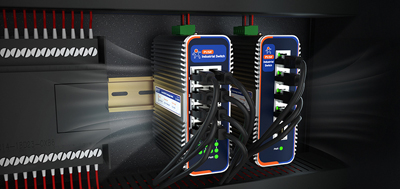
Breaking the "Signal Silos" in Fields: How Industrial LTE Routers Reshape the Neural Network of Agricultural IoT
In the thousand-acre terraced fields of Honghe County, Yunnan, Lao Zhou squats on the ridge, his phone screen flickering with intermittent signal bars. He just received a meteorological warning—a storm may arrive in 30 minutes—but soil sensor data from across the fields hasn't uploaded yet, and remote commands for the irrigation system are stuck in "sending." He can only rely on experience to direct workers to manually close valves. This scene is a common dilemma for 30 million agricultural practitioners in China: when IoT technology attempts to penetrate fields, the "last mile" of signal coverage has become a chasm between digitization and agricultural reality.
1. Field Signal Dilemma: An Overlooked "Digital War"
1.2 Fragmented Agricultural Scenarios by Signals
Traditionally, farmers rely on "weather-dependent" empiricism; in the IoT era, smart terminals like soil moisture sensors, weather stations, smart irrigation devices, and drones should weave a precise decision-making net through data. But in reality, this net is full of "holes" across fields:
- Remote Area Disconnection: In mobile greenhouses on the Inner Mongolia grassland, irrigation zones in Xinjiang's Gobi Desert, and plantations in Hainan's mountainous areas, 4G/5G base station coverage is insufficient. Wi-Fi signals can’t penetrate three ridges, and wired network铺设 costs up to tens of thousands of yuan per kilometer.
- Device Collaboration Disconnection: A large farm once deployed a smart system, but sensors from different manufacturers using ZigBee, LoRa, NB-IoT, and other protocols couldn’t interoperate, reducing it to "data islands."
- Extreme Environment Destruction: In winter on Northeast China’s black soil, ordinary routers frequently crash at -30°C. In South China’s rainy season, devices short-circuit due to moisture, with a monthly failure rate of 3 times.
1.3 Farmers’ "Digital Anxiety": Afraid to Use, Unable to Use, Unaffordable
When technical teams promote IoT solutions to farmers, they often hear such doubts:
- "Without signals, aren’t devices just scrap metal?" A cooperative spent 100,000 yuan installing a smart irrigation system, but it was abandoned after two weeks due to unstable signals.
- "The operation is too complex; we can’t even use smartphones well." In Lao Zhou’s farm, half the workers are over 60. Faced with routers requiring IP configuration and VPN setup, they often hesitate.
- "Upfront investment is too large; the payback period is too long." Wired network铺设, purchasing dedicated gateways, and maintaining high-power devices deter many small and medium-sized farmers from IoT adoption.
Behind these pain points lies a deep contradiction in agricultural IoT: the mismatch between technological advancement and scenario adaptability. While smart factories in cities enjoy 5G private networks and edge computing, fields still struggle with the basic issue of "whether signals exist."
2. The "Field Revolution" of Industrial LTE Routers: From Signal Coverage to Ecological Reconstruction
2.1 Solving Signal Coverage Challenges: Keeping Every Inch of Land "Online"
The solution of the industrial LTE router USR-G806w begins with a deep understanding of agricultural scenarios:
- Multi-Network Intelligent Switching: Built-in dual Qualcomm 4G modules support automatic switching between 4G/3G/2G. In mountainous areas without 4G signals, it downgrades to 3G. Paired with a high-gain directional antenna, signal coverage increases threefold, maintaining stable connections even in complex terrains like terraced fields and greenhouses.
- Protocol Compatibility Revolution: Supports over 20 industrial protocols such as Modbus, CAN, and RS485, seamlessly connecting various sensors. Through an edge computing module, it preprocesses data locally, reducing 30% of invalid transmission and lowering reliance on network bandwidth.
- Extreme Environment Adaptation: The metal housing meets IP30 protection, operating from -40°C to 75°C, resistant to electromagnetic interference, dust, and water. It performs stably in Northeast China’s snow season, South China’s rainy season, and Northwest China’s sandstorms.
Case: In Shouguang, Shandong’s vegetable greenhouses, the USR-G806w connects soil moisture sensors, CO₂ monitors, and smart rolling shutters. When sensors detect humidity below a threshold, the router uploads data to the cloud and automatically triggers the irrigation system. Farmers can monitor and adjust the greenhouse environment in real time via a mobile app, even miles away, through a VPN-encrypted channel.
2.2 Reconstructing the Agricultural IoT Ecosystem: From "Device Networking" to "Scenario Intelligence"
Once signal coverage is resolved, industrial LTE routers drive agricultural IoT to a deeper evolution:
- Edge Decision-Making to Reduce Latency: In a Ningxia vineyard, the USR-G806w’s edge computing analyzes soil temperature, humidity, and light intensity in real time. When frost risk is detected, it activates heating devices locally, reducing response time from minutes to milliseconds without waiting for cloud commands.
- Device Collaboration for Scalability: On an Inner Mongolia grassland ranch, the router connects drones, herding robots, and electronic fences, enabling unified scheduling via the UROVO Cloud Platform. When drones detect sheep straying, they automatically send navigation commands to robots to herd them back.
- Data Security as a Bottom Line: For sensitive agricultural data, the USR-G806w adopts five-layer encryption (IPSec/SSL/OpenVPN) and supports MAC binding and 802.1X authentication to prevent leaks. A built-in firewall blocks PortScan, DDoS, and other attacks, ensuring system stability.
Case: In Yancheng, Jiangsu’s modern agriculture demonstration park, the USR-G806w builds a "sensing-transmission-control" closed-loop system. Soil sensors upload data every 5 seconds, and the router connects low-power devices within 2 kilometers via a LoRa module. Cloud AI generates irrigation plans and sends them to terminals via the router. This system increased tomato yield by 42%, water/fertilizer utilization by 35%, and reduced maintenance costs by 60%.
3. From "Technical Tool" to "Production Partner": Value Reconstruction for Industrial LTE Routers
3.1 Lowering the Digital Threshold: Enabling Farmers to "Dare to Use, Know How to Use, Afford to Use"
The design philosophy of the USR-G806w is "keep complexity to oneself, simplicity to the user":
- Zero-Configuration Networking: Complete network and device binding in 3 steps via a mobile app QR code scan, even for less educated farmers.
- Visualized Operation and Maintenance: The UROVO Cloud Platform provides device status monitoring, traffic statistics, and fault warnings. Farmers can intuitively see "which devices are online," "signal strength," and "monthly traffic consumption," avoiding运维 cost surges due to technical blind spots.
- Low-Cost Deployment: Supports solar power and low-power modes, operating for 30 days in unpowered monitoring points. Built-in eSIMs eliminate card application processes, paired with pay-as-you-go IoT packages, reducing upfront costs by 50% compared to traditional solutions.
User Testimonial: Li Jianguo, head of a Hebei cooperative, calculated: "Previously, wired network maintenance cost 20,000 yuan annually. After switching to USR-G806w, device and traffic costs are under 8,000 yuan, with no more irrigation errors due to signal issues."
3.2 Reshaping Agricultural Productivity: From "Experience-Driven" to "Data-Driven"
As industrial LTE routers become the "nerve center" of agricultural IoT, their value transcends mere signal coverage, driving fundamental changes in production methods:
- Precise Decision-Making: In Heilongjiang’s rice fields, routers connect weather stations to predict rain 48 hours ahead, automatically adjusting irrigation plans to avoid waste. Soil sensor data optimizes fertilizer use from "guesswork" to "demand-based," saving 120 yuan per acre.
- Risk Prediction: In Shaanxi’s apple orchards, routers’ AI models analyze historical data to predict anthracnose probability, warning farmers 7 days in advance. When diseases occur, the system locates infected plants via image recognition and guides drones for precise spraying, reducing pesticide use by 30%.
- Resource Optimization: In Gansu’s Gobi agriculture, routers connect smart greenhouses to dynamically adjust light, temperature, and CO₂, shortening vegetable growth cycles by 20% and doubling yield per unit area. Drip irrigation systems increase water utilization from 40% to 85%, saving 200 tons of water per acre annually.
4. The Future is Here: When Industrial LTE Routers Meet Agriculture 4.0
In the Agriculture 4.0 vision, industrial LTE routers will no longer be standalone devices but bridges connecting "digital twins" to the physical world:
- Integration with 5G-A: Future 5G-A’s integrated sensing and communication will enable routers to monitor crop growth in real time and even analyze soil structure via millimeter-wave signals.
- Deep Collaboration with AI: Built-in lightweight AI models learn farmers’ planting habits to automatically optimize control strategies. For example, after recording a farmer’s irrigation times for three years, the system predicts decision patterns and proactively suggests pre-watering before droughts.
- Combination with Blockchain: Blockchain records router-uploaded data immutably, providing credible evidence for scenarios like agricultural product traceability and carbon trading. Consumers scan QR codes to view full data from sowing to harvest, enhancing brand premiums.
Industry Outlook: According to the Ministry of Agriculture and Rural Affairs’ "Digital Agriculture and Rural Development Plan (2025-2030)," by 2028, China’s smart greenhouse penetration will reach 60%, and agricultural IoT device connections will exceed 1 billion. In this transformation, industrial LTE routers’ role as "connectors" will grow increasingly vital—not just as signal transmitters but as enablers of agricultural productivity.
5. When Technology Truly "Understands" Agriculture
Returning to the opening scene: If Lao Zhou’s terraces had USR-G806w deployed, when a storm warning arrives, the system would complete these actions within 10 minutes: soil sensors upload humidity data → the router analyzes data and triggers irrigation closure → weather stations update rainfall forecasts → cloud AI adjusts subsequent planting plans → mobile app pushes warnings. This series of operations requires no human intervention and is faster and more accurate than experience-based decisions.
The value of industrial LTE routers lies not in flashy technical parameters but in solving "small problems" in agricultural scenarios: perhaps an old farmer no longer crawls into greenhouses in the dark to check thermometers, a storm no longer washes away a season’s harvest, or Chinese agriculture gains more confidence in global competition.
When technology truly "understands" agriculture, what changes is not only production methods but also the dignity and future of an industry.