Breaking Through the Bottlenecks in New Energy Battery Manufacturing: Technical Challenges and Breakthrough Paths for AGV Trolleys
Deep in the Gobi Desert of Golmud, Qinghai, within the intelligent workshop of a new energy battery enterprise, robotic arms are precisely grasping battery cells with an accuracy of 0.1 millimeters. However, the AGV trolleys responsible for material handling frequently shut down in the -25°C low-temperature environment—the battery management system triggers current limiting due to low-temperature protection, leading to power interruptions. This scenario reflects the deep-seated contradictions in the new energy battery manufacturing industry: as AGV trolleys become the "blood vessels" connecting core processes such as cell production, module assembly, and battery pack testing, their technical bottlenecks are turning into "blood clots" that restrict capacity ramp-up.
New energy battery manufacturing imposes stringent environmental control requirements: coating workshops must maintain a constant temperature of 23±1°C, the liquid injection process demands humidity below 10%, while outdoor logistics may face extreme cold of -30°C or high temperatures of 50°C. Traditional AGV lithium batteries experience over 40% capacity degradation in low temperatures, and the BMS protection mechanism frequently triggers current limiting in high-temperature environments, resulting in equipment utilization rates below 60%. Statistics from a leading enterprise show that AGV downtime due to environmental adaptability issues accounts for 38% of annual failures, becoming the biggest bottleneck restricting continuous production.
The power demands for AGVs in battery manufacturing exhibit "dual high" characteristics: high loads (each device needs to carry 1.5-ton cell modules) and high-frequency starts and stops (completing one material handling task every 2 minutes). Traditional lithium batteries experience a temperature rise of up to 15°C during 3C rate discharge, triggering BMS thermal protection and load reduction, while the sharp increase in internal resistance of lithium iron phosphate batteries at low temperatures results in insufficient starting current. In a power lithium battery project case, AGVs' insufficient power led to a production line rhythm matching rate of only 72%, directly affecting daily production capacity by 2,000 battery packs.
The intelligent upgrade of new energy battery manufacturing has spurred the demand for "device networking": AGVs need to interact with MES systems in real-time for production instructions, synchronize equipment status with PLC controllers, and share quality data with visual inspection systems. However, traditional AGVs adopt closed control systems, with protocol conversion delays of up to 200ms and data packet loss rates exceeding 5%, leading to "spatiotemporal dislocations" between production scheduling and material handling. In a energy storage battery project, communication delays between AGVs and the automated storage and retrieval system resulted in material misallocation accidents, causing direct economic losses exceeding one million yuan.
Wide-temperature-range battery technology: By optimizing electrolyte formulations and modifying electrode interfaces, the operating temperature range of lithium batteries is extended to -40°C to 60°C. A certain enterprise's lithium battery, using nano-scale conductive agents and high-entropy alloy anodes, maintains 85% capacity at -20°C, supporting continuous AGV operation for over 8 hours.
Intelligent thermal management systems: A composite cooling solution integrating liquid cooling and phase change materials (PCMs) controls battery pack temperature rise within 5°C during 3C discharge. In a heavy-duty AGV project, a combination design of liquid cooling plates and graphene thermal pads increased battery life to 4,000 cycles, extending it by 60% compared to traditional solutions.
High-rate cell technology: By adopting silicon-carbon composite anodes and solid electrolyte interface (SEI) regulation technology, the continuous discharge rate of lithium batteries is increased to 5C, with peak power density reaching 3kW/kg. A certain enterprise's developed 21700 cylindrical cells support 10C instantaneous discharge, meeting AGV power demands during climbing, emergency stops, and other operating conditions.
Distributed drive architectures: Through multi-motor independent control technology, power output and steering are decoupled. A forklift-type AGV adopting a four-wheel independent drive solution achieves 360° in-place rotation, improving maneuverability in narrow aisles by 40% while reducing energy consumption by 25%.
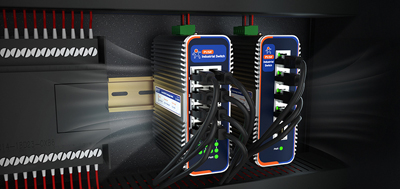
Edge computing controllers: Taking the USR-EG628 industrial computer as an example, its NPU chip enables local AI decision-making, completing path planning and obstacle avoidance calculations within 50ms. By integrating 18 industrial protocols such as Modbus and OPC UA, the device seamlessly connects with MES, WMS, and other systems, reducing communication delays to within 10ms.
Digital twin technology: By constructing virtual mirrors of AGVs and predicting failures based on historical data and real-time operating conditions. A certain enterprise increased the accuracy of AGV bearing failure predictions to 92% through a digital twin platform, optimizing maintenance cycles from "scheduled maintenance" to "on-demand maintenance" and reducing spare parts inventory costs by 35%.
This project faced two major challenges: AGVs in the coating workshop needed to operate continuously in a 60°C high-temperature environment, and communication delays with the automated storage and retrieval system needed to be controlled within 50ms. The solutions included:
Adopting high-temperature-resistant lithium batteries and liquid cooling systems, enabling AGVs to operate continuously for 12 hours without load reduction in a 60°C environment;
Deploying USR-EG628 edge controllers, using their built-in protocol conversion engines to achieve seamless conversion from Modbus RTU to OPC UA, reducing communication delays from 200ms to 35ms;
Implementing a digital twin maintenance system, integrating data from vibration and temperature sensors to reduce equipment failure rates from 3 times per month to 0.2 times.
After the transformation, production line utilization increased from 78% to 95%, saving over 20 million yuan in annual downtime losses.
This project required mixed-line production of multiple battery pack specifications, imposing extremely high demands on AGV compatibility and flexibility. The solutions included:
Developing a modular fork system, using a combination of electric rollers and pneumatic grippers to support adaptive grasping of materials ranging from 50kg to 2 tons;
Adopting USR-EG628's AI path planning algorithm to dynamically adjust handling routes based on real-time order data, reducing production line changeover times from 2 hours to 15 minutes;
Deploying wireless charging systems, installing charging plates in AGV waiting areas for "stop-and-charge" functionality, reducing equipment charging time ratios from 30% to 8%.
After project implementation, unit production capacity energy consumption decreased by 18%, and labor costs were reduced by 40%, setting an industry benchmark for flexible manufacturing.