AI + Cellular WiFi Router: Unlocking the "Smart Code" for Predictive Maintenance on Production Lines
In the wave of Industry 4.0, the stable operation of production line equipment has become the core of a company's competitiveness. However, the traditional "breakdown maintenance" model (repairing equipment after a failure) and the "periodic maintenance" model (maintaining according to a fixed schedule) have significant drawbacks. The former leads to unplanned downtime, with a single failure potentially causing losses of tens of thousands of yuan. The latter results in resource waste due to over-maintenance, with maintenance costs accounting for over 30% of the total lifecycle cost of equipment.
Predictive Maintenance (PdM) enables "on-demand maintenance" by monitoring equipment status in real-time and predicting failure risks. It can reduce unplanned downtime by 70% and maintenance costs by 25%, making it a "must-have" in the industrial sector. The combination of AI and cellular WiFi routers is the "key" to solving the challenges of implementing predictive maintenance. The cellular WiFi router serves as the "nerve center" of production line data, responsible for collecting and transmitting equipment data. The AI algorithm, acting as the "intelligent brain," conducts in-depth analysis of the data to accurately predict failures.
This article will provide an in-depth analysis of the application logic, technical path, and real-world cases of AI + cellular WiFi routers in predictive maintenance, and offer a set of "data-driven" customized services to help companies quickly build predictive maintenance systems.
1.2 Over-Maintenance: A "Bottomless Pit" of Resource Waste
To avoid unplanned downtime, many companies adopt the "periodic maintenance" model, but the issue of over-maintenance is prominent:
Fixed maintenance cycles: Regardless of the actual equipment status, maintenance is carried out according to a fixed schedule (e.g., once a month), leading to "pre-emptive repairs" on some equipment and wasting labor and spare parts.
Redundant maintenance scope: To cover all potential failure points, the maintenance scope often exceeds actual needs, such as replacing bearings that are operating normally, increasing spare part costs.
Delayed maintenance timing: Periodic maintenance cannot capture the dynamic changes in equipment status and may lead to failures occurring before the next maintenance interval due to overly long maintenance intervals.
1.3 Data Silos: The "Information Blind Spot" in Maintenance Decision-Making
Production line equipment is diverse (e.g., PLCs, sensors, motors, robots), with varying data formats (e.g., Modbus, CAN, Profinet) and dispersed across different systems (e.g., SCADA, MES, ERP), forming "data silos." Traditional maintenance models rely on manual experience or simple threshold-based judgments (e.g., triggering an alarm when the temperature exceeds 80°C), making it difficult to mine failure patterns from vast amounts of data, leading to delayed or misjudged maintenance decisions.
2.2 AI Algorithm: The "Intelligent Brain" for Fault Prediction
The AI algorithm achieves fault prediction by conducting in-depth analysis of the data collected by the cellular WiFi router, with core steps including:
Data preprocessing: Cleaning abnormal values (e.g., instantaneous noise from sensors), filling in missing values (e.g., data loss due to network interruptions), and normalizing data (mapping data with different dimensions to the same range).
Feature engineering: Extracting key features related to failures (e.g., vibration frequency, temperature change rate, current fluctuations) and constructing feature vectors.
Model training: Employing machine learning (e.g., random forests, support vector machines) or deep learning (e.g., LSTM, CNN) algorithms to train prediction models based on historical failure data.
Fault prediction: Inputting real-time data into the trained model to output failure probabilities (e.g., "85% probability of bearing wear failure") or remaining useful life (RUL, Remaining Useful Life).
2.3 Typical Application Scenarios: From "Passive Maintenance" to "Proactive Prevention"
AI + cellular WiFi routers can be applied to multiple key aspects of production lines:
Motor fault prediction: By collecting motor vibration data through vibration sensors, the AI model analyzes features such as vibration frequency and amplitude to predict failures like bearing wear and rotor imbalance, providing early warnings 2-4 weeks in advance.
PLC status monitoring: By collecting data such as CPU load, memory usage, and I/O point status from PLCs via the Modbus protocol, the AI model detects abnormal patterns (e.g., sustained CPU load exceeding 90%) to predict PLC failures.
Robot joint health management: By collecting current data from robot joint motors through current sensors, the AI model analyzes the relationship between current fluctuations and joint loads to predict joint wear or insufficient lubrication, optimizing maintenance plans.
Cellular WiFi Router USR-G809s: A "Lightweight Carrier" for AI + Predictive Maintenance
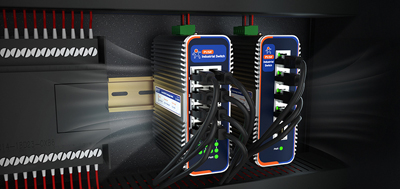
Among the product selections for AI + cellular WiFi routers, the USR-G809s industrial router gateway, with its features of "multi-protocol compatibility, edge computing, and highly reliable transmission," has become an "ideal choice" for predictive maintenance scenarios. This gateway, specifically designed for industrial applications, integrates 4G LTE, Wi-Fi, serial ports (RS232/485), digital input/output (DI/DO), and Ethernet ports (4LAN + 1WAN), supports VLAN division and five VPN protocols, and supports predictive maintenance through the following designs:
Multi-protocol compatibility: Supports mainstream industrial protocols such as Modbus TCP/RTU, CAN, Profinet, and OPC UA, enabling connection to heterogeneous equipment like PLCs, sensors, motors, and robots for unified data collection.
Edge computing capabilities: Equipped with an ARM Cortex-M7 processor with a main frequency of 200MHz, it supports lightweight AI algorithms (e.g., threshold-based judgments, simple pattern recognition) and can perform preliminary fault detection locally (e.g., triggering an alarm when the temperature exceeds a threshold), reducing cloud transmission delays.
Highly reliable transmission: Supports multi-link redundancy with 4G/5G, Wi-Fi, and Ethernet, automatically switching to backup links in case of primary link failures to ensure stable data transmission in complex industrial environments.
Open interfaces: Provides a Python SDK and RESTful API, supporting integration with third-party AI platforms (e.g., Alibaba Cloud PAI, Tencent Cloud TI-ONE), facilitating the deployment of customized AI models by companies.
An electronics manufacturing company adopted the USR-G809s to connect 20 placement machines on its production line, collecting vibration data from the equipment through vibration sensors. After preliminary processing locally, the data was uploaded to a cloud AI platform. The AI model analyzed the vibration frequency features and predicted an X-axis guide rail wear failure on one placement machine 3 weeks in advance. The company promptly replaced the guide rail, avoiding unplanned downtime and saving 120,000 yuan in repair costs.
Contact Us: Submit Equipment Data to Obtain a Customized AI Analysis Model
The predictive maintenance solution of AI + cellular WiFi routers needs to be "tailored to the specific situation." Different companies have varying equipment types, data formats, and failure modes, making it difficult for generic models to meet precise prediction needs. To help companies quickly build AI analysis models that fit their own scenarios, we offer a "data-driven" customized service:
4.1 Service Process: A "Four-Step Closed Loop" from Data Submission to Model Deployment
Submit equipment data: Fill out an equipment list (type, quantity, communication protocol), data samples (e.g., historical data on temperature, vibration, current, including both normal and fault states), and key business requirements (e.g., which failures to prioritize for prediction, desired warning times), and submit via a form (link/QR code) or email.
Data quality assessment: Based on industry experience and data science methods, we evaluate data completeness (whether all key features are covered), accuracy (whether there are abnormal values), and balance (whether the ratio of normal to fault samples is reasonable), generating a "Data Quality Assessment Report" and providing suggestions for data supplementation.
AI model development: According to the data characteristics and business requirements, select appropriate AI algorithms (e.g., random forests, LSTM) to develop a customized prediction model and test its performance (e.g., accuracy, recall, F1 score) on a validation set to ensure model reliability.
Model deployment and iteration: Deploy the model to the company's local server or cloud platform and integrate it with the USR-G809s cellular WiFi router to achieve real-time data collection and fault prediction. Regularly collect new data to iteratively optimize the model and improve prediction accuracy.
4.2 Deliverables: "Full-Link Support" from Reports to Systems
"Data Quality Assessment Report": Clarifies the current data status and improvement directions, providing a foundation for model development.
"AI Prediction Model Technical Document": Details the model algorithm, feature engineering, training parameters, and performance indicators, facilitating the company's understanding of the model logic.
Predictive maintenance system: Includes full-process functions such as data collection (USR-G809s), model inference (cloud/local), alarm management (SMS/email/APP push), and maintenance work order generation (integration with ERP/MES systems).
Operation and maintenance support: Provides 7×24-hour technical support to resolve issues such as model deployment, data transmission, and false alarms, ensuring system stable operation.
4.3 Customer Case: Practice of an Automotive Parts Company
An automotive parts company's production line includes 50 CNC machining centers. The traditional maintenance model relied on manual inspections and regular replacement of consumable parts, resulting in an average of 12 unplanned downtimes per year and maintenance costs exceeding 2 million yuan. After adopting our service:
Historical data on vibration, temperature, and current from the CNC machining centers (including 8 fault samples) was submitted.
An LSTM-based fault prediction model was developed, achieving an accuracy of 92% and capable of predicting failures such as spindle bearing wear and tool breakage 2-3 weeks in advance.
The USR-G809s was deployed to collect real-time data, and the model inference results were pushed to maintenance personnel via an APP. The maintenance plan shifted from "periodic" to "on-demand," reducing unplanned downtime to 3 times per year and cutting maintenance costs by 40%.