Adaptive Ethernet Switch Port Speed: In-Depth Analysis of Full-Duplex/Half-Duplex Switching and Speed Configuration
In industrial networks, the stability of data transmission directly determines the efficiency and safety of production lines. When AGV trolleys stall due to network packet loss and intelligent warehousing systems malfunction due to data delays, enterprises lose not only time costs but also confidence in digital transformation. The root cause of all these issues often lies in the configuration details of switch port speeds and duplex modes. This article provides an in-depth analysis from four dimensions: technical principles, switching mechanisms, configuration pitfalls, and practical case studies, along with actionable optimization solutions.
1. Duplex Modes: The Invisible Switch Determining Transmission Efficiency
1.1 Essential Differences Between Half-Duplex and Full-Duplex
Half-duplex mode is akin to walkie-talkie communication, where data can only be sent or received at the same moment, with limitations on maximum transmission distance (e.g., the maximum transmission distance for 100Base-TX half-duplex mode is 100 meters). In contrast, full-duplex mode resembles telephone communication, enabling simultaneous bidirectional data transmission with double the throughput (e.g., a gigabit full-duplex port can theoretically achieve a bandwidth of 2000 Mbps). A case study from an automotive final assembly line is highly representative: its original switches used half-duplex mode to connect welding robots. When 20 devices reported data simultaneously, 30% of data packets were lost due to collision retransmissions, forcing a production line shutdown for 2 hours. After switching to full-duplex mode, the packet loss rate dropped to 0.02%, reducing annual downtime losses by over 2 million yuan.
1.2 Operating Logic of Auto-Negotiation Mechanisms
Modern switch ports generally support auto-negotiation functionality as specified by the IEEE 802.3u standard, exchanging capability information through Fast Link Pulses (FLPs) to automatically match the optimal speed and duplex mode. However, this mechanism has three major pitfalls:
Device Compatibility Pitfalls: When the opposing device does not support auto-negotiation or has inconsistent negotiation versions, ports may enter a Down state. A photovoltaic power plant used switches from different brands for networking, resulting in 15% of ports failing to communicate normally due to differences in auto-negotiation protocols.
Performance Bottleneck Pitfalls: Auto-negotiation results may fall below actual requirements. A smart logistics center's sorting system had switches and sensors auto-negotiate to 100 Mbps half-duplex mode, leading to 40% data loss during Double 11 due to traffic surges.
Security Risk Pitfalls: Attackers can force port speed reduction by forging FLP frames. A monitoring network in an energy enterprise was once compromised by a man-in-the-middle attack, altering the data transmission rate of key cameras to 10 Mbps, creating monitoring blind spots.
2. Practical Guide to Speed and Duplex Mode Switching
2.1 Key Pre-Configuration Checklist
Before manually adjusting port parameters, three foundational verifications must be completed:
Physical Layer Verification: Use a cable tester to check if twisted-pair cables meet Category 5e standards and if fiber attenuation is within -20 dB. A chemical enterprise used inferior cables, resulting in a gigabit port only stabilizing at 100 Mbps.
Device Capability Verification: Use the display interface command to view the supported speed range of ports (e.g., ports on the USR-ISG series switches support 10/100/1000 Mbps adaptive).
Topology Structure Verification: Confirm that the network has no loops or broadcast storms. A smart factory's switches formed a physical loop due to configuration errors, causing full-duplex ports to frequently switch to half-duplex mode due to MAC address table oscillations.
2.2 Huawei/H3C Device Configuration Paradigm
Taking the Huawei S5720 switch as an example, the complete configuration process is as follows:
bash
system-view# Enter system viewinterface GigabitEthernet0/0/1# Enter target port viewnegotiation auto# Enable auto-negotiation (default state)auto duplex full# Force auto-negotiation result to full-duplexauto speed1000# Force auto-negotiation speed to 1000 Mbps# If manual configuration is requiredundo negotiation auto# Disable auto-negotiationduplex full# Set to full-duplexspeed1000# Set speed to 1000 Mbps
After configuration, verify the results using the display interface GigabitEthernet 0/0/1 command, focusing on the Negotiation, Duplex, and Speed fields.
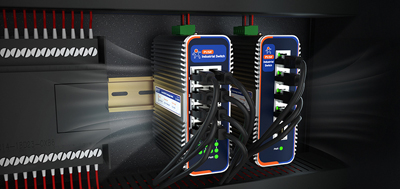
2.3 USR-ISG Series Ethernet Switch Optimization Solutions
The USR-ISG series switches offer three distinctive features tailored for industrial scenarios:
Intelligent Environmental Adaptation: Operating temperature range of -40°C to 85°C. In a steel plant's steelmaking workshop, devices ran stably for over 3000 hours at 80°C.
Anti-Interference Design: Metal casing and IP40 protection rating. In an electromagnetic interference test for a rail transit project, devices maintained 0 packet loss at a field strength of 50 V/m.
Ultra-Fast Ring Network Recovery: Based on the ERPS protocol, achieving 50 ms-level fault self-healing. In a photovoltaic power plant's monitoring network, business switching time was reduced from 30 seconds with traditional STP to 40 milliseconds after fiber interruption.
3. Typical Fault Scenarios and Solutions
3.1 Scenario 1: High-Speed Port Forwarding to Low-Speed Port (Incast Problem)
Typical Case: An automotive final assembly line adopted a 10G uplink + 1G downlink architecture. When 20 welding robots reported data simultaneously, the downlink port buffer was instantly filled, resulting in 30% packet loss.
Solutions:
Enable the ECN (Explicit Congestion Notification) function on USR-ISG switches to mark data packets when buffer occupancy reaches 60%, triggering terminal speed reduction.
Configure the WRED (Weighted Random Early Detection) algorithm to probabilistically discard low-priority traffic.
Implement port speed limiting to control robot data reporting frequency within 80% of the downlink port bandwidth.
Implementation Effect: Packet loss rate dropped from 30% to 0.5%, with data reporting delays stabilized at under 2 ms.
3.2 Scenario 2: Mixed Traffic Competition
Typical Case: A smart factory's AGV scheduling system and video surveillance system shared the same network. When 10 AGVs simultaneously requested path planning, video streams occupied the buffer, resulting in 30% control instruction loss.
Solutions:
Isolate the AGV control network from the monitoring network using VLANs.
Configure DSCP marking on USR-ISG switches to mark AGV control traffic as EF (Expedited Forwarding) class.
Enable CBQ (Class-Based Queuing) scheduling to allocate dedicated bandwidth for AGV traffic.
Implementation Effect: AGV path planning response time dropped from 500 ms to 120 ms, with scheduling success rate increasing to 99.8%.
3.3 Scenario 3: Long-Distance Transmission Attenuation
Typical Case: In a photovoltaic power plant, inverters were distributed within a 5 km range. Fiber optic transmission resulted in 10% packet loss due to signal attenuation.
Solutions:
Select USR-ISG series switches supporting SFP optical ports to automatically adjust transmission power through optical modules.
Enable Forward Error Correction (FEC) functionality to repair transmission errors at the physical layer.
Configure link aggregation (LACP) to bind four fibers into a logical link.
Implementation Effect: Effective transmission distance extended to 10 km, with packet loss rate dropping to 0.01%.
4. USR-ISG Series Ethernet Switch: A Benchmark Solution for Industrial Network Optimization
Through serving over 300 industrial clients, the USR-ISG series switches have developed a comprehensive performance optimization system:
Dynamic Buffer Management: Supports PG (Priority Group) subdivision, dividing ingress buffers into 8 priority groups with independently adjustable watermarks. A chemical enterprise successfully supported stable communication for 500+ sensors and 20 DCS controllers in extreme environments of -40°C to 85°C using this feature.
Intelligent Flow Control: Integrates PFC+ECN dual mechanisms, triggering PFC to pause upstream transmission when buffer occupancy reaches 60% and notifying terminals to reduce speed via ECN marking at 80%.
Lossless Algorithm Library: Built-in 12 scheduling algorithms such as WRED, WFQ, and SP (Strict Priority) for automatic matching based on scenarios.
Visualized Operations and Maintenance: Real-time display of 20+ key indicators such as buffer occupancy, queue depth, and packet loss statistics through a WEB interface.
A representative application in a new energy enterprise: Deployed USR-ISG 16-port switches, achieving zero-loss data collection from 500+ photovoltaic inverters in a 50°C high-temperature, strong electromagnetic interference environment through 32 MB buffer + WFQ algorithm, reducing annual fault time from 12 hours to 8 minutes.
5. Action Guide Towards Zero Packet Loss
Submit Network Diagnosis Request: Visit the official website to fill out the "Industrial Network Performance Assessment Form," providing key information such as device models, traffic models, and packet loss phenomena.
Obtain Customized Report: An expert team will deliver a complete solution within 48 hours, including buffer capacity calculations, scheduling algorithm recommendations, and device upgrade paths.
Deploy Optimization Solution: Provide full-process support from hardware replacement to configuration tuning to ensure 100% solution implementation.
Continuous Performance Monitoring: Track key indicators such as buffer utilization and packet loss rate in real-time through the USR Cloud platform to预警 potential risks.
In the Industrial 4.0 era, the reliability of data transmission has become a core element of enterprise competitiveness. The USR-ISG series switches, with their intelligent buffer management system, have helped clients achieve zero-packet-loss network architectures in automotive manufacturing, new energy, and smart logistics. Submit your inquiry now to bid farewell to data loss and embrace a new era of deterministic transmission for your industrial network!