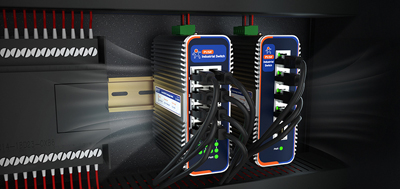
Breaking Through Complex Electromagnetic Environments: An In-Depth Analysis of the Signal Anti-Interference Capabilities of PUSR Industrial Router
In the wave of Industry 4.0 and intelligent manufacturing, industrial networks have become the "nerve center" of production systems. However, in scenarios such as steel workshops, power substations, and port terminals, electromagnetic interference generated by motor start-stop operations, welding activities, and high-voltage equipment operation often leads to network signal interruptions, data packet loss, and even equipment malfunctions. According to statistics from an auto parts factory, equipment offline incidents caused by electromagnetic interference result in direct economic losses exceeding RMB 2 million annually. How can this challenge be addressed? PUSR industrial router, with their exceptional electromagnetic compatibility (EMC) design, provide a highly reliable signal anti-interference solution for industrial settings.
In industrial settings, steel structure workshops and large metal equipment naturally shield electromagnetic waves. Actual measurement data from a stamping workshop shows that when no anti-interference equipment is deployed, the strength of a 4G signal drops sharply from -75 dBm outdoors to -110 dBm inside the workshop, resulting in a 90% decrease in data transmission rates and an offline rate of up to 30% for devices.
The electrical fast transient (EFT) pulses generated by motor start-stop operations can create voltage surges of several thousand volts within microseconds. Testing on an automated production line indicates that without anti-interference measures, each motor start leads to 10-20 seconds of data interruption, affecting production rhythm by more than 5%.
Harmonic interference generated by frequency converters, servo drives, and other equipment can disrupt the timing logic of industrial protocols such as Modbus and Profibus. A case study of a power monitoring system shows that harmonic interference caused the data collection error rate to soar from 0.1% to 15%, seriously affecting decision-making accuracy.
(1) Electromagnetic Shielding and Grounding Optimization
PUSR industrial routers feature a fully metal sheet metal enclosure with conductive sealing rings to achieve 360° electromagnetic shielding, with a shielding effectiveness of over 60 dB. The internal circuit board adopts a multi-layer design, with key signal lines wrapped in conductive fabric and independent grounding loops to effectively isolate external interference. Taking the USR-G809s as an example, its enclosure has passed the IEC61000-4-6 standard test and can withstand 10 V/m of radio frequency field interference, far exceeding industrial scenario requirements.
(2) Power Protection and Signal Isolation
The device incorporates three-level power protection:
(3) Anti-Interference Antenna Design
The directional antennas jointly developed by PUSR and antenna manufacturers optimize the radiation pattern, increasing signal gain by 3 dB while reducing backward radiation interference to the device. In testing at a mountainous substation, the 4G signal strength of the USR-G809s was 15 dBm higher than that of ordinary routers, with a 40% improvement in data transmission stability.
(1) Adaptive Modulation and Coding (AMC)
The device continuously monitors channel quality and dynamically adjusts modulation methods (e.g., downgrading from 64QAM to QPSK) and coding rates to maintain basic communication even in weak signal environments of -105 dBm. Testing in a metallurgical workshop shows that AMC technology reduced the data retransmission rate from 25% to below 5%.
(2) Forward Error Correction (FEC) and Retransmission Mechanisms
The RS (255,239) coding algorithm can correct random errors within 8 bytes; combined with the ARQ retransmission protocol, it automatically triggers retransmissions after three consecutive transmission failures to ensure zero loss of critical data. Data from a smart agriculture project shows that FEC technology increased the completeness rate of meteorological data collection from 92% to 99.9%.
(3) Deep Optimization of Industrial Protocols
For protocols such as Modbus TCP and OPC UA, PUSR has developed a dedicated anti-interference communication library:
(1) Equipment Networking in Steel Workshops
After deploying the USR-G809s, a steel mill resolved electromagnetic interference issues through the following technical combinations:
(2) Remote Monitoring in Power Substations
In a 500 kV substation, the USR-G809s addressed harmonic interference through the following designs:
In industrial settings, the stability of network signals directly impacts production efficiency and safety. PUSR industrial routers provide a highly reliable solution for complex electromagnetic environments through a three-tier protection system of hardware shielding, software optimization, and protocol customization. Represented by the USR-G809s, anti-interference products have been implemented in over 30 industries, including steel, power, and ports, helping customers achieve zero network interruptions and zero data loss.
If you are facing network challenges caused by electromagnetic interference, welcome to contact us. The PUSR professional team will provide you with:
Let anti-interference cease to be a technical challenge and become a solid foundation for your journey toward intelligent manufacturing.