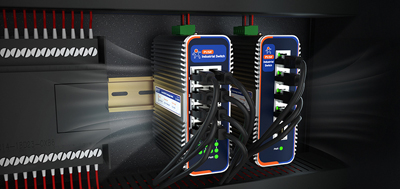
Application of Industrial 4G Modem in Smart Water Management: Innovative Practices in Remote Meter Reading and Data Acquisition
Driven by the accelerated urbanization process and the upgrading demand for water resource management, smart water management has become the core direction of digital transformation in the industry. According to statistics, the leakage rate of urban water supply networks in China has long remained between 15% and 20%. The measurement errors caused by inefficient manual meter reading result in economic losses exceeding 10 billion yuan annually. Leveraging its wireless communication, protocol conversion, and edge computing capabilities, the industrial 4G modem is emerging as a key technology to address traditional water management challenges. This article will provide an in-depth analysis of the application logic of industrial 4G modems in remote meter reading and data acquisition and explore how to achieve cost reduction and efficiency improvement in water management through technological integration.
1. Three Major Pain Points in Traditional Water Management: Transitioning from "Passive Response" to "Proactive Prevention"
1.1 The Efficiency Dilemma of Manual Meter Reading
Traditional meter reading relies on periodic manual inspections, which have three major drawbacks:
Data Lag: Meter reading cycles typically range from 1 to 3 months, failing to reflect water usage anomalies in real time;
High Labor Costs: A large water utility group incurs annual manual meter reading costs exceeding 50 million yuan, with an error rate of 3% to 5%;
Management Blind Spots: Remote areas or underground pipelines are difficult to cover, leading to persistently high leakage rates.
1.2 Collaboration Barriers Due to Data Silos
The water management system involves multiple stages, including water supply, drainage, and sewage treatment. However, traditional devices often use proprietary protocols, resulting in inconsistent data formats and high transmission delays. For example, a city's water authority once experienced a 2-hour delay in dispatching instructions during a rainstorm due to incompatible protocols between pumping stations and the control center, leading to urban flooding.
1.3 Timeliness Challenges in Emergency Response
Events such as sudden pipe bursts or water pollution require rapid location and response. However, traditional monitoring methods rely on manual inspections or wired sensors, with response times extending to several hours. A provincial capital city once failed to detect a pipeline leak promptly, resulting in daily water resource waste exceeding 100,000 tons.
Solution: Construct a "sensing-transmission-decision" closed-loop system using industrial
4G modems to enable real-time data acquisition, unified protocol conversion, and remote precision control.
2.The Technological Core of Industrial
4G Modem: From "Data Transporter" to "Edge Intelligence Node"
2.1 Hardware Architecture: Reliability Guaranteed by Industrial-Grade Design
The core function of an industrial 4G modem is to convert serial data (e.g., Modbus RTU) into IP packets (e.g., TCP/IP) and transmit them to the cloud via 4G networks. Taking the USR-G786 as an example, its industrial-grade design offers three major advantages:
Environmental Adaptability: Operating temperature range of -40°C to 85°C and an IP67 protection rating that withstands heavy rain and dust;
Anti-Interference Capability: Certified to EMC Level III, ensuring stable operation in high-voltage substations and strong electromagnetic environments;
Power Redundancy: Supports dual power inputs and uninterrupted operation during power outages, ensuring data integrity under extreme conditions.
2.2 Communication Protocols: Solving Compatibility Challenges for Heterogeneous Devices
Water management scenarios involve dozens of device types, such as flow meters, pressure sensors, and water quality monitors, with protocols including Modbus, IEC101, and DL/T645. The industrial 4G modem addresses this through an embedded protocol stack that enables:
Protocol Conversion: Converts Modbus RTU to Modbus TCP or directly encapsulates data in JSON format for cloud platform parsing;
Multi-Center Transmission: Supports simultaneous connections to five servers, meeting the data demands of water utility groups, environmental protection bureaus, and emergency response departments;
Edge Computing: Implements data filtering and threshold judgment at the industrial 4G modem level to reduce invalid data transmission. For example, when flow rate changes exceed 20%, the modem immediately triggers an alarm and uploads anomaly data.
2.3 Data Security: Full-Link Protection from Transmission to Application Layers
Water management data involves user privacy and urban security. The industrial 4G modem ensures security through the following mechanisms:
Transmission Encryption: Employs SSL/TLS encryption and VPN private networks to prevent data interception and tampering;
Identity Authentication: Supports APN/VPDN private network access to ensure only authorized devices connect to core systems;
Access Control: Implements role-based permission management to restrict data operations across departments.
3.Typical Application Scenarios: From Point Breakthroughs to System Reconstruction
3.1 Remote Meter Reading: From "Manual Inspection" to "Smart Automated Reading"
Case Study: A provincial capital city's water utility group deployed 5,000 USR-G786 industrial 4G modems to connect smart water meters and flow meters, achieving the following capabilities:
Automated Data Collection: Data is collected every 5 minutes, reducing the error rate from 5% to 0.1%;
Anomaly Alerts: The system automatically flags and notifies maintenance personnel of sudden increases in water usage or continuous zero readings;
Tiered Pricing: Dynamically adjusts water prices based on real-time usage to encourage conservation.
Results: Annual leakage rates dropped from 18% to 9%, and manual meter reading costs were reduced by 70%.
3.2 Pipeline Monitoring: From "Passive Repair" to "Proactive Prevention"
Case Study: A coastal city deployed pressure sensors and industrial 4G modems at key nodes in its water supply network to establish a three-dimensional "pressure-flow-leakage" monitoring system:
Pressure Monitoring: Real-time collection of pipeline pressure data triggers alarms when fluctuations exceed 15%;
Leakage Localization: Precisely locates pipe bursts (with an error margin of less than 50 meters) by analyzing flow rate changes and pressure decay curves;
Smart Scheduling: Automatically adjusts pumping station output based on peak and off-peak water demand, reducing energy consumption by 20%.
Results: Response time to pipe bursts was shortened from 4 hours to 30 minutes, and annual unplanned water outages decreased by 85%.
3.3 Water Quality Regulation: From "Periodic Sampling" to "Real-Time Traceability"
Case Study: An environmental protection bureau deployed multi-parameter sensors (e.g., pH, dissolved oxygen, ammonia nitrogen) at river sections and used industrial 4G modems to upload data to an environmental monitoring platform:
Real-Time Alerts: Automatically sends alarm notifications to regulatory authorities when water quality indicators exceed standards;
Pollution Traceability: Quickly locates pollution sources (e.g., illegal industrial discharges) by combining GIS maps with water flow directions;
Data Transparency: Provides real-time water quality data to the public via an app to enhance transparency.
Results: Pollution incident detection time was reduced from 72 hours to 2 hours, and public complaints decreased by 60%.
4.USR-G786: The "Reliable Choice" for Smart Water Management
Among numerous industrial 4G modems, the USR-G786 stands out for its high reliability, strong compatibility, and ease of deployment, making it the preferred solution for the water industry. Its core advantages include:
Multi-Protocol Support: Built-in support for over 20 protocols, including Modbus RTU/TCP, IEC101/104, and DL/T645, covering over 90% of water management devices;
Dual-SIM Dual-Standby: Supports seamless switching among China Mobile, China Unicom, and China Telecom networks to ensure uninterrupted coverage;
Remote Management: Enables device parameter configuration, firmware upgrades, and fault diagnosis via a cloud platform, reducing operational costs;
Low Power Consumption: Standby power consumption below 1W and solar power compatibility for deployment in remote areas.
In a comparative test, a water utility group reported that the USR-G786 operated continuously for two years without failure at -30°C, achieving a data transmission success rate of 99.98%, significantly outperforming competing products.
5.Contact Us: Initiate the Intelligent Transformation of Water Management
The industrial 4G modem has become an "infrastructure" for smart water management construction, whose value lies not only in its technological capabilities but also in driving the industry's transition from "experience-driven" to "data-driven" operations. Contact us now to receive:
Free Customized Solutions: Design an industrial 4G modem integration architecture tailored to your pipeline network structure and device types;
Device Trials: Opportunity to test USR-G786 samples and experience its anti-interference performance firsthand;
Technical Training: One-on-one guidance from dedicated engineers on industrial 4G modem configuration and water management protocol integration.
Contact Us: Obtain the "White Paper on Industrial 4G Modem Selection for Water Management" and access our industry case library.