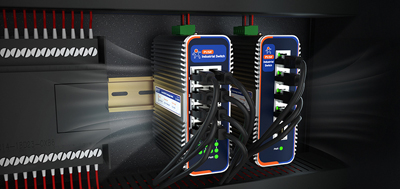
Application of Industrial LTE Modem in Industrial Security Protection: Building a Firewall Against Cyber Attacks and Data Breaches
In today's era of deep integration between Industry 4.0 and the Industrial Internet of Things (IIoT), the scale of industrial equipment networking has grown exponentially. According to statistics, the number of globally connected industrial devices has surpassed ten billion, with data transmission volumes surging at an annual rate of 30%. However, industrial cyber attacks have also climbed in tandem. In 2024, the number of vulnerabilities in global Industrial Control Systems (ICS) increased by 45% compared to the previous year, with the average loss from data breaches reaching a staggering $3.86 million per incident. Against this backdrop, the industrial LTE modem (data transmission unit), serving as the core communication hub between devices and the cloud, directly determines the stability of industrial systems and the security of data assets. This article will delve into the technical logic behind the security protection provided by industrial LTE modems and reveal how to construct a "digital moat" for industrial networks through security reinforcement.
Security Threat Landscape of Industrial LTE Modems: Full-Chain Attacks from Physical to Application Layers
The security risks associated with industrial LTE modems are not isolated but permeate every stage of the device lifecycle. Attackers can launch multi-dimensional attacks through physical contact, network penetration, and protocol vulnerabilities, forming a complete attack chain of "device hijacking - data theft - system paralysis."
1.1 Physical Layer Attacks: The "First Line of Defense" for Device Control
Industrial LTE modems are often deployed in harsh environments such as workshops, mines, and oil fields, where their physical interfaces (e.g., serial ports, network ports, SIM card slots) become entry points for attackers. For instance, attackers can implant malicious firmware through USB interfaces, tamper with the communication protocols of industrial LTE modems, and intercept or forge device data. A severe incident occurred at an automobile manufacturing plant where an unsecured debugging interface on an industrial LTE modem allowed malicious control of the production line's PLC, resulting in a 12-hour shutdown of the entire line.
1.2 Network Layer Attacks: The "Invisible Killers" of Data Transmission
Industrial LTE modems rely on networks such as 4G/5G, Wi-Fi, and Ethernet for data transmission, but the openness of public networks makes them prime targets for attacks. Common attack methods include:
Man-in-the-Middle (MITM) Attacks: Attackers use ARP spoofing or DNS hijacking to forge communication links between industrial LTE modems and cloud servers, stealing sensitive data. For example, a chemical enterprise's industrial LTE modem transmitting temperature sensor data without encryption enabled had its reactor temperature parameters tampered with, posing an explosion risk.
DDoS Attacks: Overwhelm the network bandwidth of industrial LTE modems with massive requests, preventing normal data transmission. In 2024, a smart grid project suffered a DDoS attack on its industrial LTE modems, causing data interruptions for 100,000 smart meters across the city and paralyzing the power supply dispatch system for three hours.
1.3 Application Layer Attacks: Precision Strikes on Protocol Vulnerabilities
Industrial LTE modems support dozens of industrial protocols such as Modbus, OPC UA, and IEC 61850, but some protocols have design flaws that can be exploited. For example:
Lack of Authentication in Modbus Protocol: Attackers can directly send malicious commands to industrial LTE modems to modify device parameters. A sewage treatment plant's industrial LTE modem failed to authenticate Modbus commands, leading to the remote activation of water pumps and a sewage overflow incident.
Protocol Parsing Vulnerabilities: If industrial LTE modems do not strictly validate data length and format when parsing custom protocols, buffer overflow attacks may occur. In 2023, a mine's industrial LTE modem was implanted with malicious code due to a protocol parsing vulnerability, causing the underground ventilation system to lose control and trapping 12 miners.
Security Reinforcement Technologies for Industrial LTE Modems: From Passive Defense to Active Immunity
Faced with increasingly sophisticated attack methods, industrial LTE modems need to establish an integrated "end-pipe-cloud" security protection system. Through hardware reinforcement, communication encryption, protocol security, and cloud-based management, they can upgrade from passive defense to active immunity.
2.1 Hardware Security: Building a "Resilient" Physical Defense Line
The hardware design of industrial LTE modems must meet industrial-grade standards, considering anti-interference, tamper-resistance, and environmental durability from chip selection to enclosure packaging:
Secure Chips: Utilize industrial-grade processors with built-in encryption engines (e.g., ARM Cortex-M7) that support encryption algorithms such as AES, RSA, and SM4 to ensure data confidentiality at the hardware level. For example, the USR-DR504 industrial LTE modem incorporates a hardware encryption module for real-time encryption of transmitted data, preventing MITM attacks.
Tamper-Resistant Design: Metal enclosures with an IP67 protection rating can withstand vibration, shock, dust, and other harsh conditions. Additionally, technologies such as optocoupler isolation and electromagnetic shielding prevent equipment abnormalities caused by strong electromagnetic interference.
Secure Boot: Industrial LTE modems must verify firmware signatures during startup to prevent the implantation of malicious firmware. For example, an industrial LTE modem manufacturer embeds unique digital certificates in the firmware, which must be verified with the cloud server for legitimacy during startup, ensuring the firmware has not been tampered with.
2.2 Communication Security: Constructing an "Encrypted Tunnel"
Data transmission by industrial LTE modems must adopt "end-to-end" encryption technology to prevent data theft or tampering during transmission:
VPN Tunnels: Establish encrypted channels using IPsec VPN or SSL VPN to encapsulate communication between industrial LTE modems and cloud servers within an encrypted tunnel. For example, a petroleum pipeline monitoring project uses IPsec VPN technology to keep pipeline pressure data transmitted by industrial LTE modems encrypted during transmission over public networks, preventing data leakage.
DTLS Encryption: For the unreliability of the UDP protocol, adopt the DTLS (Datagram Transport Layer Security) protocol to encrypt data packets, ensuring data integrity and confidentiality. The USR-DR504 industrial LTE modem supports DTLS encryption, effectively defending against MITM attacks.
SIM Card Binding: Bind industrial LTE modems with SIM cards, allowing only specific SIM cards to access the network and preventing device control loss due to SIM card theft. For example, a smart city project binds dedicated SIM cards to all streetlight industrial LTE modems and sets up an APN private network to ensure data transmission security.
2.3 Protocol Security: Filling Protocol Vulnerabilities
Industrial LTE modems need to reinforce the security of supported protocols, constructing a protocol security defense line from dimensions such as protocol parsing, authentication, and access control:
Deep Protocol Parsing: Perform deep parsing of protocols such as Modbus and OPC UA, extracting key fields (e.g., function codes, register addresses, data values) and validating their legitimacy. For example, when receiving Modbus commands, industrial LTE modems must verify whether the function codes are within preset ranges to prevent the execution of malicious commands.
Two-Way Authentication: Industrial LTE modems must conduct two-way authentication with cloud servers and between devices and modems to ensure the legitimacy of communication parties. For example, the USR-DR504 industrial LTE modem supports X.509 certificate authentication, exchanging digital certificates with cloud servers to verify each other's identities before establishing communication links.
Access Control: Implement access control models based on roles (RBAC) or attributes (ABAC) to restrict access permissions for different users or devices to industrial LTE modems. For example, an industrial LTE modem in a factory only allows maintenance engineers to access it via specific IP addresses, preventing operations by other personnel.
2.4 Cloud Security: Building an "Intelligent Monitoring Brain"
The cloud-based management platform for industrial LTE modems must have real-time monitoring, anomaly detection, and remote control capabilities, forming a "full lifecycle" security management for industrial LTE modems:
Real-Time Monitoring: View parameters such as online status, signal quality, data traffic, and device temperature of industrial LTE modems in real-time through the cloud platform to promptly detect anomalies. For example, the USR-DR504 industrial LTE modem supports access to the USR Cloud platform, enabling real-time monitoring of its location, signal strength, data traffic, and setting threshold alarms.
Anomaly Detection: Based on machine learning algorithms, analyze the behavior of data transmitted by industrial LTE modems to identify abnormal patterns (e.g., data mutations, frequent reconnections, traffic anomalies). For example, a smart power plant project detected a sudden surge in data traffic from an industrial LTE modem through the cloud platform. After analysis, it was found to be a DDoS attack, and traffic cleaning was immediately initiated to prevent system paralysis.
Remote Control: Support remote configuration of industrial LTE modem parameters, firmware upgrades, device restarts, and connection disconnections to quickly respond to security incidents. For example, after discovering that an industrial LTE modem in a mine project was maliciously controlled, the network connection was immediately cut off remotely through the cloud platform to prevent the attack from spreading.
USR-DR504: A "Lightweight Solution" for Security Reinforcement of Industrial LTE Modems
Among numerous industrial LTE modem products, the USR-DR504 stands out as a preferred solution for industrial security protection due to its "secure, reliable, lightweight, and easy-to-use" characteristics. Its core security features include:
3.1 Hardware-Level Security Protection
Industrial-Grade Design: Adopts a metal enclosure with an IP30 protection rating and supports a wide temperature range of -40℃ to 85℃, adapting to harsh environments such as mines, power, and petrochemical industries.
Secure Chip: Incorporates a hardware encryption module supporting AES-128/256 encryption algorithms to ensure data transmission confidentiality.
Tamper-Resistant Design: Supports optocoupler isolation and electromagnetic shielding to prevent equipment abnormalities caused by strong electromagnetic interference.
3.2 Communication Security Reinforcement
VPN Tunnels: Supports IPsec VPN/SSL VPN encrypted communication to construct an "end-to-end" secure tunnel.
DTLS Encryption: Provides DTLS encryption for the UDP protocol to defend against MITM attacks.
SIM Card Binding: Supports binding SIM cards with industrial LTE modems to prevent SIM card theft.
3.3 Protocol Security Enhancement
Deep Protocol Parsing: Supports deep parsing of industrial protocols such as Modbus, OPC UA, and IEC 61850, extracting key fields for legitimacy validation.
Two-Way Authentication: Supports X.509 certificate authentication to ensure the legitimacy of communication parties.
Access Control: Restricts illegal access based on IP whitelists and port restrictions.
3.4 Cloud-Based Intelligent Control
USR Cloud Platform Access: Supports remote configuration of parameters, firmware upgrades, monitoring of device status, and setting threshold alarms.
Anomaly Detection: Identifies abnormal behaviors such as data mutations and frequent reconnections based on machine learning algorithms.
Remote Control: Supports remote disconnection of network connections and device restarts to quickly respond to security incidents.
Contact Us: Obtain a Customized Security Reinforcement Solution
The security protection of industrial LTE modems is not a "one-time fix" but requires customized design based on factors such as enterprise actual scenarios, device types, and network environments. To help enterprises build a security protection system that meets their own needs, we offer the following services:
Free Security Assessment: Submit basic enterprise information and industrial LTE modem usage scenarios, and we will arrange experts to conduct a security risk assessment and identify potential vulnerabilities.
Customized Solution: Based on the assessment results, provide a customized security reinforcement solution covering industrial LTE modem selection, protocol reinforcement, communication encryption, and cloud-based management.
Product Trial: Apply for a USR-DR504 industrial LTE modem trial kit (including device + cloud platform access guide) to personally experience its security protection capabilities.
Case Study Visit: Schedule visits to benchmark projects such as smart factories and smart grids to understand the actual effects of industrial LTE modem security protection on-site.
On the journey of industrial security protection, every technological upgrade is a proactive anticipation of risks, and every solution implementation is a solid guardianship of security. The USR-DR504 industrial LTE modem, with security as its foundation and reliability as its commitment, assists you in steadily advancing amidst the waves of the Industrial Internet of Things.