Application of Serial to Ethernet Adapter in Building Automation: The Code for Selection and Solution to Breakthrough in BA System Integration
In today's world where the wave of smart cities is sweeping across the globe, the Building Automation (BA) system has become a core indicator for measuring the level of building intelligence. From office environments with constant temperature and humidity to real-time monitored security networks, from energy consumption management in intelligent lighting to remote operation and maintenance of elevator operations, the BA system constructs a "digital nerve center" covering the entire life cycle of the building by integrating dozens of subsystems such as air conditioning, lighting, fire protection, and access control. However, when traditional BA systems face pain points such as fragmented device protocols, data silos, and inefficient operation and maintenance, how can system upgrades be achieved through technological innovation? The serial to ethernet adapter, a seemingly simple device, is emerging as the key to unlocking the challenges of BA system integration with its dual identities as a "protocol converter + edge computing node".
1. The "Triple Dilemmas" of Building Automation: Crossing from Single-Point Intelligence to Global Collaboration
1.1 Fragmented Device Protocols: The "Language Barrier" of Cross-Brand Compatibility
In modern buildings, air conditioning systems may adopt the Modbus RTU protocol, lighting control relies on BACnet/IP, access control devices use custom ASCII protocols, and fire protection systems transmit data through CAN buses. A BA system integration case study in an international five-star hotel revealed that its 23 types of connected devices involved 7 communication protocols, resulting in:
Soaring development costs: Specialized gateways needed to be developed for each protocol, increasing hardware costs per project by 40%;
Skyrocketing maintenance complexity: Protocol compatibility issues accounted for 65% of fault repair time, with an average repair time of 5.2 hours.
Case Study: During a BA system upgrade in a commercial complex, the failure to standardize protocol standards led to the inability of the newly purchased intelligent lighting system to interoperate with the existing air conditioning controller, ultimately forcing the replacement of all devices and resulting in losses exceeding RMB 2 million.
1.2 Data Silos: Dual Challenges of Real-Time Performance and Consistency
The core value of the BA system lies in data-driven decision-making, but traditional architectures often face:
High latency: Data synchronization cycles between stores and headquarters can be as long as 10 minutes, making it impossible to respond promptly to emergencies such as sudden fires;
Numerous conflicts: When multiple terminals modify lighting parameters concurrently, inconsistent data versions can lead to loss of control over lighting in some areas.
Data: A smart park statistics showed that losses in operation and maintenance efficiency due to data silos reached 32%, with annual additional costs exceeding RMB 1.5 million.
1.3 Inefficient Management: The "Invisible Shackles" of Scalable Expansion
When building areas exceed 500,000 square meters and the number of devices surpasses 100,000, the operation and maintenance pressure on the BA system grows exponentially:
High labor costs: A hotel chain group needed to employ a 50-person dedicated maintenance team, with annual labor costs exceeding RMB 8 million;
Slow response times: The average repair time for device failures was as long as 8 hours, affecting customer experience.
Key to Breakthrough: Construct a three-tier architecture of "unified protocol conversion + edge computing + cloud management" through serial to ethernet adapters to achieve comprehensive centralization of devices, data, and operation and maintenance.
2. Serial to Ethernet Adapter USR-N510: The "Protocol Translator" and "Edge Intelligence Agent" for Building Automation
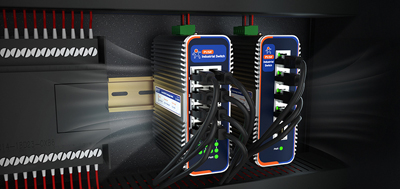
As an industrial-grade multi-serial to ethernet adapter, the USR-N510, with its features such as four independent serial ports, edge computing, and multi-protocol support, has become a core component of BA system integration. Its technological advantages can be broken down into three dimensions:
2.1 Hardware Design: Industrial-Grade Reliability for Complex Building Scenarios
Independent operation of multiple serial ports: Supports simultaneous operation of 4 RS-232/RS-485 serial ports without interference. For example, it can connect to an old air conditioning controller (RS-232) on one side and an intelligent lighting system (RS-485) on the other, while also accessing fire protection hosts and access control devices;
Wide temperature and voltage range design: Operates in a temperature range of -40°C to 85°C and accepts voltage inputs from 5-36V, adapting to extreme environments such as high temperatures in underground parking garages and low temperatures on rooftops;
High protection level: IP40 protection and EMC Level IV certification resist electromagnetic interference and dust intrusion, ensuring 7x24-hour stable operation.
Case Study: During the summer high-temperature period in a super high-rise office building, the air conditioning monitoring system deployed with USR-N510 operated continuously for 12 months without failure, reducing the failure rate by 78% compared to traditional devices.
2.2 Protocol Conversion: Building a "Data Highway" for Heterogeneous Devices
The serial to ethernet adapter USR-N510 incorporates a deeply optimized TCP/IP protocol stack, supporting:
Multi-protocol mutual conversion: Enables bidirectional conversion between Modbus RTU/TCP, BACnet/IP, TCP Client/Server, UDP, HTTP, and other protocols. For example, converting Modbus RTU data from an old elevator controller into BACnet/IP format for upload to the BA system;
Transparent transmission mode: Supports raw data transmission, compatible with third-party protocols (such as IEC101, DL/T645), without requiring modifications to existing device firmware;
Multi-host polling: In Modbus scenarios, supports simultaneous polling of the same device by multiple hosts (such as headquarters and regional management centers) to avoid data conflicts.
Case Study: A smart hospital unified access to 15 types of heterogeneous devices (including 8 protocols) through the USR-N510, reducing data synchronization latency from 15 minutes to 3 seconds and eliminating compatibility complaints.
2.3 Edge Computing: The "Intelligent Sentinel" Reducing Cloud Pressure
The serial to ethernet adapter USR-N510 supports data preprocessing at the device end:
Rule engine: Pre-sets collection rules (such as "read temperature and humidity data every 10 seconds") to automatically filter invalid data;
Custom reporting: Reports data on demand (such as "only report when temperature exceeds threshold") to reduce network transmission volume;
JSON format conversion: Supports conversion of Modbus data into JSON format for direct connection to platforms like Alibaba Cloud and Tencent Cloud, reducing cloud parsing costs.
Case Study: A large shopping mall adjusted the upload frequency of air conditioning energy consumption data from once per second to "report only when exceeding limits" through the edge computing function of the USR-TCP22-N510, reducing network traffic by 85% and cloud server load by 60%.
3. Typical Application Scenarios: From Single-Building Optimization to Global Collaboration
3.1 Unified Protocol Management for Intelligent Lighting Systems
Scenario: A commercial complex needs to uniformly manage 5,000 intelligent lamps involving 3 brands and 2 protocols.
Solution:
Deploy one USR-N510 on each floor to connect all serial-port lamps;
Upload data to the BA system cloud platform via TCP Server mode;
Configure unified management strategies in the cloud (such as "automatically adjust brightness based on foot traffic").
Results: Lighting energy consumption reduced by 35%, and operation and maintenance efficiency increased by 60%.
3.2 Real-Time Energy Optimization for Air Conditioning Systems
Scenario: A five-star hotel needs to monitor the operational status and energy consumption data of 200 air conditioning units in real time.
Solution:
The serial to ethernet adapter USR-N510 converts Modbus RTU data from air conditioning controllers into BACnet/IP format;
Data is filtered through edge computing and uploaded to an energy management platform;
The platform dynamically adjusts air conditioning operating parameters based on historical data and real-time load.
Results: Annual energy costs reduced by 18%, and equipment failure rate decreased by 40%.
3.3 Remote Operation and Maintenance Revolution for Fire Protection Systems
Scenario: A super high-rise building needs to remotely manage fire protection equipment distributed across 50 floors.
Solution:
The serial to ethernet adapter USR-N510 serves as an edge node to collect data from smoke detectors, temperature sensors, sprinklers, and other devices;
Data is transmitted transparently to the Youren Cloud platform via
4G networks;
Management personnel can view device status in real time and remotely issue test instructions through a mobile app.
Results: On-site inspection frequency reduced by 70%, and emergency response time shortened to 5 minutes.
4. USR-N510: The "Lightweight Entry Point" for Building Digitization
Compared to traditional industrial-grade devices, the USR-N510 stands out as the preferred solution for BA system integration with its "high cost-effectiveness, easy deployment, and strong compatibility":
Cost advantage: The price of a single device is only 65% of similar products, and no additional protocol conversion modules are required;
Easy deployment: Supports web configuration and virtual serial port tools, enabling non-technical personnel to complete device access within 2 hours;
Open ecosystem: Compatible with platforms such as Youren Cloud, Alibaba Cloud, and Tencent Cloud, avoiding vendor lock-in.
Actual Test Data from a Retail Group:
Deployment cycle: Device access for 20 stores took only 1 week (traditional solutions required 2 months);
Data synchronization latency: <300ms (traditional solutions >10 seconds);
Three-year total cost of ownership (TCO): Reduced by 48%.
5. Contact Us: Ushering in a New Era of Centralized Management in Building Automation
In the competition where "efficiency is king" in the building industry, the serial to ethernet adapter has become the core hub connecting devices, data, and decision-making. The serial to ethernet adapter USR-N510, with its industrial-grade reliability, multi-protocol support, and edge computing capabilities, provides a low-cost, high-efficiency digital transformation path for BA system integration.
Contact us now to receive:
Free solution customization: Design a customized BA system integration architecture based on your building size, device types, and business needs;
Device trial: Opportunity to trial USR-N510 samples and experience their stable performance and ease of use firsthand;
Technical training: One-on-one guidance from dedicated engineers on device configuration, protocol conversion, and edge computing rule settings.
Contact Us: Obtain the "Building Automation System Integration White Paper" and industry case library.