Power IoT Stalling Alerts? How Cellular Router's "Intelligent Traffic Scheduling" Boosts Monitoring Data Throughput
People who do power IoT operations don't dare silence their phones 24/7.
Not because they love overtime. Because of that alert SMS — "Communication link latency exceeds threshold." "Data collection abnormal." "Telemetry data lost." Behind every single one is a substation that may be spiraling out of control, a line that may be overloading, a group of dispatchers who may be rolling the dice.
Old Zhang, the O&M lead at a provincial power company, once told me a story. Last summer, the temperature sensor data from a 110 kV substation in the provincial capital suddenly froze. The SCADA system showed a steady 37.2°C. But the field crew smelled something burning. By the time they arrived, they found a switchgear contact overheating — another ten minutes and it would have been an arc flash short circuit.
The root cause? Not a bad sensor. Not a dead link. The data was "stuck in traffic." That afternoon was peak load across the entire grid. Video inspection streams, alarm uploads, and routine telemetry from other sites all flooded in simultaneously. Bandwidth was squeezed. The temperature data's priority got "drowned."
Old Zhang said something I still remember: "Our system doesn't lack data. The data just can't get where it needs to go."
That sentence hits the deepest pain point of power IoT dead center.
When most power companies hit data stalling, the first instinct is to add bandwidth.
Makes sense — highway's jammed, so widen it. But have you actually measured the "road"?
Power IoT traffic structure is nothing like a corporate network. It's not a steady stream. It's a never-ending "tide" —
Morning peak: Dispatch commands, telemetry data, SCADA polling fire simultaneously. Tens of thousands of packets per second flood the core link.
Afternoon inspection: AI visual inspection HD video streams suddenly max out bandwidth. A single camera eats 10 Mbps. A dozen sites inspecting at once instantly saturate the link.
Nighttime fault window: Alarm data, fault recordings, protection action info all explode at once — demanding millisecond delivery.
Your bandwidth might be enough — on average. But power systems don't care about averages. They care about every peak moment, every critical data point arriving on time.
Worse, traditional routers process on a "first come, first served" basis. It doesn't distinguish between a PMU phasor packet and frame 37 of an inspection video. All packets line up and take turns. Result: a critical temperature alarm gets queued behind a meaningless log entry and waits 200 ms before going out.
200 ms means nothing to human perception. But in power protection, 200 ms is enough to lose critical transient components from a fault recording, enough to skew differential protection judgment.
So power IoT stalling isn't fundamentally "the road isn't wide enough." It's "there are no traffic lights."
What is intelligent traffic scheduling?
In the simplest terms: teaching the router to "treat people differently."
Not all data is equal. PMU phasor data demands under 100 ms latency and less than 0.01% packet loss — it's the "heartbeat" of grid stability. SCADA telemetry tolerates up to 500 ms. Video inspection needs steady bandwidth and can handle 1–2 second delay. Daily logs and reports? Nobody cares if they arrive a few minutes late.
The core of intelligent traffic scheduling is this: the moment data enters the router, it gets a "priority tag." Then, based on real-time link conditions, the system dynamically decides which path it takes, how fast it goes, and whether it needs compression or buffering.
This isn't simple QoS. Traditional QoS is static — you pre-set rules: video gets high priority, logs get low. But the real network is dynamic: one second the link is idle, the next it's congested; one site is calm, the next is in fault mode. Static rules can never keep up.
Real intelligent scheduling is "alive." It continuously monitors latency, jitter, and packet loss on every link, recalculating the optimal forwarding strategy in real time. When it detects a path starting to congest, it doesn't just drop low-priority packets — it proactively "moves" critical data to an idle path, like a veteran traffic cop routing an ambulance to a side street before the jam even forms.
A 220 kV line experiences a single-phase-to-ground fault. Protection trips correctly. But the fault recording data must fully upload to the master station within 500 ms of the trip — otherwise, the differential protection's post-event analysis will miss critical fault current waveforms.
Without intelligent scheduling, if other sites happen to be doing bulk data sync at that moment, the recording data could be blocked for 300–500 ms, producing an incomplete waveform. The dispatcher gets a "headless" dataset and can't accurately locate the fault point.
With intelligent traffic scheduling enabled, the router recognizes the recording data's special marker (usually from the priority field of the IEC 61850 GOOSE message), automatically elevates it to the highest priority, and gives it a dedicated forwarding queue. Even if other traffic occupies 90% of bandwidth, the recording data still goes out within 50 ms.
A medium-sized distribution utility deployed AI visual inspection across 48 substations. 2–4 cameras per station, two inspections daily, 30 minutes each. That's nearly 5 hours of HD video per day eating into the backbone link.
The problem: inspection time coincides with afternoon peak load. SCADA telemetry, distribution automation data, and metering data all run simultaneously. Bandwidth is fixed. Video turns on, telemetry latency spikes from 80 ms to over 600 ms.
Intelligent scheduling solves this with "staggering + compression + tiering": when video streams are detected, it automatically reduces the sampling rate of non-critical telemetry (from once per second to once per 5 seconds), while dynamically compressing the video — minimum bitrate when the scene is static, full quality the instant an anomaly is detected. Critical telemetry data always travels on a separate low-latency channel, untouched by video.
Result: video doesn't stutter, telemetry doesn't drop, and bandwidth utilization actually improves by 30%.
Power IoT isn't isolated sites — it's a network. A communication glitch at one edge site can cascade and affect others through the routing fabric.
For example, a site's comm module fails and starts aggressively retransmitting packets, consuming shared link resources. A traditional router is helpless — it just sees "this site is sending data" and can't tell if it's normal traffic or fault-induced retransmission. One site's problem drags down the entire link.
Intelligent scheduling detects abnormal traffic patterns. When a site's retransmission rate suddenly spikes (say, over 30%), the system automatically isolates that site's traffic into a separate queue, caps its maximum bandwidth, and prevents "one bad apple spoils the bunch." Simultaneously, it sends an alert to the O&M system flagging a possible hardware fault.
This isn't damage control. It's preemptive quarantine.
No matter how good the traffic scheduling algorithm is, it needs a reliable hardware carrier to execute on.
The environment at power sites is brutally unforgiving: substation cabinets sit at 40–55°C year-round, electromagnetic interference is intense, vibration comes from transformers and switchgear, and some sites don't even have air conditioning. A commercial router in there starts dropping packets in three months and burns out in six.
That's why edge nodes in power IoT must use industrial-grade routers.
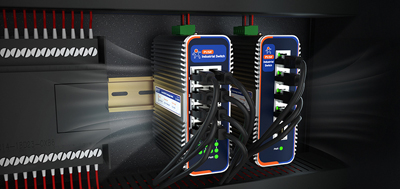
Take the USR-G806w as an example. The design logic of this class of cellular router is fundamentally different from consumer products — fanless passive cooling, -40°C to 70°C wide-range operation, metal chassis for EMI shielding, and a power input range wide enough to connect directly to station DC panels. More critically, it has a built-in intelligent traffic scheduling engine — no extra controller or software license needed. Out of the box, it works.
For power companies, the deployment logic is straightforward: one unit per substation or switching station, uplink via multi-WAN aggregation to the prefecture or provincial SD-WAN gateway, with policies configured and pushed centrally from the gateway. The site-side router handles execution — identifying traffic, tagging it, scheduling forwarding.
The entire retrofit touches nothing in the SCADA system, changes nothing in IEC 61850, and affects no existing protection or automation configuration. It's like installing a smart valve on your data pipeline — letting what needs to be fast go fast, what can be slow go slow, and what must stop, stop.
Power IoT data volume is growing at over 40% per year.
New energy integration brings more monitoring points — distributed PV, energy storage, EV chargers — each generating data. Distribution automation coverage is expanding: fault indicators, smart fuses, ring main unit online monitoring routinely double the data load. AI inspection is going from pilot to standard, and video streams are shifting from optional to mandatory.
Your bandwidth being enough today doesn't mean it'll be enough next year. Your router holding up today doesn't mean it will the year after.
But if you deploy a cellular router with intelligent scheduling at the edge now, you're essentially buying an "elastic ticket" for the future. Data volume doubles? The scheduling engine auto-reallocates. New video streams added? Priority policies auto-adapt.
The future of power IoT isn't about who has the fatter pipe. It's about who has the smarter scheduling.
Those 3 AM alert texts, those moments when dispatchers stare at grayed-out data, those rushed trips to site because "the data didn't arrive" — they shouldn't be the daily reality of power O&M.
A good traffic scheduling solution can't guarantee the grid never faults. But it can guarantee that when a fault happens, your data is there.
Data there means judgment is there. Judgment there means safety is there.