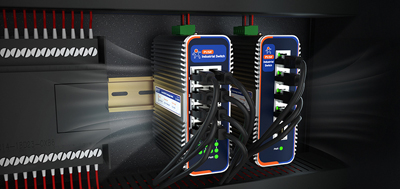
Cellular WiFi Router Selection Pitfall Guide: 5 Most Common Mistakes Auto Parts Factories Make — #3 Burns the Most Money
Open Taobao. Search "cellular wifi router." Sort by sales. Pick one with lots of reviews. Check the price. Looks about right. Place the order.
Then three months later, you're standing in the CNC workshop, watching another router smoking, thinking: "Industrial grade, my ass."
If you've been through this, you're not alone.
I've worked with network procurement at over a hundred auto parts factories, and I found a shocking pattern: 80% of router selection mistakes aren't because the products are bad — it's because the procurement logic was wrong from step one.
This article won't talk specs, won't talk protocols, won't talk architecture.
Just five mistakes you've definitely made — or are making right now.
Especially the third one — it's not the most common, but it's the most expensive. The kind that makes you question life.
This is the most basic — and most fatal — mistake.
How do you pick a home router? Count the antennas. Check wall-penetration. Check WiFi speed. Check if anyone in the reviews says "gaming doesn't lag."
How do you pick a cellular wifi router?
None of that matters. Not even a little.
An auto parts factory's CNC workshop doesn't need WiFi to penetrate walls. It needs: continuous 365-day operation without crashing in 50°C heat, 85% humidity, cutting fluid mist, metal shavings, and machine vibration.
The "cellular wifi router" you picked using home logic is probably a plastic shell stuffed with a home motherboard, slapped with an "industrial grade" label, price doubled.
Result? Dead in three months.
The #1 iron rule for picking a cellular wifi router: check the housing material first, everything else second.
Plastic housing? No matter how "industrial grade" it claims to be — pass immediately.
Metal housing (sheet metal / aluminum alloy)? Only then does it qualify for the next round.
Why? Because the housing isn't "for looks." The core functions of a metal housing are: heat dissipation + EMI shielding + grounding for ESD protection.
These three things, in an auto parts workshop, are the router's life.
This one has trapped countless people.
The product page says: "Supports 4G all networks." You see it, think great, it'll work. Order it.
Get it on-site and realize: the 4G signal in your factory can't even support this router.
Why?
What's the structure of an auto parts workshop? Steel-frame building, dense metal equipment, thick walls. These things are devastating to 4G signal.
A carrier's field test data: inside a steel-frame workshop, 4G signal attenuates 15–25 dB compared to outdoors. What does that mean? Full bars outside, maybe one bar inside the workshop.
What can a one-bar 4G router do? It can get online. It can transmit data. But can it transmit datastably?
No.
When signal is weak, the router constantly searches for base stations, constantly switches, constantly reconnects. Every reconnection is a disconnection. Every disconnection, your production line goes "blind" for a second.
One second isn't much? Your CNC program download interrupts for one second, and you might have to restart. Your quality data upload interrupts for one second, and you might have to re-collect.
You think you bought a 4G router. Actually you bought a "on-again-off-again" router.
So what's the right thing to do?
Pick a cellular wifi router that supports multi-network backup. 4G + wired dual-network simultaneous online — when primary 4G drops, auto-switch to wired within 2 seconds.
That way, even if your factory's 4G signal is terrible, your production line won't go down.
Here it is. The most expensive one.
When you were picking, did you think like this:
"This router is 800 yuan, that one is 1,500 yuan. That's 700 yuan difference. The 800 one should be enough, right?"
Enough.
Then three months later, it died.
Have you calculated the cost of "dying once"?
Let's do the real math, using a medium auto parts factory's CNC workshop as an example:
| Cost Item | Amount | Explanation |
|---|---|---|
| Router itself | 800 RMB | The 700 yuan you "saved" |
| On-site O&M labor | 500 RMB/time | Send someone to troubleshoot and replace |
| Downtime loss (materials + labor) | ~12,000 RMB/time | Based on 2 hours shutdown |
| Delivery delay penalty | ~5,000–20,000 RMB/time | Depends on the customer |
| Total cost of 3 deaths per year | ~53,900 RMB | Not counting hidden loss from customer churn |
53,900 yuan. That's the real price of an 800-yuan router "dying three times."
And a 1,500-yuan cellular wifi router (like USR IoT's USR-G806w), in the same CNC workshop environment, tested stable for over 14 months, zero faults.
1,500 yuan vs. 800 yuan. 700 yuan difference.
But that 700-yuan difference bought you 53,900 yuan in annual losses.
You saved 700, lost 53,000. That's not saving money. That's burning money.
And that's just one router. How many do you have? 5? 10?
Each one "dies three times," and the money you burn in a year could buy you a car.
When picking a cellular wifi router, never just look at the purchase price. Look at "cost per failure × failures per year."
Purchase price is one-time. Failure cost is ongoing, cumulative, and snowballing.
That 800-yuan router isn't cheap. It's expensive. Expensive enough that you can't afford it.
This mistake doesn't burn money. But it burns people.
Have you ever been through this scenario:
Router has a problem. You don't know what it is. You have to send someone on-site.
Where's the site? Deep inside the factory. 15-minute walk. Get there, router is out of power. Plug it in, it's fine.
Half an hour round trip. Just to plug in a power cord.
Or worse: router crashed. Send someone on-site, reboot it, it's fine. Next day, crashed again. Send someone again, reboot again.
Four site visits a month, half an hour each. That's 24 hours a year. How much of your O&M staff's time is spent on "plugging in" and "rebooting"?
An auto parts factory's O&M supervisor calculated this for me: his team of 3 O&M guys, each spends at least 8 hours a month on "router-related" on-site troubleshooting. That's 288 man-hours a year. At 50 RMB/hour per person, that's 14,400 RMB a year just in router O&M labor.
14,400 yuan. Just to maintain a few routers.
What if those routers supported remote management?
Device status, network quality, data usage, fault alerts — all visible on your phone. When something goes wrong, remote reboot, remote parameter change, remote firmware upgrade. No site visit needed.
288 man-hours, reduced to zero.
Take the USR-G806w. It supports USR Cloud remote management. A logistics company with 30 warehouses nationwide said after using it: "The remote management feature is incredibly practical. Unified control of all routers nationwide, labor costs cut in half."
When you buy a router, spend two extra minutes checking if it supports remote management. Those two minutes could save you 14,000 yuan a year.
The last mistake, and the most hidden one.
Most people's router selection standard is: "As long as it connects, it's fine."
Connects? Fine. Transmits data? Fine. Runs? Fine.
But "runs" and "runs forever" are two different things.
What's the design life of an ordinary router? 1 to 2 years. In harsh environments, 3 to 6 months.
What's the design life of a cellular wifi router? 5 to 10 years. In harsh environments, 3 to 5 years.
You buy an ordinary router, 800 yuan, it lasts 6 months, dies. Buy another, 800 yuan, lasts 6 months, dies again. Two replacements a year, 1,600 yuan.
You buy a cellular wifi router, 1,500 yuan, lasts 5 years, doesn't die.
5-year total cost: 1,500 yuan vs. 8,000 yuan.
Did you save? No. You spent 6,500 yuan more.
But what matters more isn't the money. It's stability.
Every time you replace an ordinary router, you have to reconfigure, re-debug, re-adapt. Every replacement is a potential disconnection risk.
A cellular wifi router — buy once, configure once, then forget about it. It just sits there, running silently, no worries.
In an auto parts factory, what are those four words — "no worries" — worth?
They're worth all the O&M labor you save, all the downtime losses, all the delivery delay penalties.
They're worth a good night's sleep.
| Mistake | Your Thinking | Real Cost | Correct Approach |
|---|---|---|---|
| ① Pick by home logic | "More antennas = better" | Dies in 3 months | Check housing material first — plastic = pass |
| ② Only check "supports 4G" | "Connects to 4G = fine" | On-again-off-again, line keeps going blind | Pick multi-network backup — 4G + wired dual insurance |
| ③ Only check purchase price | "It's 700 yuan cheaper" | Burns 50,000+ a year | Calculate "cost per failure × failures per year" |
| ④ Ignore remote management | "Works = fine" | Wastes 14,000 yuan/year in labor | Pick one with cloud platform remote management |
| ⑤ Only check if it works | "Runs = fine" | Spends 6,500 yuan more over 5 years | Pick design life of 5+ years |
Auto parts factory owners already have enough to worry about every day.
Orders, delivery dates, quality, customers, workers, equipment… which one isn't a sword hanging over your head?
You don't need to worry about a router too.
What you need is: buy once, configure once, then forget about it. It sits there, running steadily — no crashes, no disconnections, no need for you to manage it.
That's what a cellular wifi router should be.
Not the most expensive. Not the best specs. The one that gives you the most peace of mind.
One USR-G806w, 1,500 yuan. Sheet-metal housing handles 50°C heat. Hardware watchdog revives itself when it crashes. 4G + wired dual-network never disconnects. USR Cloud remote management means no site visits.
What you save isn't just money. It's your already-scarce energy.
And energy is the most expensive thing an auto parts factory owner has.