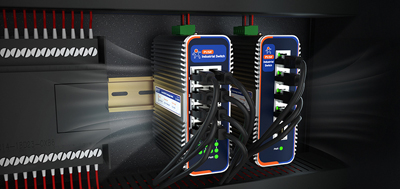
Chemical Park Safety Monitoring: An Industrial Switch's ATEX Certification in Practice
Lao Zhou remembered it clearly.
It was a November morning last year. His phone rang while he was dozing in the duty room. The screen showed the park's Safety and Environment Department.
"Engineer Zhou, the gas alarm data for Tank Area No. 3 just dropped out. The monitoring screen is blank. The on-site inspector hasn't responded yet. Can you see anything from your end?"
Lao Zhou sat bolt upright, opened his laptop, and pulled up the monitoring system—all eight sensor nodes in Tank Area No. 3 showed "offline."
The sensors weren't broken. The industrial switch was down.
Tank Area No. 3 used a standard commercial industrial switch. It had been intermittently dropping packets since last summer. Nobody cared at the time—chemical park, equipment toughs it out.
But not that night. At 2:58 a.m., methyl mercaptan concentration in Tank Area No. 3 began creeping up slowly—from 0.3 ppm toward 0.8 ppm. The sensors were still collecting data. But the industrial switch couldn't handle the overnight temperature swing—the server room AC failed, temperature spiked to 47°C. The industrial switch overheated and crashed. All eight sensors' data froze locally.
By the time the monitoring system came back, concentration had reached 1.2 ppm.
0.3 ppm from the alarm threshold.
Lao Zhou later checked the logs. From the industrial switch overheating to full crash: eleven minutes of complete data vacuum. Eleven minutes in a chemical park—enough for a disaster.
The Safety Department issued a notice the next day, worded harshly: "Critical safety monitoring nodes have data transmission blind spots. Monitoring link reliability does not meet explosion-proof area safety requirements. Rectify within the deadline."
Deadline: one month.
Lao Zhou took the notice to procurement. Procurement took it to the supplier. The supplier said:
"Engineer Zhou, your location needs ATEX-certified equipment. A regular industrial switch can't enter an explosion-proof zone. We can't help with that."
Anyone in chemicals knows: building a network in a chemical park is a pitfall.
Not a technical pitfall—a cognitive one.
Most chemical park networks were built ten years ago. The logic was simple: offices get regular industrial switches, workshops get a few network cables, explosion-proof zones get an isolation barrier. Done.
But think about it—there's a fatal flaw in this architecture:
You put the most dangerous place in the hands of the least reliable equipment.
What's an explosion-proof zone? A place where flammable gases, dust, and vapors can coexist. In this zone, any spark can be an ignition source. The ATEX Directive (2014/34/EU) requires all electrical equipment entering explosion-proof zones to pass explosion-proof certification—proving it won't become an ignition source.
But your industrial switch?
That Cisco or Huawei in your office—no matter how powerful—has no ATEX certification. Its casing is plastic. Its PCB has electrolytic capacitors. Its power module heats up under overload. Fine in an office. In an explosion-proof zone? A time bomb.
Worse: many chemical parks do this—place a regular industrial switch outside the explosion-proof zone, run one network cable through the barrier, connect to sensors inside.
That one cable is the "fuse."
If the regular industrial switch fails on the non-explosion-proof side—overheats, shorts, power surge—the fault energy travels along that cable into the explosion-proof zone. ATEX certification tests exactly this: can your equipment guarantee it won't ignite the surrounding environment under worst-case conditions?
A non-ATEX-certified industrial switch—would you put it at the door of an explosion-proof zone?
You wouldn't. But your park is probably full of them.
Most people hear ATEX and think: expensive. Then: complicated. Then: our park isn't a refinery—do we really need it?
Lao Zhou used to think the same.
After that 3 a.m. call, he spent two weeks studying ATEX and realized he'd been completely wrong.
ATEX isn't a "nice-to-have" certification. Every requirement it tests maps to a real risk in a chemical park.
First: it certifies your equipment won't become an ignition source.
A core ATEX test is "surface temperature." The device runs at maximum load continuously—its casing surface temperature must not exceed the auto-ignition temperature of the gas present. Methane auto-ignites at 537°C, hydrogen at 500°C, but carbon disulfide at only 100°C. If your equipment's surface exceeds 100°C in a carbon disulfide vapor environment, it's an ignition source.
A regular industrial switch's chip surface temperature easily exceeds 85°C under full load. Add ambient heat—in a summer chemical park, casing temperature over 100°C is routine.
Second: it certifies your equipment won't propagate ignition.
Even if an internal fault occurs—capacitor bursts, PCB burns—ATEX requires the fault not to spread outside the device. This is the meaning of "flameproof" (Ex d) design—the casing is thick and strong enough that an internal explosion can't breach it and ignite external gas.
A regular industrial switch's plastic casing—try a lighter on it and see.
Third: it certifies your equipment can operate continuously in harsh environments.
How harsh is a chemical park? Temperatures from -20°C to 60°C are normal. Humidity above 95% isn't unusual. Corrosive gases—H₂S, Cl₂, SO₂—drift through daily. Equipment must run 24/7 without crashing, rebooting, or losing data.
A regular industrial switch is designed for 3–5 years of life, 0–45°C operating range. Drop it into a chemical park—six months if you're lucky.
Fourth—and most overlooked—it certifies your data link is complete.
Many people don't know this. ATEX doesn't just certify the device—it requires that installation and cabling within the explosion-proof zone meet standards, ensuring the entire data transmission link is safe and intact.
Translation: not just your industrial switch must be explosion-proof—your link must be too.
That was Lao Zhou's problem. His sensors were explosion-proof. His transmitters were explosion-proof. But the industrial switch in between wasn't. The whole chain—the shortest plank in the barrel—was that regular industrial switch.
After getting the notice, Lao Zhou's first move wasn't calling suppliers—it was pulling every network device inventory in the park.
He didn't know what he'd find. What he found scared him.
The park had 47 monitoring nodes total. Nineteen involved explosion-proof zones. Of those nineteen: fourteen used regular commercial industrial switches, three used so-called "industrial-grade" switches without ATEX certification, and only two used proper ATEX-certified equipment—installed five years ago, long past maintenance.
In other words: 87% of explosion-proof zone monitoring nodes had non-compliant network equipment.
Lao Zhou reported the number to the park management committee. They were silent for ten seconds, then said one word: "Replace."
Budget came through—but not much. Chemical park margins are thin; safety spending gets cut every year. Lao Zhou started selecting equipment with limited funds.
The selection process was far more complex than he imagined.
First: ATEX-certified equipment is expensive. One ATEX industrial switch costs three to five times a regular one. Replace all nineteen nodes—budget blown.
Second: the park's network topology isn't star-shaped—it's a chain-plus-ring hybrid. Some nodes sit on pipe racks, 800 meters from the nearest cabinet. Some sit next to reactors—heavy vibration, strong EMI. You can't just buy any ATEX industrial switch—you need to check ports, protocols, mounting methods, protection ratings.
Lao Zhou eventually found a device that barely fit the budget—the USR-ISG series industrial switch.
Why this one? Lao Zhou later gave me three reasons. I thought they were spot-on.
First: it actually passed ATEX certification. Not a label slapped on saying "suitable for explosion-proof zones"—it earned proper ATEX Zone 2 certification, with a certificate number verifiable in the EU ATEX database. Lao Zhou checked. It was real.
Second: its port configuration was just right. Chemical park monitoring nodes typically need 4–8 sensor connections—Modbus RTU or 4–20mA—plus one uplink port via fiber to the control room. The USR-ISG's port combination covered exactly that. No extra modules needed. Saved money.
Third—and most critical—it could survive a chemical park. Metal casing, fanless design, -40 to 75°C operating range, IP40 protection, DIN rail mounting. Lao Zhou took a sample unit, hung it on-site at Tank Area No. 3 for two weeks. No crashes. No packet loss. Maximum casing temperature: 62°C—well below carbon disulfide's auto-ignition point.
"That's the one," Lao Zhou said.
The rectification took 23 days—one week ahead of deadline.
All nineteen nodes replaced. On the control room's monitoring screen, the eight sensors in Tank Area No. 3 came back online.
But what truly put Lao Zhou at ease wasn't the data coming back. It was an accident one month later.
That afternoon, a level sensor in Tank Area No. 2 suddenly output erratic data—jumping from 1.2m to 0.3m and back, over a dozen times.
In the old days, this would've been logged as a sensor fault, discovered only when an inspector arrived on-site. But this time—the USR-ISG industrial switch had edge diagnostics. It detected the abnormal port data pattern, auto-generated an alarm log, and sent it to the control room via SNMP trap.
The control room operator saw the alert and reached the site 40 minutes before the inspector.
What they found: the sensor wasn't broken. The inlet valve at the bottom of the tank area was leaking internally—the level was fluctuating.
Forty minutes in a chemical park can be the difference between a leak incident and a normal response.
Lao Zhou later wrote in the park's monthly safety report: "The biggest gain from this rectification isn't passing ATEX certification. It's that for the first time, we have a truly reliable data link inside an explosion-proof zone."
I'm not writing this to push the USR-ISG.
I'm writing this because Lao Zhou's story happens every day in chemical parks across China.
Go look at your park. Look at the industrial switch at the entrance to your explosion-proof zone. Is its casing plastic or metal? Does it have an ATEX nameplate? What's its operating temperature range? When was it last rebooted?
You might discover that the millions you spent on DCS, SIS, and GDS systems—the last mile of the data link runs on a device with zero explosion-proof certification.
This isn't a technical problem. It's a cognitive problem.
The essence of chemical safety isn't how many systems you have. It's whether every data point can be trusted.
A sensor's data—from collection to transmission to storage to display—every device, every cable, every interface it passes through must be trustworthy. If any link is untrustworthy, the whole chain is untrustworthy.
ATEX certification stamps that chain: this segment, I guarantee.
You don't need to replace everything overnight. Start with the most dangerous node. The tank area you worry about most. The point where data dropped last time.
One device. One node. One link.
Fix the shortest plank first.
Lao Zhou spent under 200,000 RMB on nineteen nodes. About 10,000 RMB per node on average.
Ten thousand RMB per node—for a complete, trustworthy, ATEX-certified data link.
Do the math: if Tank Area No. 3 had actually had an incident that night, what would that cost?
Lao Zhou still does duty at that park.
He told me that since replacing the equipment, he hasn't received a single 3 a.m. alarm call.
Not because the park got safer. Because he finally sleeps through the night.
Chemical park safety sometimes doesn't come from more regulations, more inspections, more training. It comes from that one industrial switch you finally chose right.
Your explosion-proof zone deserves a truly explosion-proof device.
Not because regulations demand it. Because that data really does save lives.