-25℃, 180 Days, Zero Failures — A "Life-or-Death Breakthrough" in Cold Chain Monitoring
1. Have you ever experienced that kind of despair?
It's not an alarm. It's an alert.
You jolt out of bed, heart already racing at 120 BPM — the temperature monitoring on the cold chain transport truck has gone dark. You don't know how long it's been down. You don't know what state that 800,000 yuan batch of vaccines is in right now. All you know is: if the temperature went out of control for more than 30 minutes, the entire shipment — scrap.
Then you start making calls. The driver says, "The equipment froze and the screen went black." The tech guy says, "A regular switch can't handle this temperature." The boss says, "This is the third time this year."
You stand there in the 3 AM cold, phone clenched in your hand, and suddenly you feel — this industry isn't a business. It's a gamble.
I know what you're thinking.
You're thinking: I spent a fortune on a temperature control system, bought the most expensive sensors, hired the most professional quality inspectors. Why did it all come down to one "little box"?
You're thinking: Is my luck just that bad?
No. It's not bad luck. You used the wrong equipment.
Let me rip open a truth the industry has been quietly ignoring.
Many cold chain companies, when building their monitoring networks, cut corners and saved money by using commercial switches. The reasoning seems solid — "It's just passing data around. How different can it be?"
Very different. Different enough to cost you 5 million yuan a year.
Commercial switches are designed for 0℃~40℃. Sounds adequate? But your cold chain warehouse is minus 25℃. Your refrigerated truck, after 8 hours on the highway, sees a temperature swing of over 60℃ between inside and outside. Condensation freezes into thin ice inside the equipment. The plastic housing of commercial devices becomes brittle in the cold. Fans freeze and stop spinning. Solder joints on circuit boards crack from thermal expansion and contraction.
A cold chain veteran with 20 years of experience once said something I still remember: "In pharmaceutical cold chain logistics, equipment failure can mean an entire shipment is scrapped. What we need is dedicated equipment as precise and reliable as a Swiss watch."
But what's the reality?
The reality is, 80% of cold chain companies are still "gambling" with commercial equipment. Gambling it won't fail on the coldest night. Gambling it won't crash at the moment of a sudden temperature shift.
And then?
Cargo loss rates hit 3%. Customer complaints stay stubbornly high. Verifying a single shipment takes half a day — because the equipment froze, data won't transmit, and you have to wait for it to "warm up" before you can keep working.
You didn't lose to your competitors. You lost to your own network equipment.
Last winter, a pharmaceutical cold chain company in North China made a "crazy" decision — they replaced every commercial switch in their entire monitoring network with industrial-grade equipment.
The reason was simple: for three consecutive months, network equipment failures in low temperatures created "blind spots" in the temperature data for three batches of high-value pharmaceuticals. Although the cargo wasn't ultimately scrapped, customers were already wavering. Two major clients explicitly stated: "One more incident, and we switch suppliers."
They picked an industrial switch, threw it into a minus 25℃ cold storage room, mounted it on long-haul refrigerated trucks, and placed it at open-air transfer stations.
Then they waited.
30 days — no failure. 60 days — no failure. 90 days — no failure. 180 days — still, zero failures.
What did this equipment endure over those 180 days?
It withstood all of it.
The data after 180 days silenced everyone:
| Metric | Before Replacement | After Replacement |
|---|---|---|
| Cargo Loss Rate | 3% | 0.5% |
| Customer Complaint Rate | Persistently High | Down 85% |
| Verification Time | Avg. 4 hours | Reduced by 70% |
| Network Failures | Avg. 5/month | Zero in 180 days |
| Annual Quality Cost Savings | — | ~5 million yuan |
That cold chain expert later said: "Quality is the lifeline of cold chain logistics. Intelligent monitoring equipment shifts quality management from reactive fixes to proactive prevention."
That sentence is worth 5 million yuan.
I've met too many cold chain executives. What torments them most isn't the breakdown itself — it's not knowing when it will happen.
Commercial equipment is like a time bomb. You don't know at which temperature, which vibration, which power surge it will suddenly die. You can only pray — pray that today isn't the day.
That "uncertainty" is the real cost.
Because you won't take on big orders. Because you won't commit to delivery timelines. Because you won't tell your clients "Our monitoring is 100% reliable."
An industrial-grade switch doesn't just solve the "can it work?" problem. It solves the "can you trust it?" problem.
Let me tell you exactly why a true industrial switch dares to sit in a -25℃ environment for 180 days without flinching:
First, it fears neither cold nor heat.
Operating temperature range: -40℃~85℃, a 125℃ span. This isn't a lab spec — it's proven capability validated through thousands of thermal cycle tests. Special PCB materials and soldering processes prevent low-temperature brittleness; optimized heat dissipation ensures components don't derate at high temperatures. In a -25℃ cold storage room, it performs identically to how it does in a 25℃ office.
Second, it has no fan.
You read that right — no fan.
The fan is the most failure-prone component in any electronic device. In the cold, lubricant solidifies. In dusty environments, blades get clogged. An industrial switch uses a fanless design, relying on aluminum heat sink fins for natural convection cooling. No moving parts means no mechanical failure.
Third, it can "self-heal."
It supports the ERPS ring protocol. When a link fails due to cold, vibration, or accidental disconnection, the network automatically switches to a backup path in 20~50 milliseconds. You won't even notice the fault occurred. Dual power redundancy: if the main power drops, the backup takes over seamlessly in under 10 milliseconds — no reboot.
Fourth, it can take a beating.
6,000V industrial lightning protection, Level 4 EMC certification, IP40 rating. Lightning? Handled. EMI? Handled. Condensation? Anti-condensation design eliminates it at the source. Vibration? M12 threaded locking connectors — three times sturdier than standard RJ45.
This isn't a switch. This is insurance for your cold chain network.
I know what you're hesitating about.
You're thinking: "Isn't an industrial switch too expensive?" "Our current gear hasn't caused any major problems yet." "What if we switch and it still fails?"
I get it. Every yuan must be spent wisely — that's the instinct of running a business.
But have you run the numbers?
One cold chain break causing a scrapped shipment — what's the loss? 100K? 500K? Or, like that pharmaceutical company, 800K in vaccines, gone in an instant?
One customer complaint causing a lost order — what's the cost? Retaining an existing customer costs one-fifth of acquiring a new one. Losing a major client could take three years to recover from.
The money you saved on that switch might not even cover a fraction of one incident.
Studies show: after smart upgrades, cold chain companies reduce product loss from the industry average of 3% to 0.5%, cut complaints by 85%, and significantly boost brand reputation. One pharmaceutical cold chain firm achieved zero incidents across 2,000 shipments, saved ~5 million yuan annually in quality costs, earned international quality certification, and reached 99.5% customer satisfaction.
These numbers aren't made up. They're lessons bought with 3 AM alarm calls.
Being in the cold chain business is exhausting enough already.
You monitor temperature, humidity, delivery schedules, customer moods. You've controlled every variable you can — except that "invisible killer" called network equipment, which has been planting landmines where you can't see.
Now it's time to defuse that bomb.
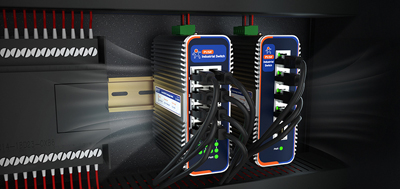
If you're looking for an industrial switch that's rock-solid in extreme environments, there are plenty of options out there. The USR-ISG series from USR IOT, for example, is purpose-built for exactly this kind of scenario — -40℃~85℃ wide temp, fanless, IP40, PoE, ring redundancy. It's got everything you need. It's not the most expensive, but in its price range, it might be the toughest.
But more important than any product is your resolve.
Are you willing, starting today, to stop gambling?
180 days. Zero failures. That's not a miracle. That's what industrial-grade equipment is supposed to do.
And your cold chain business deserves that kind of stability.
You shouldn't be getting that 3 AM alert call anymore.