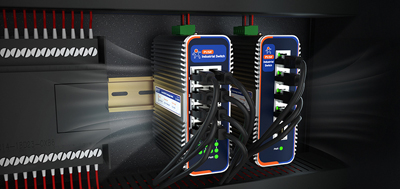
Comparison between DIN Rail-Mounted and Rack-Mounted Serial to Ethernet Adapters: Which Saves More Space?
In the rapid development of the Industrial Internet of Things (IIoT), the serial to Ethernet adapter, as a core hub connecting traditional serial devices with modern Ethernet networks, has its installation method directly influencing space utilization, operational efficiency, and project costs. DIN rail-mounted and rack-mounted, as two mainstream installation forms, respectively feature "compactness and flexibility" and "high-density integration" as their core advantages, catering to deployment needs in different scales and scenarios. This article will conduct an in-depth comparison from dimensions such as space occupation, scalability, and functional suitability, and provide professional selection advice to assist enterprises in making precise decisions.
Space Occupation: DIN Rail-Mounted "Small and Beautiful" vs. Rack-Mounted "Intensive Integration"
1.1 DIN Rail-Mounted: Designed for Confined Spaces
The DIN rail-mounted serial to Ethernet adapter is centered around the design concept of standardized DIN rail installation. Its shape is mostly narrow and elongated, with a height typically controlled between 50-150mm and a depth of less than 100mm. It can be directly embedded inside distribution boxes and control cabinets, sharing rails with electrical components such as circuit breakers and relays without requiring additional independent space. For example, in a household distribution box, a DIN rail-mounted serial to Ethernet adapter can be linked with lighting circuits and socket circuits to enable remote switching and timed power-off through a central control system, saving space while enhancing electrical safety.
Typical Application Scenarios:
Smart Homes: Connect sensors, thermostats, and other devices to cloud platforms for whole-house smart control.
Small Offices: Centrally manage serial devices such as printers and attendance machines in limited space.
Industrial Sites: Deploy in narrow equipment control cabinets to reduce wiring complexity.
1.2 Rack-Mounted: Space Manager for High-Density Integration
The rack-mounted serial to Ethernet adapter adopts standard 19-inch cabinet installation and measures height in "U" units (1U = 4.445cm). A single device can integrate 4-16 serial ports and achieve higher-density deployment through stacking. For example, the USR-N668 eight-port serial to Ethernet adapter features a 1U design, supporting eight RS232/485/422 interfaces simultaneously. Paired with a 42U cabinet, it can accommodate dozens of devices, significantly improving space utilization. In data center scenarios, the rack-mounted solution can centrally manage power supply and communication for hundreds of servers, reducing the floor area of the machine room.
Typical Application Scenarios:
Data Centers: Centrally manage serial communication for servers, switches, and other devices.
Large Conference Rooms: Link multiple devices such as projectors, audio systems, and lighting for one-touch control.
Industrial Automation: Deploy on production lines for centralized monitoring of equipment clusters.
1.3 Conclusion on Space Comparison
DIN Rail-Mounted: Suitable for scenarios with ≤8 serial devices and limited space (e.g., homes, small control cabinets), where its "embedded" design avoids space wastage.
Rack-Mounted: Suitable for scenarios with ≥10 serial devices and standard cabinets (e.g., data centers, large conference rooms), where its "high-density integration" advantage is significant.
Scalability: DIN Rail-Mounted "Basic Adaptation" vs. Rack-Mounted "Modular Upgrade"
2.1 DIN Rail-Mounted: Centered on Basic Functions
The DIN rail-mounted serial to Ethernet adapter, limited by its size, typically focuses on "single/multi-port independent control," supporting basic functions such as current overload protection and short-circuit protection. Some high-end products can integrate power metering modules. However, its scalability is limited. For example, although the USR-DR302 DIN rail-mounted serial to Ethernet adapter supports Modbus gateway and HTTP data submission, it cannot increase interface types or communication protocols through modular design.
Applicable Scenarios: Scenarios with low scalability requirements and primarily focused on "basic power supply control," such as environmental temperature and humidity collection and small device networking.
2.2 Rack-Mounted: Flexible Expansion through Modular Design
The rack-mounted serial to Ethernet adapter supports modular design, allowing users to flexibly add or remove power supply modules, metering modules, communication modules, etc., based on needs. For example, the USR-N668 eight-port serial to Ethernet adapter supports independent configuration of RS232/485/422 interfaces for each serial port and can expand to more interfaces through external expansion cabinets. Additionally, it supports dual-socket design, enabling data to be sent simultaneously to two different servers to meet complex business needs.
Applicable Scenarios: Scenarios requiring advanced functions such as redundant power supply, power metering, and multi-protocol compatibility, such as industrial automation and power monitoring.
2.3 Conclusion on Scalability Comparison
DIN Rail-Mounted: Cost-effective, suitable for projects with limited budgets and simple requirements.
Rack-Mounted: Highly scalable, suitable for medium to large projects with clear requirements for functional complexity and future upgrades.
Functional Suitability: DIN Rail-Mounted "Lightweight" vs. Rack-Mounted "Intelligent"
3.1 DIN Rail-Mounted: A Model of Lightweight Deployment
The DIN rail-mounted serial to Ethernet adapter features "plug-and-play" as its core advantage, supporting rapid parameter configuration via web pages or mobile apps to lower deployment thresholds. For example, the USR-DR302 DIN rail-mounted serial to Ethernet adapter, equipped with a built-in TCP/IP protocol stack, can quickly convert serial data into network data, suitable for scenarios such as power data networking and unmanned weighing. Its V0-grade flame-retardant material and lightweight design further enhance safety and portability.
Core Functions:
Supports Modbus RTU/TCP protocol conversion.
Supports HTTPD data submission and custom heartbeat packets.
Supports DHCP/static IP address acquisition.
3.2 Rack-Mounted: A Benchmark for Intelligent Management
The rack-mounted serial to Ethernet adapter places greater emphasis on "stability" and "intelligence." For example, the USR-N668 supports SSL encrypted transmission, remote monitoring, and firmware upgrades, and is equipped with an RTC real-time clock to ensure accurate time. Its "timeout restart" and "timeout reconnection" functions can automatically recover communication failures, reducing manual intervention. In industrial scenarios, rack-mounted products can preset power supply sequences based on production plans to achieve automated equipment startup and shutdown.
Core Functions:
Supports SSL/TLS encrypted transmission to ensure data security.
Supports DNS domain name resolution and Oray DDNS functionality.
Supports ModbusTCP to ModbusRTU conversion, compatible with multiple device types.
3.3 Conclusion on Functional Suitability Comparison
DIN Rail-Mounted: Suitable for scenarios with low real-time requirements and a need for rapid deployment.
Rack-Mounted: Suitable for scenarios with stringent stability and security requirements, such as finance, transportation, and energy.
USR-N510 - The "Intermediate Solution" between DIN Rail-Mounted and Rack-Mounted
For projects that require both space savings and certain scalability, the USR-N510 series serial to Ethernet adapter offers a flexible choice. It supports DIN rail-mounted installation, is compact in size, and possesses the following features:
Dual Serial Ports: Supports RS485 half-duplex transmission with a baud rate range of 1200bps-921.6Kbps.
Multiple Operating Modes: Supports TCP Server/Client, UDP Client/Server, HTTP Client, and other modes.
Intelligent Management: Built-in web configuration interface and virtual serial port software, supporting firmware upgrades over the network.
High Reliability: Custom heartbeat packet mechanism eliminates dead connections and adapts to industrial-grade environments.
Application Case: In a smart factory project, the USR-N510 was used to connect PLCs on the production line with the central control system, saving space in control cabinets through DIN rail-mounted installation while utilizing its dual serial ports for real-time data collection and remote monitoring of equipment.
Selection Decision Tree: Three Steps to Identify the Optimal Solution
5.1 Step 1: Clarify Device Quantity and Space Conditions
≤8 Devices and Limited Space: Prioritize DIN rail-mounted products (e.g., USR-DR302), whose compact design avoids space wastage.
≥10 Devices and Cabinet Available: Choose rack-mounted products (e.g., USR-N668), where the high-density integration advantage is more prominent.
5.2 Step 2: Evaluate Functional Requirements and Scalability
Basic Power Supply Control Only: DIN rail-mounted products offer higher cost-effectiveness.
Need for Redundant Power Supply, Power Metering, or Modular Expansion: Rack-mounted products better meet requirements.
5.3 Step 3: Consider Communication Protocols and Safety Standards
Ensure the product supports the communication protocols of the central control system (e.g., TCP/IP, Modbus, etc.).
Pay attention to certification qualifications (e.g., CE, UL, 3C, etc.) to ensure compliance with electrical safety standards.
Contact Us for a Customized Selection Plan
Whether it's the "flexible and compact" DIN rail-mounted or the "efficient and stable" rack-mounted, choosing the most suitable solution maximizes return on investment. We offer the following services to assist you in making precise decisions:
Free Needs Assessment: Submit information on device quantity, space conditions, and functional requirements to receive expert 1-on-1 analysis.
Customized Solutions: Provide a complete deployment plan including serial to Ethernet adapter selection, protocol integration, and edge computing rule design.
Product Trials: Apply for serial to Ethernet adapter samples to personally experience their performance and ease of use.
Case Visits: Schedule visits to benchmark projects such as smart factories and data centers to understand product application effects on-site.
In the wave of the Industrial Internet of Things, selecting the right serial to Ethernet adapter is the first step towards intelligence. DIN rail-mounted and rack-mounted are not "replacement relationships" but complementary choices. Submit your inquiry to receive your customized selection plan and embark on a new chapter in device networking!