December 23, 2025
Comparison of Full-Gigabit and 10-Gigabit Industrial Switches
Comparison of Full-Gigabit and 10-Gigabit Industrial Switche: How to Select Bandwidth Based on Actual Needs? Unlock a New Path for Enterprise Network Upgrades
In today's era where Industry 4.0 is sweeping across the globe, industrial networks have become the "nerve center" of intelligent manufacturing. From PLC control on production lines to AGV scheduling in workshops, from intelligent sorting in warehousing and logistics to real-time monitoring in remote operation and maintenance, every link relies on stable and efficient network support. However, when enterprises face network upgrades, a core question has always perplexed decision-makers: How should one choose between full-gigabit industrial switche and 10-gigabit industrial switches? This article will conduct an in-depth analysis from three dimensions: technical characteristics, application scenarios, and cost-effectiveness, and provide actionable bandwidth upgrade suggestions to help enterprises precisely match their needs and avoid the double traps of "bandwidth waste" or "performance bottlenecks."
1. Comparison of Technical Characteristics: The "Hard Power" Differences Between Gigabit and 10-Gigabit
1.1 Transmission Rate: A Leap from "Adequate" to "Ahead of the Curve"
Full-gigabit switches: Support 10/100/1000 Mbps adaptive port rates, with a maximum transmission rate of 1000 Mbps (approximately 125 MB/s) per port. Taking the USR-ISG1005 as an example, its five gigabit electrical ports can meet the basic data transmission needs of small and medium-sized workshops, such as PLC control commands and sensor data collection.
10-gigabit switches: Support a port rate of 10 Gbps (10,000 Mbps), which is 10 times that of gigabit switches. Taking the 10-gigabit models in the USR-ISG series as an example, their backplane bandwidth can reach 100 Gbps, with a packet forwarding rate exceeding tens of millions of pps, easily handling high-bandwidth scenarios such as high-definition video surveillance, large-scale industrial robot collaboration, and VR/AR remote collaboration.
Key differences: Gigabit switches are suitable for "point-to-point" or small-scale device connections, while 10-gigabit switches can support "many-to-many" large-scale networking and reserve space for future expansion.
1.2 Latency and Stability: The "Lifeline" in Industrial Scenarios
Latency control: The packet forwarding latency of gigabit switches is typically 5-10 μs, while 10-gigabit switches can compress the latency to less than 1 μs through hardware acceleration technology. In scenarios such as PLC synchronous control and motion control, 10-gigabit switches can significantly reduce instruction transmission latency and avoid production accidents caused by unsynchronized device actions.
Stability guarantee: 10-gigabit switches generally adopt a distributed switching architecture and support the ERPS ring network redundancy protocol, enabling self-healing within 50 ms in the event of link failures. For example, in highway ETC systems, 10-gigabit switches can ensure zero loss of toll data, while gigabit switches may cause lane congestion due to retransmissions in extreme cases.
Case evidence: A certain automobile manufacturing enterprise used gigabit switches before the upgrade, which led to an increase in defective product rates due to data conflicts between welding robots and visual inspection systems. After upgrading to 10-gigabit switches, the data transmission latency was reduced by 80%, and the defective product rate dropped to 0.3%.
1.3 Environmental Adaptability: The "Survival Rules" in Industrial Scenarios
Temperature range: Both full-gigabit and 10-gigabit industrial switche support a wide operating temperature range of -40°C to 85°C, but 10-gigabit switches, due to their higher power consumption, require more optimized heat dissipation designs. For example, the USR-ISG series adopts fanless heat dissipation and a fully metal casing to ensure stable operation in high-temperature workshops or outdoor cabinets.
Protection level: Both types achieve an IP40 protection standard, which can resist dust, moisture, and electromagnetic interference. However, due to their higher port density, 10-gigabit switches require stricter lightning protection designs (such as 6000 V surge protection) to cope with lightning strikes or power fluctuations.
User pain points: A certain chemical enterprise frequently experienced crashes when using ordinary commercial 10-gigabit switches in high-temperature environments during summer. The problem was resolved after replacing them with industrial-grade 10-gigabit switches.
2. Matching Application Scenarios: From "One-Size-Fits-All" to "Precision Strategies"
2.1 "Golden Scenarios" for Gigabit Switches
Small and medium-sized manufacturing workshops: With fewer than 50 devices and data mainly consisting of control commands (such as packaging machines and conveyor lines), gigabit switches can meet the needs and are more cost-effective.
Security surveillance networks: When the camera resolution is ≤4K, gigabit switches can support the transmission of 32 video streams, suitable for scenarios such as warehouses and industrial parks.
Edge computing nodes: As downstream devices of industrial gateways, gigabit switches can aggregate sensor data and upload it to the cloud, balancing performance and cost.
Cost advantages: Gigabit switches are approximately one-third the price of 10-gigabit switches and have lower power consumption (<5 W vs. 20-50 W), significantly reducing long-term operating costs.
2.2 "Must-Have Scenarios" for 10-Gigabit Switches
Large-scale automated production lines: With more than 100 devices, it is necessary to simultaneously transmit control commands, high-definition video (such as welding quality inspection), and 3D modeling data. 10-gigabit switches can avoid data congestion and improve production efficiency.
Data centers and cloud computing: As core-layer devices, 10-gigabit switches support advanced functions such as virtualization and SDN, meeting the requirements of industrial internet platforms for low latency and high reliability.
5G + Industrial Internet: When interfacing with 5G base stations, 10-gigabit switches can carry massive device access and support emerging applications such as AR remote operation and maintenance and AI visual quality inspection.
Technical outlook: With the popularization of TSN (Time-Sensitive Networking) technology, 10-gigabit switches will gradually support microsecond-level time synchronization and become the core components of industrial real-time networks.
3. Cost-Effectiveness Analysis: From "Short-Term Investment" to "Long-Term Value"
3.1 Initial Investment Comparison
Equipment cost: The price of a single gigabit switch is approximately 500-2000 yuan, while that of a 10-gigabit switch is approximately 3000-10,000 yuan. However, 10-gigabit switches can reduce the number of core-layer devices (e.g., replacing three gigabit switches with one 10-gigabit switch), potentially lowering the overall cost.
Deployment cost: 10-gigabit switches support optical fiber transmission, and the cabling cost is higher than that of gigabit (copper cables). However, optical fibers have a longer lifespan (>20 years vs. 5-10 years), resulting in lower long-term maintenance costs.
3.2 Operational Efficiency Comparison
Energy efficiency ratio: Gigabit switches have a power consumption of <5 W per port, while 10-gigabit switches have a power consumption of approximately 20-50 W per port. However, 10-gigabit switches can reduce the number of devices, potentially lowering overall energy consumption.
Production efficiency: 10-gigabit switches can shorten production cycles (e.g., reducing device waiting times). According to a certain enterprise's case calculation, annual production value can be increased by approximately 5%-10%.
ROI calculation: Taking an automobile production line with an annual output of 100,000 units as an example, upgrading to a 10-gigabit network requires an investment of approximately 500,000 yuan. However, due to a decrease in defective product rates and improved efficiency, the cost can be recovered within 2 years.
4. Bandwidth Upgrade Suggestions: From "Passive Response" to "Proactive Planning"
4.1 Pre-Upgrade Checklist
Device quantity: Does the current number of connected devices exceed the port density of gigabit switches (usually 24-48 ports)?
Data type: Does it involve high-bandwidth applications such as high-definition video, 3D modeling, or large-scale sensor data?
Future plans: Are there plans to introduce emerging technologies such as AI quality inspection, 5G private networks, or digital twins?
4.2 Step-by-Step Upgrade Strategy
Phase 1 (1-2 years): Deploy 10-gigabit switches at the core layer and retain gigabit switches at the access layer, gradually replacing outdated devices.
Phase 2 (3-5 years): Upgrade the entire link to 10-gigabit and introduce technologies such as TSN and SDN to build a deterministic network.
Phase 3 (5+ years): Explore 40G/100G switching technologies to support future scenarios such as the industrial metaverse.
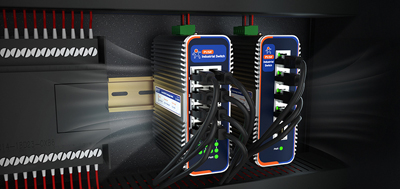
4.3 Product Recommendation: USR-ISG Series Industrial Switche
Full-gigabit models: The USR-ISG1005 (5-port gigabit) is suitable for small and medium-sized workshops, supporting a wide temperature range of -40°C to 85°C, IP40 protection, and dual power redundancy. It is affordable, stable, and reliable.
10-gigabit models: The 10-gigabit models in the USR-ISG series support 10G uplink/downlink ports, with a backplane bandwidth of up to 100 Gbps, meeting the needs of large-scale networking. They also offer a 5-year warranty, reducing long-term risks.
User testimonials: After adopting USR-ISG 10-gigabit switches, a certain electronics manufacturing enterprise saw a 90% decrease in network failure rates and a 40% reduction in operation and maintenance costs, earning the title of "Provincial Intelligent Factory."
5. Bandwidth Selection Determines the "Genes" of Industrial Networks
In the era of the industrial internet, network bandwidth has upgraded from "supporting business" to "defining business." Full-gigabit switches are an "economical and practical" choice, suitable for cost-sensitive and clearly defined scenarios; while 10-gigabit switches are a "future-oriented" investment, providing underlying support for high-end applications such as intelligent manufacturing and the industrial internet. Enterprises need to choose the most suitable bandwidth solution based on their development stage, technological route, and budget planning, avoiding the double traps of "over-design" or "insufficient capability."
Contact Us: If you are facing network upgrade challenges or need customized bandwidth solutions, welcome to submit an inquiry. Our expert team will provide free network planning advice based on your business scenarios, helping you seize the opportunities of Industry 4.0!
Industrial Gateways Ranked First in China by Online Sales for Seven Consecutive Years* Source: Frost & Sullivan; Based on the "2026 China Online Channel Industrial Gateways Market Independent Market Research Report" (2019-2025)
We use cookies to ensure that we give you the best
experience on our website. If you continue to use this site we will assume that you are happy with it.