November 24, 2025
Deep Application of Ethernet Switches in Power Monitoring
Deep Application of Ethernet Switche in Power Monitoring: The Innovative Path of Remote Meter Reading and Data Acquisition
Introduction: The Digital Revolution Wave in Power Monitoring
In today's era where the energy Internet and smart grids are accelerating their integration, power monitoring systems are undergoing a profound transformation from traditional manual inspection to intelligent and real-time operation. Remote meter reading and data acquisition, as core components of power monitoring, directly impact the safety and economic efficiency of power grid operation in terms of their efficiency and reliability. Ethernet switche, with their advantages of high-speed transmission, strong anti-interference capabilities, and flexible networking, have become key infrastructure driving the innovation of power monitoring systems. This article will take the USR-ISG series industrial Ethernet switche as a typical case to deeply explore their technological breakthroughs and application value in remote meter reading and data acquisition scenarios.
1. Pain Points of Traditional Power Monitoring and the Breakthrough Solutions of Ethernet Technology
1.1 Limitations of Traditional Meter Reading Systems
Traditional power meter reading relies on manual periodic inspections or low-speed serial communication, presenting three core pain points:
Inefficiency: Manual meter reading consumes a large amount of manpower and is difficult to cover remote areas; serial communication rates are generally below 100 kbps, and data transmission can take up to several hours.
Insufficient reliability: Complex electromagnetic environments easily cause signal attenuation, with error rates exceeding 5%; in the event of device failures, there is a lack of self-healing capabilities, significantly increasing the risk of data loss.
Poor scalability: Traditional systems adopt star or bus topologies, and adding new nodes requires rewiring, resulting in high expansion costs.
1.2 Technological Advantages of Ethernet Switches
Ethernet switches achieve technological breakthroughs through the following characteristics:
High-speed transmission: Gigabit Ethernet has a theoretical bandwidth of 1 Gbps, with actual data transmission rates exceeding 800 Mbps, meeting the needs of real-time acquisition of massive data.
Anti-interference design: Adopting industrial-grade EMC protection (IEC 61000-4-5 standard), it can withstand ±6 kV lightning surges, with an error rate below 0.001% in strong electromagnetic interference environments.
Flexible networking: Supporting ring, redundant, tree, and other topologies, it achieves millisecond-level fault self-healing through RSTP/MSTP protocols, with network availability reaching 99.999%.
Intelligent management: Integrated with SNMP and a Web management interface, it can remotely monitor device status, configure VLAN and QoS policies, and improve operational efficiency by 80%.
2. Technological Innovation in Remote Meter Reading Systems: From "Manual Meter Reading" to "Intelligent Perception"
2.1 System Architecture Upgrade: Three-Layer Distributed Design
The remote meter reading system based on Ethernet switches adopts a "terminal layer-aggregation layer-core layer" three-layer architecture:
Terminal layer: Smart meters connect to protocol converters via RS485 interfaces, converting the Modbus-RTU protocol to TCP/IP protocol to standardize data formats.
Aggregation layer: USR-ISG series switches are deployed in substations or distribution rooms, connecting terminal devices through 4 Gigabit electrical ports and 1 Gigabit optical port to the core layer. They support MDI/MDI-X self-identification functions, automatically adapting to straight-through or crossover network cables and simplifying wiring complexity.
Core layer: The core switch connects multiple aggregation nodes through an optical fiber ring network, constructing a highly reliable communication backbone network. It adopts the VRRP protocol to achieve dual-machine hot backup, ensuring that single-point failures do not affect the overall system operation.
2.2 Key Technological Breakthroughs: Dual Guarantees of Real-Time Performance and Accuracy
Time synchronization technology: Through the IEEE 1588 Precision Time Protocol (PTP), the clock synchronization error between terminal devices and the master station is less than 1 μs, meeting the high-precision requirements of power monitoring for data timestamps.
Data compression algorithm: Using the LZW lossless compression algorithm, the volume of original data packets is compressed by 40%-60%, allowing 2,000 smart meters to upload data simultaneously over a 100 Mbps bandwidth.
Edge computing capabilities: The USR-ISG series switches are equipped with a 1K MAC address table and 512 kbit packet buffer, supporting data filtering and preliminary analysis at the device end, reducing the upload of invalid data and lowering the load on the core network.
2.3 Typical Application Case: A Remote Meter Reading Project of a Provincial Power Grid
A provincial power grid company deployed a remote meter reading system covering the entire province, using USR-ISG-005 switches as aggregation layer devices:
Project scale: Connecting 120,000 smart meters and covering 3,000 distribution transformer monitoring points.
Implementation effects:
The meter reading cycle was shortened from 7 days to 15 minutes, and the data acquisition success rate increased from 92% to 99.99%.
Annual manual inspection costs were reduced by 12 million yuan, and fault location time was shortened from 4 hours to 10 minutes.
Through power load analysis functions, grid dispatching strategies were optimized, saving 8 million yuan in annual electricity purchase costs.
3. Evolution of Data Acquisition Systems: From "Single Monitoring" to "Panoramic Perception"
3.1 Multi-Source Data Fusion Acquisition Architecture
Modern power monitoring systems need to simultaneously collect more than 20 types of parameters, such as voltage, current, power factor, temperature, and humidity. Ethernet switches achieve multi-source data fusion through the following technologies:
Protocol conversion capabilities: Supporting multiple industrial protocols such as Modbus TCP, IEC 60870-5-104, and DNP3, compatible with devices from different manufacturers.
Time-Sensitive Networking (TSN): Through the IEEE 802.1Qbv time-aware shaper, dedicated time slots are allocated for data of different priorities, ensuring the real-time transmission of critical monitoring data (such as fault recordings).
PoE power supply function: The USR-ISG series switches support the IEEE 802.3af/at standard, with a maximum output of 30 W per port, directly powering cameras, temperature and humidity sensors, and other devices, reducing the deployment cost of power cables.
Power monitoring devices are often deployed in harsh environments with high temperatures, high humidity, and strong vibrations. The USR-ISG series switches ensure long-term stable operation through the following designs:
Industrial-grade protection:
Operating temperature range: -40°C to 85°C, adapting to extreme climates such as deserts and polar regions.
Protection level: IP40 dustproof design, preventing the intrusion of particles with a diameter greater than 1 mm.
Vibration resistance: Passing the IEC 60068-2-6 standard vibration test, it can operate normally in continuous vibration environments in the 5-500 Hz frequency band.
Redundant power supply design:
Supporting dual DC 12-52 V power inputs, it automatically switches to the backup power supply when the main power fails, with a switching time of less than 10 ms.
Built-in overcurrent protection (4.0 A) and reverse connection protection to prevent device damage due to power abnormalities.
3.3 Intelligent Operation and Maintenance System: From "Passive Response" to "Proactive Prevention"
By integrating AI algorithms and big data analysis, Ethernet switches can achieve intelligent operation and maintenance:
Fault prediction: Based on the historical operating data of devices, the probability of switch port failures is predicted through LSTM neural networks, issuing warnings 30 days in advance.
Traffic anomaly detection: Using machine learning models to analyze network traffic patterns, it can identify DDoS attacks or data tampering behaviors in real time, with a false alarm rate below 0.1%.
Automated configuration: Through Zero-Touch Provisioning (ZTP) technology, new devices automatically obtain configuration files from DHCP servers after power-on, achieving "plug-and-play."
4. Industrial Switch USR-ISG Series: A Customized Solution for Power Monitoring Scenarios
4.1 Core Product Advantages
The USR-ISG series industrial Ethernet switches are specifically designed for power monitoring scenarios and have the following differentiated advantages:
Ultra-low power consumption: The entire machine consumes less than 3 W, adopting a natural cooling design without fan failure points, with an MTBF (Mean Time Between Failures) of 300,000 hours.
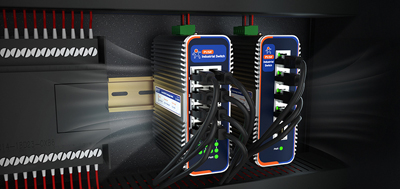
Flexible deployment: Supporting DIN rail mounting, with dimensions of only 130×95×33.5 mm, it can be compactly installed in distribution cabinets.
Long-term service: Providing a 5-year warranty and 24-hour technical response, with 30 service outlets deployed nationwide, ensuring rapid on-site support.
4.2 Typical Application Scenarios
Substation monitoring: Connecting protection devices, measurement and control units, and fault recorders to build a highly reliable communication network.
New energy power stations: Achieving high-speed data transmission among photovoltaic inverters and wind power converters, supporting the IEC 61850 protocol.
Smart buildings: Powering security cameras and access control systems through the PoE function, simplifying weak current wiring.
Rail transit: Deploying vibration-resistant switches in subway tunnels to ensure the stable transmission of onboard video monitoring data.
5. Future Outlook: The Deep Integration of Ethernet Switches and the Power Internet of Things
With the maturity of technologies such as 5G, TSN, and digital twins, power monitoring systems will evolve towards "full perception, full connection, and full intelligence." Ethernet switches will play a more core role:
Time-sensitive applications: Achieving microsecond-level synchronization through TSN technology to support high-precision requirements such as differential protection and synchronized phasor measurement.
AI-empowered operation and maintenance: Integrating lightweight AI models at the switch end to achieve localized anomaly detection and decision-making.
Open ecosystem construction: Supporting IoT protocols such as OPC UA and MQTT to seamlessly connect with cloud platforms, forming an "end-edge-cloud" collaborative architecture.
6. Collaborating to Create a New Future for Power Monitoring
Ethernet switches have upgraded from simple communication devices to the "nerve centers" of power monitoring systems, and their technological evolution is directly driving the industry towards intelligence and high efficiency. The USR-ISG series switches, with their industrial-grade quality and scenario-based innovation capabilities, are creating greater value for global power users. We sincerely invite industry partners to jointly explore and empower power monitoring with technological innovation, working together to build a safe, reliable, and green modern energy system.
Industrial loT Gateways Ranked First in China by Online Sales for Seven Consecutive Years **Data from China's Industrial IoT Gateways Market Research in 2023 by Frost & Sullivan
We use cookies to ensure that we give you the best
experience on our website. If you continue to use this site we will assume that you are happy with it.