Deep Application of Industrial 4G LTE Modem in Building Automation: An Efficient Choice for BA System Integration and Building Control Solutions
In the wave of smart city construction, Building Automation (BA) systems, as the core of building intelligence, are undergoing a leapfrog upgrade from "single-device control" to "global collaborative management." However, traditional BA systems often face challenges such as incompatible device protocols, data silos, and difficulties in remote operation and maintenance, leading to low management efficiency and high energy consumption costs. The industrial 4G LTE modem (data transmission unit), with its powerful protocol conversion capabilities, stable data transmission performance, and flexible edge computing functions, has become a key technology to solve this problem. This article will deeply analyze the application value of the industrial 4G LTE modem in BA system integration and recommend an efficient and reliable solution—USR-DR154—to help enterprises achieve intelligent transformation in building management.
1. Three Major Dilemmas of Traditional BA Systems: Data Silos and Efficiency Bottlenecks
1.1 Incompatible Device Protocols: Cross-Brand Integration Challenges
Buildings house a variety of equipment brands with different protocol standards. For example, in a large commercial complex, the air conditioning system uses the Modbus RTU protocol, the lighting system uses the BACnet protocol, and the security equipment relies on the OPC UA protocol. Traditional BA systems require multiple gateways for protocol conversion, which is not only costly but also complex to maintain, resulting in data incompatibility between devices and the formation of "information silos."
1.2 Unstable Data Transmission: Network Dependency and Latency Risks
Traditional BA systems mostly rely on wired networks or WiFi for data transmission, but in large buildings, issues such as signal coverage blind spots and network congestion frequently occur. For instance, a hospital project once experienced unstable WiFi signals, causing delays in uploading temperature and humidity monitoring data from operating rooms, nearly leading to a medical incident. Additionally, wired network cabling is costly and has poor scalability, making it difficult to adapt to future equipment capacity expansion needs.
1.3 Low Operation and Maintenance Efficiency: Manual Inspections and Lagging Fault Responses
Traditional BA systems lack remote diagnostic capabilities, requiring on-site troubleshooting by operation and maintenance personnel. Statistics from an office building project show that manual inspections take an average of 2 hours per session, with a fault location accuracy rate of less than 60%, resulting in prolonged equipment downtime and increased maintenance costs.
2. Industrial
4G LTE Modem: The "Nerve Center" for Solving BA System Dilemmas
As a bridge connecting devices to the cloud platform, the industrial 4G LTE modem enables standardized data collection and efficient transmission of device data through functions such as protocol conversion, data encryption, and edge computing, providing three core values for BA system integration:
2.1 Full Protocol Compatibility: Breaking Down Device Barriers
The industrial 4G LTE modem supports mainstream industrial protocols such as Modbus RTU/TCP, BACnet, OPC UA, and MQTT, enabling seamless integration with various devices such as air conditioners, lighting, security, and elevators. For example, the USR-DR154 can simultaneously parse more than 10 device protocols through its built-in protocol library, converting heterogeneous data into JSON format and uploading it to the cloud for unified management.
2.2 Stable Transmission: Dual-Network Redundancy and Low Latency Guarantee
The industrial 4G LTE modem adopts a dual-channel design of 4G/
5G + Ethernet, supporting automatic switching between primary and backup networks. For example, the USR-DR154 can switch to a 4G network within 3 seconds upon detecting a wired network interruption, ensuring zero interruption in data transmission. Its theoretical latency is as low as 10ms, meeting real-time monitoring needs. For instance, a factory achieved millisecond-level transmission of robotic arm motion data through an industrial 4G LTE modem, avoiding processing errors.
2.3 Edge Intelligence: Local Preprocessing and Fault Warning
The industrial 4G LTE modem integrates an edge computing module, enabling local data cleaning, aggregation, and preliminary analysis. For example, the USR-DR154 supports a "change reporting" function, transmitting only critical data to reduce redundant traffic. At the same time, through built-in algorithm models, it can monitor device operating status in real-time and provide early fault warnings. A chemical park project improved equipment fault prediction accuracy to 92% and reduced annual maintenance costs by 40% through edge computing with an industrial 4G LTE modem.
3. USR-DR154: The "Efficient Engine" for BA System Integration
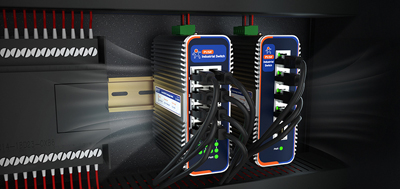
USR-DR154 is an industrial-grade industrial 4G LTE modem launched by Jinan UROVO IoT. With its high cost-effectiveness, stability, reliability, and ease of deployment, it has become an ideal choice for BA system integration. The following analysis covers its technical parameters, application scenarios, and deployment advantages:
3.1 Technical Parameters: Industrial-Grade Design for Harsh Environments
Communication Capabilities: Supports 4G Cat1 full Netcom, compatible with China Mobile, China Unicom, and China Telecom networks; optional
5G module to meet high-bandwidth needs such as HD video surveillance.
Interface Types: Provides multiple interfaces such as RS232, RS485, and TTL, enabling connection to temperature sensors, pressure sensors, PLCs, and other devices.
Edge Computing: Built-in RISC-V core processor supports local data preprocessing, reducing cloud load.
Security Protection: Supports SSL/TLS 1.2 encrypted transmission to prevent data tampering; features anti-static (8KV) and lightning protection (15KA) capabilities for industrial environments.
Environmental Adaptability: Operating temperature range of -40°C to 85°C, IP30 protection rating, resistant to oil, dust, and other contaminants.
3.2 Application Scenarios: Covering Full-Link Needs of BA Systems
Environmental Monitoring and Control: Connect temperature and humidity sensors, CO2 sensors to adjust air conditioning and fresh air system operating parameters in real-time, improving indoor comfort. For example, an office building project achieved automatic indoor temperature and humidity adjustment through the USR-DR154, reducing energy consumption by 18%.
Energy Management: Collect data from electricity and water meters, analyze peak energy consumption periods, and optimize equipment operating strategies. A shopping mall project achieved time-segmented lighting control through an industrial 4G LTE modem, saving 250,000 yuan in annual electricity costs.
Security Prevention: Integrate surveillance camera and access control system data for remote monitoring and abnormal alarms. A hospital project uploaded security data to the cloud through an industrial 4G LTE modem, reducing fault response time to 5 minutes.
Device Status Monitoring: Monitor the operating status of critical equipment such as elevators and water pumps to provide early fault warnings. A factory project achieved predictive maintenance of equipment through an industrial 4G LTE modem, reducing downtime by 60%.
3.3 Deployment Advantages: Simple Configuration for Rapid Deployment
QR Code Configuration: Complete parameter settings by scanning the industrial 4G LTE modem's QR code via a WeChat mini-program, without the need for professional technicians.
Remote Management: Support remote firmware upgrades and parameter adjustments through the UROVO cloud platform, reducing operation and maintenance costs.
Multi-Platform Integration: Provide standard API interfaces for rapid integration with third-party platforms such as Alibaba Cloud and Huawei Cloud, enabling data sharing.
4. Practical Cases: USR-DR154 Empowers Intelligent Upgrade of BA Systems
Case 1: BA System Transformation of a Commercial Complex
Background: The complex's original BA system relied on wired networks, had incompatible device protocols, and high operation and maintenance costs.
Solution:
Deploy USR-DR154 to connect air conditioning, lighting, security, and other devices, achieving unified protocol conversion;
Transmit data to the cloud via 4G networks to solve signal blind spot issues;
Utilize edge computing functions for real-time device status monitoring and fault warnings.
Results:
Reduced equipment integration costs by 50%;
Improved operation and maintenance efficiency by 70%, reducing fault response time to 10 minutes;
Saved 320,000 yuan in annual energy consumption costs.
Case 2: Security Upgrade of a Hospital's BA System
Background: Hospitals have strict environmental control requirements, and traditional BA systems cannot meet real-time monitoring needs.
Solution:
USR-DR154 connects temperature and humidity sensors and air quality monitors to upload data to the cloud in real-time;
Set threshold alarms through the UROVO cloud platform to automatically activate the fresh air system when CO2 concentrations exceed standards;
Integrate access control system data for remote querying of personnel entry and exit records.
Results:
Improved indoor air quality compliance rate to 99%;
Reduced security incident response time to 3 minutes;
Increased patient satisfaction by 20%.
5. Future Outlook: Deep Integration of Industrial 4G LTE Modem and BA Systems
With the popularization of technologies such as AI,
5G, and digital twins, industrial 4G LTE modems will evolve towards higher integration and stronger intelligence:
AI-Driven: Industrial 4G LTE modems will incorporate built-in AI algorithm models for self-diagnosis of equipment faults and self-optimization of energy consumption.
5G Empowerment: 5G industrial 4G LTE modems will support ultra-low latency (1ms) transmission, meeting the needs of high-precision scenarios such as remote surgery and robot collaboration.
Digital Twins: Device data collected by industrial 4G LTE modems will be mapped to virtual building models for fault simulation and预案推演 (scenario rehearsal).
Contact Us: Opening a New Chapter in Building Automation
In the race to upgrade building automation, choosing an efficient and reliable industrial 4G LTE modem is the first step to success. The USR-DR154 from Jinan UROVO IoT has become the preferred choice for many enterprises due to its full protocol compatibility, stable transmission, and edge intelligence. Whether you are seeking a BA system integration solution or aiming to build a full-link intelligent building system, PUSR's professional team can provide you with:
Free Consultation: Customize personalized building control solutions based on your business scenarios;
Product Trials: Provide USR-DR154 sample machines for testing to experience its performance advantages firsthand;
Deployment Support: Offer full technical guidance from device networking to system integration to ensure rapid project implementation.
The deep integration of industrial 4G LTE modems and BA systems is driving building management from "human-driven" to "data-driven." In this transformation, choosing a technologically advanced and service-oriented partner will be key for enterprises to seize the high ground in smart buildings. Jinan UROVO IoT is willing to work with you to explore the infinite possibilities of building automation!