Edge Computing + Cellular Router: Architecture Design and POC Testing Guide for Real-Time Production Line Data Processing
In the wave of intelligent manufacturing, the ability to process real-time data on production lines has become a core competitiveness for enterprises to enhance efficiency and reduce costs. Traditional cloud computing models face challenges such as high data transmission latency, substantial bandwidth costs, and significant privacy risks, making it difficult to meet the millisecond-level response requirements of industrial scenarios. The combined architecture of edge computing and cellular router, by decentralizing computing power to the production line site, enables localized data processing and real-time feedback, emerging as a key technological pathway for industrial digital transformation. This article will provide an in-depth analysis of the design logic and implementation key points of this architecture, and open applications for POC (Proof of Concept) testing qualifications to help enterprises quickly validate the technological value.
In traditional architectures, data generated by production line equipment (such as PLCs, sensors, and robots) needs to be uploaded to cloud servers via cellular router for processing, with control instructions then returned. This process involves multiple network hops, typically resulting in latency exceeding 100ms. For scenarios such as high-precision machining and AGV scheduling, latency can lead to equipment action deviations and production line shutdowns. An actual measurement at an automotive parts factory showed that under cloud processing mode, the machining accuracy of machine tools decreased by 0.05mm due to latency, resulting in annual losses exceeding RMB 2 million.
An intelligent production line may deploy hundreds of sensors, generating several MB of data per second. If all this data is uploaded to the cloud, the monthly bandwidth cost for a single production line can reach several thousand yuan, with annual expenses for multi-line enterprises exceeding RMB 1 million. Additionally, frequent transmission of core data (such as process parameters and equipment status) can trigger network congestion, further exacerbating latency.
Industrial data involves sensitive information such as core processes and equipment status of enterprises. If all data is stored in the cloud, a network attack or data breach could lead to the leakage of trade secrets. An electronics factory once experienced an intrusion into its cloud database, resulting in the leakage of key process parameters. Competitors quickly launched similar products, causing direct economic losses exceeding RMB 5 million.
Architecture Design: Hierarchical Processing with Local Closed-Loop
The new architecture centers around edge computing nodes, utilizing cellular router to achieve device connectivity and data aggregation, constructing a three-tier "end-edge-cloud" system:
End Layer: Production line equipment (PLCs, sensors, robots) is responsible for data collection and basic processing;
Edge Layer: Edge computing nodes (deployed on cellular router or local servers) run lightweight AI models for real-time data analysis, anomaly detection, and control instruction generation;
Cloud Layer: Only historical data and samples required for model training are stored, responsible for long-term trend analysis and strategy optimization.
Typical Scenario: In an AGV scheduling system, edge computing nodes receive AGV position and obstacle information in real-time via cellular router, completing path planning and issuing instructions within 5ms, improving response speed by 20 times compared to cloud-based modes.
Core Advantages: Triple Upgrades in Cost Reduction, Efficiency Enhancement, and Security
Cost Reduction: Local data processing reduces cloud transmission volume by over 90%, lowering bandwidth costs by 80%; edge node hardware costs are only 1/5 of cloud servers.
Efficiency Enhancement: Millisecond-level response meets the needs of high-precision machining and real-time control, improving production line efficiency by 15%-30%.
Security: Sensitive data remains within the factory premises, complying with regulations such as the Data Security Law and reducing leakage risks.
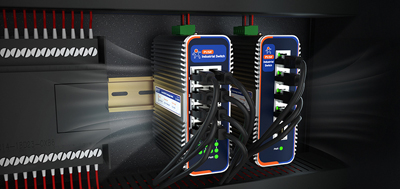
In implementing the architecture, cellular router need to undertake multiple roles such as device connectivity, data aggregation, and edge computing deployment. The USR-M300, as an intelligent router specifically designed for industrial scenarios, is an ideal choice for edge computing architectures due to its high performance and reliability:
Multi-Protocol Support: Compatible with industrial protocols such as Modbus TCP, Profinet, and OPC UA, seamlessly connecting PLCs, sensors, and other devices;
Edge Computing Capabilities: Built-in quad-core 1.2GHz processor capable of running lightweight AI models (such as anomaly detection and predictive maintenance) with processing latency ≤5ms;
Industrial-Grade Protection: IP30 protection rating, wide temperature design from -20°C to 70°C, and EMC Level 3 anti-interference, adapting to harsh production line environments;
Flexible Expansion: Supports 4G/5G/Wi-Fi 6 multi-link backup to ensure network continuity; provides a Python SDK for customized function development.
Case Study: After deploying the USR-M300, a photovoltaic enterprise ran a silicon wafer defect detection model on the router to analyze camera data in real-time, achieving a detection speed of 20 wafers per second, 10 times faster than cloud-based modes, and reducing the false detection rate to 0.5%.
Clarify the core needs of the production line (such as real-time control, predictive maintenance, quality inspection), determine the types of data to be processed by edge computing (such as equipment status, process parameters, environmental data), and the response time requirements (such as ≤10ms). For example, high-precision machine tool machining scenarios need to focus on vibration and temperature data, with response times ≤5ms.
Step 2: Edge Node Selection and DeploymentSelect hardware (such as the USR-M300 cellular router or dedicated edge servers) based on processing requirements and deploy lightweight AI models. Models need to be trained and optimized with production line data to ensure accuracy ≥95%. For example, an injection molding machine manufacturer deployed a mold temperature prediction model on the USR-M300, providing 10-minute advance warnings of temperature anomalies and reducing mold damage rates by 40%.
Step 3: Network Architecture OptimizationConstruct a redundant network (such as dual-link backup and VLAN segmentation) through cellular router to ensure data transmission reliability. For example, using the USR-M300's 5G + Wi-Fi 6 dual-link backup, network interruption recovery time is ≤50ms.
Step 4: Data Security EnhancementDeploy data encryption (such as AES-256), access control (such as 802.1X authentication), and audit logging functions on edge nodes to prevent unauthorized access. The USR-M300 supports IPSec VPN and firewall functions to construct a securely isolated production line network.
To help enterprises quickly assess the applicability of the architecture, we are opening applications for POC testing qualifications, providing the following support:
Free Device Trial: Provide USR-M300 cellular router prototypes with a 30-day no-questions-asked return policy;
Technical Team Support: Senior engineers assist in deploying edge computing nodes, optimizing network architectures, and training AI models;
Customized Testing Scenarios: Design test cases based on enterprise needs (such as AGV scheduling, equipment predictive maintenance, quality inspection) to quantitatively evaluate indicators such as latency, accuracy, and cost savings;
Test Report Output: Provide a detailed report including data comparisons, cost analyses, and optimization recommendations to inform enterprise decision-making.
POC Testing Case Study of a Semiconductor Enterprise:
Test Scenario: Real-time path planning for wafer transfer robots;
Test Plan: Deploy path optimization algorithms on the USR-M300 and compare response times and path lengths between cloud-based and edge-based modes;
Test Results: Edge mode reduced response time from 120ms to 8ms and shortened path length by 12%, saving over RMB 300,000 in annual robot energy costs;
Follow-Up Actions: The enterprise has fully deployed the edge computing architecture across 10 production lines.
Whether you aim to reduce bandwidth costs, enhance production line efficiency, or strengthen data security, the edge computing + cellular router architecture offers a practical solution. Take immediate action by applying for POC testing qualifications through the following methods, and our technical team will provide you with:
Online Application: Click the button to fill in your enterprise name, contact person, production line scenario, and core needs;
Requirements Communication: We will contact you within 24 hours to confirm test details and equipment shipping address;
Test Deployment: Technical teams will assist with on-site installation and debugging to ensure smooth testing;
Result Feedback: Provide a detailed report after testing and develop a scalable deployment plan based on needs.
The integration of edge computing and cellular router is redefining the standards for real-time production line data processing. From POC testing to scalable deployment, we are willing to work with you to jointly explore the infinite possibilities of intelligent manufacturing.