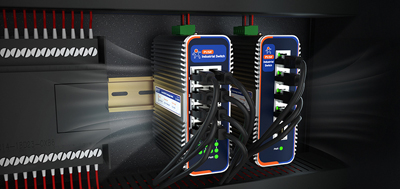
Encryption Communication Function of IoT Gateway: The Upgrade Path from AES to Chinese National Cryptographic Algorithm SM4 for Protection
In the wave of intelligent manufacturing, the IoT gateway, serving as the "nerve center" connecting the physical and digital worlds, has its security directly determining the stability of production systems and the value of data assets. A certain automobile manufacturing enterprise once experienced tampering of production line control commands due to vulnerabilities in the IoT gateway's encryption protocol, resulting in daily losses exceeding 3 million yuan. Another energy group had its key process parameters stolen during cross-border data transmission due to the non-use of Chinese national cryptographic algorithms, triggering a major intellectual property dispute. These cases reveal a harsh reality: the encrypted communication capability of IoT gateways has become the "last line of defense" for enterprises to resist cyber attacks and safeguard production security. This article will deeply analyze the evolution logic of encrypted communication in IoT gateways from three dimensions—technical principles, application scenarios, and upgrade paths—and provide enterprises with an upgrade plan for protection from AES to Chinese national cryptographic algorithm SM4.
1. Core Challenges of Encrypted Communication: Finding a Balance Between Efficiency and Security
The encrypted communication needs in industrial settings exhibit distinct industry characteristics:
Strict real-time requirements: The transmission delay of PLC control commands must be controlled at the millisecond level; otherwise, it may lead to out-of-sync equipment actions.
High data throughput: A single automobile welding production line generates over 100,000 sensor data points per second, requiring the encryption algorithm to support high-speed processing.
Harsh environmental adaptability: The gateway must operate stably under extreme temperatures ranging from -40°C to 85°C and strong electromagnetic interference (10V/m field strength).
Stringent compliance requirements: Key sectors such as government affairs, finance, and energy must meet the localization requirements of the Cybersecurity Law and the Data Security Law.
These needs pose dual challenges to encryption algorithms: they must resist brute-force attacks through complex mathematical operations while ensuring real-time performance with minimal resource consumption. Traditional encryption solutions often face a dilemma: international algorithms like AES-256, while highly secure, rely on imported chips for hardware acceleration; domestic SM4 algorithms, while independently controllable, had performance limitations in early implementations. How can this bottleneck be broken? The answer lies in innovations in algorithm optimization and hardware collaboration.
2. AES Encryption: The "Global Passport" for Industrial Communication
2.1 Technical Advantages of AES: The Golden Balance Between Speed and Security
Since its selection as an international standard by NIST in 2001, AES (Advanced Encryption Standard) has become the mainstream choice for industrial communication due to its three major characteristics:
Efficiency of symmetric encryption: Using the same key for encryption and decryption, hardware-accelerated speeds can reach tens of Gbps, meeting the needs of massive data transmission in industrial settings.
Robustness of algorithm structure: Through 10 rounds of nonlinear transformations, including byte substitution, row shifting, column mixing, and round key addition, it effectively resists differential cryptanalysis and linear cryptanalysis.
Flexibility of key length: Supports 128/192/256-bit keys, with AES-256 having a key space of 2^256, making it unbreakable even by quantum computers for billions of years.
Typical application scenario: A photovoltaic inverter manufacturer adopted the AES-128-GCM mode to encrypt inverter operation data, combined with local processing at edge computing nodes, reducing data transmission delay from 200ms to 6ms and significantly improving power generation efficiency.
2.2 Limitations of AES: The Game Between Global Compatibility and Sovereign Control
Despite its excellent performance, AES has shortcomings in specific scenarios:
Compliance risks: China's Cryptography Law explicitly requires the use of domestic cryptographic algorithms for critical information infrastructure, limiting AES applications in government affairs and finance.
Supply chain vulnerabilities: AES hardware acceleration relies on Intel's AES-NI instruction set, and monopoly of the chip supply chain could lead to "chokepoint" risks.
Future threats: Quantum computing poses a potential threat to AES-128; although AES-256 remains secure, proactive布局 (pre-emptive deployment) of quantum-resistant encryption is necessary.
3. Chinese National Cryptographic Algorithm SM4: The "Security Moat" of Independent Control
3.1 Technical Breakthroughs of SM4: Designed Specifically for Industrial Scenarios
SM4 is a block symmetric encryption algorithm independently developed by China, designed to address three major pain points in the industrial sector:
High-performance implementation: With a block length and key length of 128 bits, it adopts a 32-round nonlinear iterative structure, achieving single-thread encryption/decryption speeds of up to 10 Gbps and multi-thread speeds exceeding 100 Gbps, meeting the real-time encryption needs of massive data.
Hardware friendliness: The algorithm structure is simple and can be efficiently implemented in hardware such as FPGAs and ASICs. An energy enterprise boosted SM4 performance to 88 times that of traditional solutions through GPU parallel acceleration.
Compliance adaptability: It complies with the Basic Requirements for Network Security Classification Protection of Information Security Technology and is mandatorily deployed in government clouds and financial core systems.
Typical application scenario: A smart grid project adopted the SM4 algorithm to encrypt data from power monitoring systems, combined with SM2 digital signatures and SM3 hash algorithms, to construct a three-tier protection system of "transmission encryption + identity authentication + integrity protection," successfully resisting APT attacks.
3.2 Upgrade Value of SM4: From "Available" to "Mandatory"
In the following scenarios, SM4 has become an irreplaceable choice:
Cross-border data transmission: China's Measures for the Security Assessment of Data Exits require the use of domestic cryptographic algorithms for the encryption of critical data exiting the country, ensuring data sovereignty.
Industrial Internet platforms: Mainstream platforms like Alibaba Cloud and Huawei Cloud already support SM4 encryption, and enterprises going to the cloud must meet the requirements of Classification Protection 2.0.
Upgrading legacy equipment: The simple implementation of the SM4 algorithm allows deployment in resource-constrained PLCs and sensors, reducing upgrading costs.
4. Protection Upgrade Path: A Three-Step Strategy from AES to SM4
4.1 Step 1: Assess the Current Situation and Identify Risk Points
Enterprises need to evaluate the encryption capabilities of their existing gateways from three dimensions:
Protocol compatibility: Whether it supports industrial protocols such as Modbus TCP/RTU, Profinet, and OPC UA, as well as IoT protocols like MQTT and CoAP.
Algorithm coverage: Whether it supports both AES and SM4 and can dynamically switch to meet different scenario requirements.
Performance metrics: Whether encryption delay, throughput, and concurrent connection numbers meet real-time control requirements.
Tool recommendation: Use the free testing tools provided by the USR Cloud platform to quickly generate encryption performance assessment reports.
4.2 Step 2: Choose a Hybrid Encryption Solution for a Smooth Transition
To avoid business disruptions caused by a "one-size-fits-all" upgrade, it is recommended to adopt a "AES + SM4" hybrid encryption mode:
Internal communication: Continue using AES-256 within the factory's internal network to ensure the stability of existing systems.
External communication: Mandate the use of SM4 for cross-border data, cloud data, and remote maintenance scenarios to meet compliance requirements.
Critical equipment: Gradually replace PLCs, DCSs, and other core control equipment with domestic gateways supporting SM4.
Case reference: During the upgrade process, an automobile parts manufacturer used the "dual protocol stack" function of the USR-M300 IoT gateway to achieve automatic negotiation between AES and SM4, ensuring uninterrupted production during the upgrade.
4.3 Step 3: Deploy USR-M300 to Build a Full-Link Security System
The USR-M300 IoT gateway, with its "software-hardware integrated" security design, has become the preferred choice for enterprise upgrades:
Algorithm support: Built-in AES-256 and SM4 hardware encryption engines, supporting secure protocols such as TLS 1.3 and mTLS.
Performance guarantee: Equipped with an RK3562J quad-core 1.
2GHz processor, it can simultaneously handle 16-channel protocol conversions with encryption delays of less than 0.5ms.
Ecosystem compatibility: Supports mainstream platforms like USR Cloud, Alibaba Cloud, and Huawei Cloud, providing OPC UA server functionality for seamless integration with SCADA and MES systems.
Compliance certification: Passed IEC 61850 electromagnetic compatibility certification and security reviews by the State Cryptography Administration, meeting the requirements of Classification Protection 2.0 Level 3.
Application scenario: In the rolling mill production line of a steel enterprise, the USR-M300 gateway encrypted temperature sensor data using SM4, combined with edge computing for real-time control of steel plate thickness, improving product qualification rates by 12% and saving over 20 million yuan annually.
5. Contact Us: Submit Your Requirements to Obtain a Customized Upgrade Solution
Is your enterprise facing the following challenges?
Existing gateways only support AES and cannot meet the compliance requirements of Classification Protection 2.0.
There is a risk of data leakage in cross-border data transmission, requiring protection by domestic cryptographic algorithms.
The upgrading of legacy equipment is time-consuming, affecting production schedules.
Contact us to enjoy three major benefits:
Free consultation: Our engineering team will respond within 24 hours, providing:
Encryption algorithm selection advice (AES/SM4/hybrid mode).
Gateway performance assessment reports (delay, throughput, concurrent capability).
Compliance upgrade roadmaps (Classification Protection 2.0, data exit security assessment).
Prototype trial: Support a 7-day free trial of the USR-M300 gateway to verify encryption performance and protocol compatibility.
Custom development: Provide customized services such as graphical programming and Python script development based on your equipment list and communication protocols.
The Future Is Here, Security Comes First
In the era of Industry 4.0, encrypted communication capabilities have become a key indicator of an enterprise's core competitiveness. Choosing the USR-M300 IoT gateway is not just choosing a product but selecting a complete protection system from AES to SM4 and a secure pathway to intelligent manufacturing. Submit your requirements now, and let our expert team tailor an upgrade solution for you, opening a new chapter in industrial communication security!