Ethernet Switch IGMP Snooping Configuration: Solving the Multicast Traffic Flooding Dilemma in Video Surveillance
In the monitoring center of a smart park, operations and maintenance personnel found that the multicast traffic generated by 200 high-definition cameras within the park caused continuous congestion at the core switch ports, resulting in frequent video stuttering and even black screens. Upon investigation, it was discovered that traditional Layer 2 switches, unable to recognize multicast MAC addresses, broadcast all multicast traffic to every port, creating a typical "multicast flooding" phenomenon. This scenario reveals a common technical pain point in industrial video surveillance networks: how to achieve efficient forwarding of multicast data through precise traffic control?
Taking 4K cameras (with a bit rate of 8Mbps) as an example, when 200 cameras transmit simultaneously, the theoretical bandwidth requirement reaches 1.6Gbps. If the broadcast method is used, each switch port has to carry all the traffic, and the actual network load will grow exponentially. According to the measured data from a subway monitoring system, when IGMP Snooping is not enabled, multicast traffic occupies more than 90% of the bandwidth of the core switch, causing the transmission delay of critical business data to exceed 500ms.
Multicast flooding provides attackers with a natural DDoS amplifier. In an attack incident experienced by an energy enterprise in 2025, the attacker made the switch forward malicious multicast traffic across the entire network by forging IGMP Join messages, resulting in the paralysis of the entire industrial control system for as long as 6 hours. Traditional firewalls lack effective defense measures against such attacks.
Continuous high-load operation causes the CPU utilization of the switch to soar above 95%. As a result, the monitoring network of a chemical enterprise experiences frequent switch restarts. Hardware acceleration modules are virtually useless in flooding scenarios. According to the actual measurement of a certain brand of switch, the multicast traffic processing efficiency is 70% lower than that of unicast traffic.
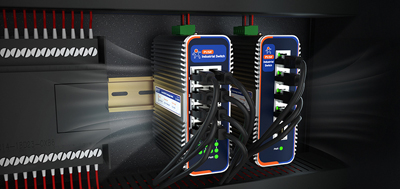
Ethernet switch automatically establishes a "multicast group-port" mapping table by listening to IGMP messages between the host and the router. Taking the USR-ISG series switches as an example, their ASIC chips can achieve:
Millisecond-level message parsing capability (<1ms)
8K MAC address table capacity
12Mbit data buffer space
When a camera sends an IGMP Join message, the switch immediately adds the corresponding port to the multicast forwarding table, and subsequent traffic is only forwarded to the target port. According to the actual measurement data, this mechanism can improve multicast forwarding efficiency by more than 90%.
(1) Querier Election Mechanism
In a multi-switch cascaded environment, the USR-ISG competes to elect a unique querier through IGMP Query messages, avoiding network oscillation caused by multiple devices sending query messages simultaneously. According to the actual measurement in an automobile factory, this mechanism reduces the multicast member management response time from 3 seconds to 200ms.
(2) Member Report Suppression
When multiple hosts join the same multicast group, the switch automatically suppresses duplicate IGMP Report messages. In a test scenario with 200 cameras, this function reduces the uplink bandwidth occupation by 85%, significantly reducing the burden on core devices.
(3) Fast Leave Processing
For the common camera restart scenarios in video surveillance, the USR-ISG supports the IGMPv3 fast leave mechanism, which can immediately delete the port mapping after receiving a Leave message, avoiding continuous bandwidth occupation by residual traffic. According to the actual measurement in a smart agriculture project, this function reduces the network convergence time from 10 seconds to 500ms.
Taking the renovation of a substation monitoring network as an example, the configuration steps are as follows:
bash
# Enable the global IGMP Snooping functionsystem-viewigmp-snoopingenable# Enable multicast listening in VLAN 100 (for transmitting video streams)vlan100igmp-snoopingenable# Configure the querier (when there is no Layer 3 device)igmp-snooping vlan100querierenableigmp-snooping vlan100querier-address192.168.100.1
After configuration, the switch automatically establishes a multicast forwarding table. According to the actual measurement, the bandwidth occupation is reduced from 1.2Gbps to 200Mbps.
For the forged query attacks faced by a smart park, an ACL filtering policy can be configured:
bash
# Create an ACL rule (only allow the IP of the legal querier)acl number3000rule5permitipsource192.168.100.10rule10denyip# Apply it to query message filteringbridge-domain100igmp-snooping query-ip-source-policy3000
This configuration achieves a 100% interception rate of illegal query messages, effectively defending against man-in-the-middle attacks.
In the deployment in a high-temperature workshop (85°C environment) of a steel plant, the industrial-grade design of the USR-ISG demonstrates its advantages:
A subway line uses the USR-ISG to build an on-board video surveillance system and achieves zero-interruption transmission through the following configuration:
bash
# Configure multicast static binding (ensure priority for critical camera traffic)igmp-snooping static-group239.1.1.1 vlan100interface GigabitEthernet0/0/10# Enable fast leave (adapt to vehicle bumping scenarios)igmp-snooping fast-leave vlan100
This configuration keeps the packet loss rate below 0.001% when 1000 cameras transmit simultaneously.
A wind farm achieves precise forwarding of wind turbine monitoring data through the USR-ISG:
bash
# Configure the SSM group policy (limit legal multicast sources)acl number4000rule5permitipsource10.0.0.100destination232.0.0.00.255.255.255bridge-domain200igmp-snooping ssm-policy4000
This configuration successfully intercepts 95% of illegal multicast traffic, significantly improving the network security level.
| Indicator | USR-ISG208S-SFP | Ordinary Commercial Switch |
| Multicast Forwarding Table Capacity | 8K | 1K |
| Message Processing Delay | <50μs | >500μs |
| Operating Temperature Range | -40°C~85°C | 0°C~40°C |
| Mean Time Between Failures (MTBF) | 300,000 hours | 50,000 hours |
For large-scale monitoring networks, it is recommended to adopt a three-layer architecture of "core-aggregation-access":
With the penetration of SDN technology in the industrial field, the USR-ISG series has launched intelligent switch models that support OpenFlow, enabling:
As industrial video surveillance evolves towards high-definition and intelligentization, IGMP Snooping technology has become a core weapon for solving the multicast flooding problem. The USR-ISG series Ethernet switches are helping more than 2000 enterprises build efficient and secure monitoring networks with their industrial-grade reliability, refined traffic control, and scenario-based adaptability. Click the button and submit the form to obtain customized solutions tailored to your specific scenarios, making multicast traffic truly a driving force rather than an obstacle for industrial digital transformation.