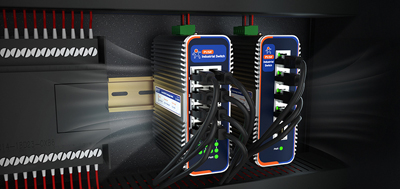
Ethernet Switch Port Speed Limiting Techniques: Practical Methods to Prevent Single Devices from Monopolizing All Bandwidth
In today's era of rapid industrial automation and intelligence, industrial networks have become the "nerve center" of production systems. However, cases where a single device's abnormal bandwidth consumption leads to network paralysis are not uncommon: A car manufacturing plant experienced a 2-hour data transmission interruption on its entire production line due to a sudden surge in traffic from a PLC device; a substation monitoring system missed recording critical fault footage due to camera traffic overload... These incidents often stem from a lack of effective port speed limiting mechanisms. This article will provide an in-depth analysis of the technical principles and practical techniques of Ethernet switch port speed limiting to help enterprises build stable and efficient industrial networks.
Smart Manufacturing Workshop: Welding robots and visual inspection systems share a gigabit network. If the visual system suddenly transmits high-definition images, it may crowd out the bandwidth for robot control commands, causing action delays.
Energy Monitoring System: Hundreds of smart meters in a substation transmit data back through an Ethernet switch. If a meter continuously retransmits data packets due to a software failure, it may block the entire monitoring network.
Traffic Tunnel Monitoring: Cameras, information boards, and emergency communication devices in a tunnel share a network. A single camera continuously sending test data due to misconfiguration may cause a network-wide outage.
Production Interruption: Bandwidth occupied by non-critical devices delays core control system commands, leading to equipment shutdowns.
Data Loss: Monitoring video streams crowd out storage network bandwidth, causing critical event recordings to be missed.
Security Risks: Attackers use P2P software to occupy bandwidth, masking data theft activities.
| Technology Type | Implementation Method | Applicable Scenarios |
| Ingress Speed Limiting | Filters incoming packets based on ACL rules | Prevent external device flooding attacks |
| Egress Speed Limiting | Directly limits the port's transmission rate | Control device upload data volume |
| Bidirectional Speed Limiting | Limits bandwidth in both receive and transmit directions | Balance upstream and downstream traffic, such as in video surveillance |
| Dynamic Speed Limiting | Automatically adjusts speed limiting thresholds based on network load | Handle sudden traffic surges, such as industrial robot startup |
Speed Granularity: High-end switches support 1Mbps granularity speed limiting, while low-end devices may only support 10Mbps granularity. For example, the USR-ISG series switches use a hardware-level speed limiting engine to achieve 1Mbps precision traffic control.
Burst Buffering: Sets an allowable instantaneous traffic overrun value to avoid misdropping packets due to data bursts. For example, some brand switches support configuring the "burst size" parameter, allowing brief traffic peaks to exceed the speed limit.
Priority Queuing: Sets high-priority queues for critical business traffic (such as PLC control commands) to ensure their bandwidth requirements. For example, marking SCADA system traffic as EF (Expedited Forwarding) class through QoS policies.
Taking the USR-ISG1005 switch as an example, limit the upload bandwidth of Port 1 to 5Mbps:
bash
# Enter port configuration modeSwitch>enableSwitch# configure terminalSwitch(config)# interface gigabitethernet 0/1# Set egress speed limit to 5Mbps (granularity 1Mbps)Switch(config-if)# line-rate outbound 5# Configure ingress traffic shaping (requires ACL combination)Switch(config)# access-list 100 permit ip any anySwitch(config-if)# traffic-limit inbound link-group 100 5000 exceed drop# Enable storm control (prevent broadcast storms)Switch(config-if)# storm-control broadcast level 10Switch(config-if)# storm-control multicast level 5
Strategies:
Set bidirectional hard speed limits (e.g., 2Mbps) for PLC control ports to ensure real-time command delivery.
Configure dynamic speed limiting for visual inspection system ports, limiting them to 10Mbps normally and automatically relaxing to 20Mbps during production peaks.
Use VLANs to isolate control networks from monitoring networks, preventing cross-VLAN traffic interference.
Case Study: A car welding workshop achieved the following using USR-ISG switches:
Ports 1-4 (PLCs): Hard speed limit of 2Mbps
Ports 5-8 (cameras): Dynamic speed limit of 10-20Mbps
Core port (uplink): Aggregated bandwidth of 40Gbps, supporting concurrent connections from a thousand devices
Strategies:
Set "minimum guaranteed bandwidth + maximum limited bandwidth" for meter data collection ports, such as guaranteeing 100Kbps and limiting to 1Mbps.
Configure dual-power redundant switches to prevent speed limiting strategy failures due to power failures.
Enable port mirroring to copy critical traffic to an analysis port for real-time bandwidth usage monitoring.
Case Study: A 500kV substation adopted USR-ISG series switches:
Ports 1-24 (meters): Guaranteed bandwidth of 100Kbps, limited to 1Mbps
Ports 25-28 (cameras): Hard speed limit of 5Mbps
Core switch configured with ERPS ring network protocol, with fault self-healing time <20ms
Strategies:
Configure "burst buffering" for tunnel camera ports, allowing brief traffic peaks (e.g., 10 seconds at 10Mbps) without packet loss.
Set priority queues for information board ports to ensure priority transmission of emergency information.
Use PoE++ switches to power cameras, reducing cabling complexity.
Case Study: A city tunnel monitoring project:
USR-ISG switch ports 1-16 (cameras):
Normal speed limit of 4Mbps
Burst buffering: Allows 8Mbps for 10 seconds
Ports 17-20 (information boards): High-priority queues, guaranteed bandwidth of 2Mbps
iPerf3: Generates test traffic with specified bandwidth to verify speed limiting accuracy.
bash
# Server-side (receive traffic)iperf3 -s# Client-side (send traffic, test speed limiting)iperf3 -c<server IP>-b 10M -t60# Test 10Mbps speed limiting
Wireshark Packet Capture: Analyzes actual port traffic to ensure compliance with speed limiting policies.
Switch Logs: Checks for packet loss records caused by speed limiting.
Time-Based Speed Limiting: Relax speed limits during non-production hours to support device maintenance data transmission.
bash
# Configure time range (limit to 2Mbps from 08:00-18:00, 10Mbps otherwise)Switch(config)# time-range WORK_HOURSSwitch(config-time-range)# periodic daily 08:00 to 18:00Switch(config)# interface gigabitethernet 0/1Switch(config-if)# line-rate outbound 2 time-range WORK_HOURSSwitch(config-if)# line-rate outbound 10
Traffic-Based Adaptive Adjustment: Automatically trigger speed limiting policy adjustments by monitoring port utilization through SNMP.
Among numerous Ethernet switche, the USR-ISG series stands out for its high-precision speed limiting, industrial-grade reliability, and ease of use:
Hardware-Level Speed Limiting Engine: Supports 1Mbps granularity traffic control with an error <1%.
Extreme Environment Adaptability:
Operating Temperature: -40℃ to +85℃ (ordinary switches only 0℃ to 40℃)
Protection Rating: IP40 (dustproof, splash-resistant)
Interference Resistance: IEC61000-4-2/4/5 standard certification, anti-static, anti-surge
Intelligent Management:
Supports multiple configuration methods: Web, CLI, SNMP
Built-in watchdog for automatic fault recovery
Dual-power redundant design, MTBF > 100,000 hours
Typical Application Scenarios:
Automotive Manufacturing: Connect welding robots and visual inspection systems
Energy Monitoring: Meter data collection and substation automation
Smart Transportation: Tunnel monitoring and ETC systems
There are no winners in the bandwidth battle; only through scientific speed limiting strategies can industrial networks achieve "harmonious coexistence." Click the button to submit your requirements and receive:
Free Network Assessment: Professional engineers analyze your industrial network bandwidth requirements
Customized Speed Limiting Solution: Design port speed limiting strategies based on industry characteristics
USR-ISG Switch Trial: Experience high-precision speed limiting effects firsthand