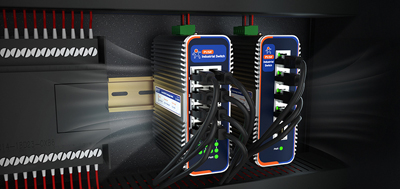
Ethernet Switch QoS Policy Optimization: Bandwidth Allocation Scheme to Prioritize PLC Control Instructions
In industrial automation scenarios, PLCs (Programmable Logic Controllers) serve as the "brains" of production lines, responsible for real-time monitoring of equipment status, executing control instructions, and feeding back data. However, with the surge in non-critical traffic such as video surveillance and IoT devices in industrial networks, PLC instructions often experience delays or even loss due to bandwidth competition, leading to severe consequences such as equipment shutdowns and production accidents. How can QoS (Quality of Service) policies on Ethernet switch be optimized to allocate dedicated bandwidth for PLC control instructions, ensuring "zero-delay, zero-packet loss" transmission? This article provides an in-depth analysis from four dimensions: technical principles, optimization challenges, solutions, and product selection.
PLC control instructions (such as motor start/stop and valve adjustment) must be transmitted and executed within milliseconds. For example:
Automotive Welding Production Line: The PLC must synchronize the welding robot and conveyor belt within 10ms; otherwise, weld spot misalignment may occur.
Chemical Reactor: Delays exceeding 50ms in temperature and pressure control instructions may pose explosion risks.
Power Dispatching System: Loss of circuit breaker opening/closing instructions will lead to grid paralysis.
Industry Pain Point: In traditional industrial networks, non-critical data such as video surveillance and office traffic share bandwidth with PLC instructions, causing critical instructions to be "starved," which is the biggest obstacle to industrial automation upgrades.
QoS technology ensures dedicated bandwidth resources for PLC control instructions through traffic classification, priority marking, and bandwidth allocation, guaranteeing:
Low latency: Avoiding transmission delays caused by queuing.
Zero packet loss: Preventing critical data from being discarded through congestion management mechanisms.
High reliability: Ensuring stable transmission of critical instructions even during network congestion.
Problem: The complexity of traffic types in industrial networks (such as Modbus TCP, Profinet, EtherCAT protocols) makes it difficult for traditional QoS policies to distinguish PLC instructions from ordinary data.
Solution:
Protocol Deep Parsing: Utilize the built-in industrial protocol identification engine in switches to accurately match the characteristic fields of PLC communication (such as source/destination MAC addresses, port numbers, and protocol types).
VLAN Isolation: Assign independent VLANs to PLC devices for physical isolation from video and office traffic, simplifying traffic classification logic.
DSCP Marking: Mark critical traffic with high-priority labels (such as DSCP=46) at the PLC device end or switch port for easy policy matching.
Case Study: A steel plant deployed USR-ISG Ethernet switches, improving the identification accuracy of Profinet control instructions to 99.9% and reducing misclassification rates to below 0.1% through protocol deep parsing.
Problem: Bandwidth requirements in industrial networks vary dynamically with production status (such as equipment start/stop and capacity adjustments), making fixed bandwidth allocation prone to resource waste or shortage.
Solution:
Priority-Based Bandwidth Guarantee: Allocate a minimum guaranteed bandwidth (such as 10Mbps) for PLC instructions to meet basic needs even during network congestion.
Dynamic Bandwidth Adjustment: Adjust bandwidth allocation ratios in real-time through the switch management interface or API based on actual traffic demands (such as increasing PLC bandwidth to 20Mbps during peak periods).
Traffic Shaping and Rate Limiting: Limit non-critical traffic (such as video surveillance) to a maximum bandwidth (such as 5Mbps) to prevent it from抢占 (seizing) PLC resources.
Case Study: A chemical enterprise used the dynamic bandwidth adjustment function of USR-ISG switches to increase the PLC bandwidth share from 30% to 60% during reactor control phases, reducing instruction transmission delay from 50ms to 5ms.
Problem: Sudden equipment failures and link interruptions in industrial networks can easily cause congestion, leading to the loss of PLC instructions.
Solution:
Rapid Ring Network Technology: Achieve telecom-grade self-healing (<20ms) in case of link failures based on ERPS or RSTP protocols, avoiding congestion caused by network splitting.
Congestion Avoidance and Control: Use the WRED (Weighted Random Early Detection) algorithm to proactively discard low-priority traffic (such as office data) during early congestion stages, ensuring PLC instruction transmission.
Dual-Link Redundancy: Configure primary and backup communication paths for PLC devices, automatically switching to the backup link in case of primary link failure to ensure continuous instruction transmission.
Case Study: An automotive factory deployed the dual-link redundancy function of USR-ISG switches, with the backup link taking over communication within 15ms after the primary link was interrupted due to fiber optic cable breakage, ensuring zero PLC instruction loss.
The USR-ISG series Ethernet switches are deeply optimized for industrial automation scenarios, featuring the following characteristics:
Industrial-Grade QoS Engine: Supports 802.1p/DSCP priority marking, port trust modes, traffic classification, and policy matching to meet complex industrial protocol requirements.
Dynamic Bandwidth Management: Adjust the minimum guaranteed bandwidth and maximum bandwidth limit for PLC instructions in real-time through the Web interface or SNMP protocol.
Rapid Ring Network and Redundancy: Achieve <20ms self-healing based on the ERPS protocol and support dual power inputs and fiber optic link redundancy.
Protocol Deep Parsing: Built-in industrial protocol identification libraries for Modbus TCP, Profinet, EtherCAT, etc., accurately matching PLC control instructions.
Environmental Adaptability: Operate in a wide temperature range of -40℃ to 85℃, with IP40 protection and 6kV lightning protection design to adapt to harsh industrial environments.
Smart Manufacturing: Ensure real-time control instruction transmission between PLCs and drives in robot welding and CNC machining scenarios.
Energy Industry: Provide low-latency communication guarantees for SCADA systems in wind farms and PLC control stations in oil fields.
Process Control: Ensure stable transmission of critical control instructions for temperature and pressure in chemical and pharmaceutical process industries.
Rail Transit: Support QoS priority management for subway signaling systems and train control networks.
Tools: Use network packet capture tools (such as Wireshark) or built-in traffic statistics functions in switches to analyze the protocol types, source/destination IPs, and port numbers of PLC instructions in the network.
Classification Rules: Develop QoS classification policies based on analysis results (such as "mark all Profinet traffic as high priority").
Priority Marking: Mark PLC traffic with high-priority labels (such as 802.1p=7 or DSCP=46) at switch ports or VLAN interfaces.
Bandwidth Allocation: Allocate a minimum guaranteed bandwidth (such as 10Mbps) for PLC instructions and limit the maximum bandwidth for non-critical traffic (such as video surveillance ≤5Mbps).
Congestion Management: Enable the WRED algorithm to prioritize discarding low-priority traffic during congestion.
Latency Testing: Measure the transmission latency of PLC instructions using the Ping command or dedicated tools (such as iPerf) to ensure it is <10ms.
Packet Loss Rate Testing: Verify whether the packet loss rate of PLC instructions is 0 during network congestion (such as simultaneous transmission of high-definition video).
Failure Simulation: Manually interrupt the primary link to test the backup link switching time and PLC communication continuity.
Dynamic Adjustment: Adjust QoS policy parameters dynamically based on production cycles (such as peak/off-peak periods).
Monitoring and Alarming: Monitor the bandwidth utilization rate of PLC traffic in real-time through SNMP or the USR Cloud platform and trigger alarms in case of abnormalities.
Regular Audits: Review QoS policies quarterly to ensure they match actual business needs.
In the era of Industry 4.0, the stable transmission of PLC control in>structions is the cornerstone of production safety and efficiency. By optimizing QoS policies on Ethernet switches, a dedicated bandwidth channel with "zero-delay, zero-packet loss" can be created for PLCs, completely solving pain points such as bandwidth competition and network congestion. The USR-ISG series Ethernet switches, with their industrial-grade QoS engine, dynamic bandwidth management, and high-reliability design, have become the preferred solution for smart manufacturing, energy, transportation, and other industries.
Take Action Now: Submit an inquiry to obtain a dedicated QoS configuration scheme for USR-ISG Ethernet switches and free sample machine testing qualifications, ensuring your PLC control instructions enjoy unimpeded transmission in complex industrial networks!