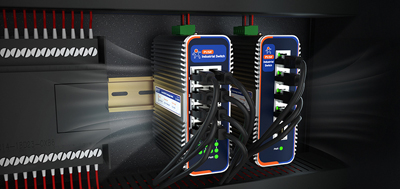
Fanless Cooling Design for Industrial Computers: How to Achieve Stable Operation in a Wide Temperature Range of -40°C to 85°C?
In today's world, where industrial automation and the Internet of Things (IoT) are deeply integrated, industrial computers, as the core devices for edge computing, are facing unprecedented environmental challenges. From the -30°C cold at unattended stations along the Qinghai-Tibet Railway to the 70°C heat in operational areas of Xinjiang oil fields; from metal dust workshops in Northeast China's old industrial bases to high-humidity and salt-fog environments in Hainan Free Trade Port—the reliability of industrial computers directly determines the continuity of production lines, the accuracy of data collection, and the stability of remote control. However, traditional fan-based cooling designs are gradually revealing fatal flaws in extreme environments due to issues such as easy dust accumulation, high failure rates, and loud noise. Fanless cooling technology, with its fully enclosed structure, passive cooling mechanism, and wide-temperature adaptability, is becoming a key solution for industrial computers to break through environmental bottlenecks.
Traditional industrial computers rely on fans for forced convection cooling, but the mechanical structure of fans determines their reliability shortcomings:
Dust Accumulation Failures: In dusty environments such as coal mines and flour processing plants, fan bearings are prone to seizure by particulate matter, leading to cooling failures. A steel plant once experienced CPU overheating due to fan failure, causing a blast furnace control system outage and direct losses exceeding 2 million yuan.
Vibration Damage: In mining equipment or AGV carts with strong vibrations, fan blades are prone to breakage, resulting in a sharp drop in cooling efficiency.
Noise Pollution: In noise-sensitive scenarios such as medical monitoring and laboratories, fan noise may interfere with precision instruments and even affect personnel health.
Low-Temperature Solidification: In -40°C environments, fan lubricants solidify, making startup difficult and even causing motor burnout. A monitoring system at an oil field in Northeast China once experienced fan shutdown due to low temperatures, interrupting data collection for up to 12 hours.
High-Temperature Efficiency Reduction: In environments above 70°C, fan motor efficiency decreases, and cooling capacity is insufficient, creating a vicious cycle of "the hotter it gets, the slower it runs; the slower it runs, the hotter it gets."
Humidity Corrosion: In coastal or high-humidity environments, fan bearings are prone to rust, shortening equipment lifespan.
Fanless cooling is not simply about removing fans but involves constructing a complete thermal management system through the synergistic effects of heat conduction, heat diffusion, and natural convection. Its core principles can be broken down into the following four steps:
Low-Power Chip Selection: Using ARM architecture processors (such as RK3562J) or ultra-low-voltage Intel processors (such as i3/i5 U series), whose thermal design power (TDP) can be as low as 5W, reducing heat generation by more than 90% compared to traditional desktop-grade chips (TDP 65W).
Intelligent Power Management: Through dynamic voltage and frequency scaling (DVFS) technology, automatically reducing CPU frequency under low loads to reduce ineffective power consumption. For example, the USR-EG628 industrial computer can reduce its CPU frequency to 0.8GHz in idle states, reducing power consumption by 60%.
Application of High-Thermal-Conductivity Materials:
Aluminum Alloy Enclosures: With a thermal conductivity of 200W/m·K, hundreds of times that of plastic, they can quickly conduct internal heat out. For example, the Kongxian G3 industrial tablet adopts a fully enclosed aluminum alloy enclosure, with an internal temperature of only 65°C measured in an 85°C environment.
Thermal Silicone Pads: Filling the tiny gaps between the CPU and the enclosure to reduce thermal resistance. A mining monitoring system improved its thermal resistance from 0.5°C/W to 0.1°C/W by replacing thermal silicone pads, increasing cooling efficiency by 4 times.
Heat Pipe Technology: Utilizing the vaporization-condensation cycle of liquid working fluids (such as pure water) to achieve rapid heat transfer. A remote monitoring system at a wind farm reduced its average annual failure rate from 2.3 to 0.5 after adopting heat pipe cooling.
Finned Enclosure Design: Increasing the contact area with air through dense cooling fins to improve natural convection efficiency. For example, the Indes ECS-T351 micro industrial computer adopts a finned enclosure, with a measured 30% increase in heat dissipation in a 60°C environment.
Heat Spreader Technology: Evenly distributing heat across the entire surface to avoid local overheating. A semiconductor inspection device maintained its core temperature within 55°C and reduced noise to below 35dB through heat spreader design.
Air Duct Design: Promoting natural air flow by optimizing the position and size of enclosure openings. For example, the USR-EG628 industrial computer adopts an "up-in, down-out" air duct design, maintaining efficient cooling even in enclosed cabinets.
Environmental Adaptation: In low-temperature environments, utilizing the temperature difference between the device's own heat generation and the environment to form natural convection; in high-temperature environments, supplementing natural convection with radiant heat dissipation from enclosure materials (such as copper).
Achieving stable operation in a wide temperature range requires not only cooling design but also optimization throughout the entire process, from component selection and structural design to system verification.
Fully Enclosed and Seamless Design: IP65/IP67 protection ratings prevent dust and liquid from entering the interior, avoiding short circuits or corrosion caused by environmental factors. For example, an unmanned mining truck at a mine improved its signal-to-noise ratio by 3 times at -20°C through fully enclosed design, avoiding bad sectors on mechanical hard drives caused by vibrations.
Anti-Vibration and Shock Design: Adopting floating support structures and shock-absorbing rubber to reduce damage to components from vibrations. The RK3576 core board in a blast furnace workshop at a steel plant extended its lifespan from 3 years to over 5 years through anti-vibration design.
Thermal Expansion Compensation for Materials: Addressing the differences in thermal expansion coefficients between metals and plastics by using PBT+GF material seals and fluororubber to avoid low-temperature cracking or high-temperature deformation.
High- and Low-Temperature Cycling Tests: Completing a temperature step every 2 hours in a -40°C to 85°C temperature cycle, with a continuous test duration of 1000 hours, achieving a 100% data retention rate in storage and a clock source frequency deviation ≤2ppm.
Anti-Interference Tests: Passing IEC 61000-4-6 standard tests, with a serial communication bit error rate ≤10^-6 under 20V/m field strength interference.
Life Acceleration Tests: Simulating long-term operation in extreme environments to predict an mean time between failures (MTBF) of up to 80,000 hours for the device, more than 2 times that of traditional devices.
Among numerous fanless industrial computers, the USR-EG628 stands out as an ideal choice for industrial automation, energy management, agricultural automation, and other scenarios with its "four-in-one" edge intelligence control capabilities and extreme wide-temperature adaptability.
Processor: RK3562J industrial-grade chip, 4-core 64-bit Cortex-A53 architecture, main frequency 2.0GHz, built-in 1 TOPS AI computing power, supporting edge AI tasks such as image recognition and voice judgment.
Memory and Storage: 4GB memory + 32GB storage, running Ubuntu system, supporting secondary development environments such as Docker, Node-Red, and Python.
Rich Interfaces: 2 RS485 ports, 1 RS232 port, 1 CAN port, 2 network ports, 2 USB ports, supporting HDMI external screen visualization.
Communication Capabilities: 4G/5G/Wi-Fi/Ethernet multi-network backup, integrating VPN, firewall, and routing functions to ensure secure data transmission.
Hardware-Level Temperature Resistance Design: From processors to power modules, the entire chain has passed -40°C to 85°C wide-temperature verification, enabling stable operation in the -40°C cold of Northeast oil fields or the 70°C heat of Xinjiang deserts.
Fanless Cooling: Aluminum alloy enclosure + fin design + thermal silicone pads, with an internal temperature of only 65°C measured in an 85°C environment, improving cooling efficiency by 40% compared to traditional air-cooling solutions.
Industrial-Grade Protection: IP65 protection rating, three-level surge protection, and three-level electrostatic protection, adapting to high-dust, high-humidity, and strong electromagnetic interference environments.
Smart Energy: Linking with BMS/PCS for remote diagnosis of energy storage systems and real-time collection of battery temperature, voltage, and other data.
Industrial Manufacturing: Millisecond-level collection of data from PLCs or IO devices, with local edge preprocessing before uploading to cloud platforms for production line joint control and cloud synchronization.
Smart Agriculture: Controlling water pumps and fans, collecting temperature, humidity, and light data, and supporting remote configuration graphical programming.
Traffic Control: Operating 24/7 in railway signal systems and traffic monitoring systems to ensure zero data loss.
From the extreme cold of -40°C to the high heat of 85°C, from dusty mines to high-humidity salt-fog environments, fanless cooling technology is redefining the boundaries of industrial computers with its advantages of "quietness, dust prevention, and reliability." The USR-EG628, as a benchmark for wide-temperature fanless industrial computers, not only solves the pain points of traditional fan-based cooling but also provides more efficient and intelligent solutions for industrial automation, energy management, agricultural automation, and other scenarios through the integration of edge computing, AI capabilities, and communication capabilities.
If you are facing reliability challenges with equipment in extreme environments or need customized wide-temperature industrial computer solutions, welcome to submit inquiries for consultation. The expert team at PUSR will provide free cooling design and product selection advice based on your business scenarios, helping you build an "always-on" industrial edge computing system!