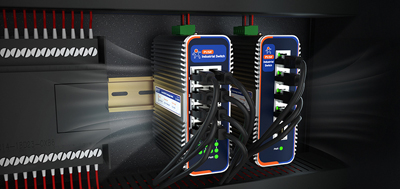
The "Green Genes" of 5G Cellular Router: How Low-Power Design Reshapes the Carbon Neutrality Path in Smart Factories
In a photovoltaic module factory in Kunshan, Jiangsu, Mr. Wang, the Equipment Department Director, is staring at an energy consumption monitoring screen—the annual power consumption of 200 5G cellular router reaches 87,000 kWh, equivalent to burning 28 tons of standard coal and emitting 10.2 tons of CO₂. This is not an isolated case but a common "energy consumption dilemma" faced by over 3,000 smart factories in China. As "carbon neutrality" evolves from a policy requirement into a core competitive advantage for enterprises, the low-power design of 5G cellular routers is serving as a breakthrough with its "green genes," reshaping the path to carbon neutrality in smart factories.
Most manufacturing enterprises fall into the mindset of "performance first" when selecting 5G cellular routers:
Energy Consumption Black Hole: A automotive parts factory deployed 200 traditional routers, consuming 120,000 kWh annually, equivalent to emitting 13.8 tons of CO₂, accounting for 8% of the factory's total carbon emissions.
Hidden Costs: An electronics manufacturing factory saw its air conditioning and cooling costs rise due to high-energy-consumption devices, with annual hidden expenses exceeding one million yuan.
Compliance Risks: As "dual carbon" policies tightened, an equipment manufacturing enterprise faced million-yuan environmental fines for non-compliance, with a 40% increase in customer order loss rates.
These pain points stem from deep-seated psychological barriers to low-power design among customers:
Performance Skepticism: Concerns that low-power design may affect router stability and transmission rates.
Migration Phobia: Misjudgments about the complexity of migrating from traditional to low-power devices, mistakenly believing it requires a complete overhaul of the existing network architecture.
Cost Sensitivity: Overemphasis on initial hardware investment while ignoring hidden costs, where energy consumption accounts for over 70% of the total lifecycle cost.
As the carbon neutrality strategy deepens, customer needs have undergone three major transformations:
Green Performance: Demanding that 5G cellular routers reduce power consumption by over 50% while maintaining high performance.
Lifecycle Management: Requiring traceability of carbon emissions throughout the device's lifecycle, from production and use to recycling.
Value Co-Creation: Expecting low-power design to not only reduce its own energy consumption but also enhance the energy efficiency of the entire production line.
The key to achieving low power consumption in 5G cellular routers lies in three technological innovations:
Energy-Efficient Chip Architecture: Adopting ARM Cortex-M series low-power processors, combined with Dynamic Voltage and Frequency Scaling (DVFS) technology, to enable intelligent power regulation under different loads.
Intelligent Sleep Mode: Utilizing patented "deep sleep + rapid wake-up" technology to automatically enter sleep mode during periods of no data transmission, with a wake-up time of ≤10ms.
Passive Cooling Design: Employing aluminum alloy heat sinks and graphene composite cooling materials to achieve passive cooling, eliminating additional energy consumption from traditional fan cooling.
Taking the 5G cellular router USR-G816 as an example, its low-power design achieves:
Ultimate Energy Efficiency Ratio: Typical power consumption ≤5W, only one-third of traditional routers, reducing annual power consumption from 435 kWh to 145 kWh.
Intelligent Power Regulation: Built-in AI energy management engine monitors load changes in real-time and dynamically adjusts power consumption, improving energy efficiency by 40%.
Green Material Application: The casing uses 30% recycled plastic, and the printed circuit board adopts a lead-free process, reducing carbon emissions during production by 20%.
Low-power design does not come at the expense of performance but achieves a "win-win" through technological innovation:
5G/4G Dual-Mode Intelligent Switching: Prioritizes 5G when the signal is strong and automatically switches to 4G when the signal is weak, ensuring transmission rates while reducing power consumption.
Edge Computing Collaboration: The built-in quad-core ARM processor supports Docker containerization deployment, enabling the running of lightweight AI algorithms for local data preprocessing and reducing cloud transmission energy consumption.
Protocol Optimization: Through patented "data packet aggregation" technology, multiple small data packets are merged for transmission, reducing channel occupation time and lowering transmission power consumption.
On automotive assembly lines, the USR-G816 achieves:
Production Line Energy Efficiency Improvement: Through low-power design, a single production line saves 12,000 kWh annually, equivalent to reducing 3.4 tons of CO₂ emissions.
Green Supply Chain: Real-time integration with supplier systems through 5G networks optimizes material transportation routes, reducing annual transportation carbon emissions by 200 tons.
Carbon Footprint Tracking: The built-in carbon footprint calculation module collects device energy consumption data in real-time, constructing a product lifecycle carbon ledger.
Case Study of a New Energy Vehicle Manufacturer: After deploying the USR-G816, the assembly line saved 85,000 kWh annually, reducing 24 tons of CO₂ emissions. It obtained the "Green Production Line" certification from an international carbon certification agency, with a 15% reduction in carbon tariffs for products exported to the EU.
On SMT production lines, the USR-G816 achieves:
Intelligent Energy-Saving Scheduling: AI algorithms analyze production line loads and dynamically adjust equipment operation strategies, saving 21,000 kWh annually.
Paperless Production: Edge computing enables real-time push of electronic work instructions, reducing paper consumption and cutting annual carbon emissions by 1.2 tons.
Waste Recycling Optimization: IoT technology enables intelligent planning of waste recycling routes, reducing annual transportation energy consumption by 30%.
Case Study of a 3C Manufacturing Enterprise: After deploying the USR-G816, the SMT production line saved 38,000 kWh annually, reducing 10.8 tons of CO₂ emissions. It obtained the provincial "Green Factory" title and received government subsidies exceeding one million yuan.
In the food and pharmaceutical industries, the USR-G816 achieves:
Cold Chain Energy Saving: Intelligent temperature control algorithms enable dynamic frequency modulation of cold chain equipment, saving 15,000 kWh annually.
Sterile Workshop Energy Saving: Air quality sensors enable intelligent ventilation in sterile workshops, saving 8,000 kWh annually.
Packaging Material Optimization: Edge computing enables intelligent selection of packaging materials, reducing excessive packaging and cutting annual carbon emissions by 0.5 tons.
Case Study of a Biopharmaceutical Enterprise: After deploying the USR-G816, the cold chain system saved 23,000 kWh annually, reducing 6.5 tons of CO₂ emissions. The product's carbon footprint decreased by 15%, meeting EU carbon tariff compliance requirements.
After deploying the USR-G816, a precision machine tool factory achieved:
Energy Consumption Reduction: Power consumption per device dropped from 15W to 5W, saving 42,000 kWh annually and reducing 12 tons of CO₂ emissions.
Production Line Upgrade: Low-power design drove energy efficiency improvements across the entire production line, increasing Overall Equipment Effectiveness (OEE) by 10%.
Green Certification: Obtained the "Carbon Neutral Factory" certification from an international authoritative agency, enhancing product export competitiveness by 20%.
After deploying the USR-G816, an electronics manufacturing base achieved:
Flexible Energy Saving: Supported product model switching on the production line within 30 minutes, reducing energy consumption by 30% during the switching process.
Intelligent Scheduling: The AI energy management engine optimized equipment operation strategies, saving 56,000 kWh annually.
Carbon Asset Management: The built-in carbon asset management module enabled real-time trading of carbon emission rights, generating annual carbon revenue exceeding one million yuan.
With the development of technologies such as 5G-Advanced and AI autonomous networks, low-power design will evolve to higher dimensions:
Intelligent Energy Consumption 2.0: AI algorithms enable self-optimization and fault prediction of device energy consumption, reducing manual intervention.
Digital Twin Energy Saving: Constructing digital twins of devices to simulate energy consumption changes and reduce trial-and-error costs.
Green Supply Chain Collaboration: Blockchain technology enables full traceability of supply chain energy consumption, building a green supply chain ecosystem.
As a practitioner of this transformation, the USR-G816 not only addresses customer pain points in energy consumption and environmental protection but also defines a new standard for 5G cellular routers with its low-power design. Choosing the USR-G816 is not just choosing a device but embracing an industrial philosophy of "creating value through greenness"—allowing low-power design to continuously evolve and create green value, and enabling carbon neutrality to be continuously achieved through technological innovation.
The promotion of carbon neutrality through the low-power design of 5G cellular routers is essentially a revolution in management thinking. The traditional "energy consumption first" model regards energy consumption as a cost burden, while the green gene model sees low energy consumption as a source of value creation. This transformation requires enterprises to:
Shift from cost thinking to value thinking: Treat low-energy design as a carrier of value creation rather than a cost burden.
Move from passive emission reduction to active value creation: Achieve dual benefits of energy consumption reduction and value creation through technological innovation.
Upgrade from compliance requirements to strategic advantages: Elevate carbon neutrality from a policy requirement to a core competitive advantage for the enterprise.
This transformation in management philosophy is reshaping the competitive landscape of the manufacturing industry. Enterprises that take the lead in upgrading their green genes will gain a first-mover advantage in the carbon neutrality wave.
In the wave of carbon neutrality, traditional high-energy-consumption devices are no longer "immutable cornerstones" but litmus tests for green gene capabilities. 5G cellular routers, driven by low-power design, propel smart factories to evolve from "energy consumption dilemmas" to "green benchmarks." The USR-G816, with its proven performance, serves as a model for this evolution. When green genes become an instinct in design, the future of intelligent manufacturing will be more low-carbon, efficient, and sustainable. This is not just a victory for technology but also a sublimation of management thinking—allowing green genes to continuously evolve and create value, and enabling carbon neutrality to be continuously achieved through technological innovation.