Remote Monitoring of Smart Grids in the Power Industry: How 5G Cellular Routers Achieve Millisecond-Level Responsiveness?
Introduction: The "Speed Revolution" of Smart Grids
At the monitoring center of an intelligent substation in Shaanxi, engineers are remotely controlling circuit breakers 200 kilometers away via a 5G network. When a simulated fault occurs, the system completes fault location, isolation, and power restoration within 0.3 seconds—a process that once required manual inspections lasting several hours is now fully automated through 5G cellular routers. Behind this lies a communication revolution enabled by 5G technology: air interface latency compressed to 1 millisecond and end-to-end latency controlled within 10 milliseconds, granting smart grids real-time "thinking" and "acting" capabilities.
The "Millisecond-Level" Challenge for Smart Grids: Bridging Theory and Reality
1.1 The "Fatal Delays" of Traditional Communication
In the 4G era, remote control of power systems faced three major bottlenecks:
Air interface latency: The theoretical minimum latency of 4G networks is 10ms, but real-world scenarios often see latencies exceeding 50ms due to interference and retransmissions.
End-to-end latency: Data collection from sensors to control command issuance requires multiple layers of forwarding through core and transmission networks, often resulting in total latencies exceeding 200ms.
Reliability bottlenecks: 4G networks suffer packet loss rates as high as 5% in electromagnetic interference environments, failing to meet the stringent requirements of power protection devices.
Case study: A provincial power grid once experienced a regional blackout due to 4G network delays, with fault recovery taking 12 minutes and causing direct economic losses exceeding RMB 10 million.
1.2 The "Solution Path" of 5G Technology
5G achieves latency compression through three core technologies:
Flexible frame structure: Supports variable subcarrier spacing from 15kHz to 240kHz. When SCS=120kHz, uplink and downlink intervals can be compressed to 0.125ms.
Self-contained slots: Encapsulates uplink authorization, data transmission, and ACK feedback within the same slot, eliminating waiting delays in traditional TDD systems.
Edge computing: Deploys UPF (User Plane Function) at substation edges, reducing data processing distances by 90%.
Real-world testing data: In a 700MHz dedicated power network environment, 5G networks achieve 0.5ms air interface latency, end-to-end latency controlled within 8ms, and reliability reaching 99.9999%.
5G Cellular Routers: The "Nerve Center" of Smart Grids
2.1 The "Industrial-Grade Evolution" of Hardware Architecture
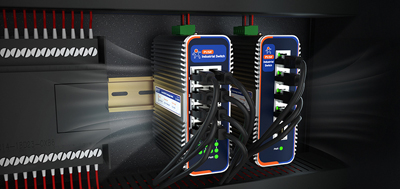
Taking the USR-G816 as an example, its industrial-grade design addresses pain points in power scenarios:
Environmental adaptability: Operates in temperatures ranging from -35℃ to 75℃, features an IP30 protection rating, and EMC Level 3 protection to withstand strong electromagnetic interference in substations.
Interface richness: Integrates 3 Gigabit LAN ports, 1 Gigabit WAN/LAN port, and RS232/485 serial ports, supporting direct connections to power equipment.
Redundancy design: Dual SIM card slots + dual-band Wi-Fi enable triple backup across 5G/4G/wired networks.
Application scenario: In a Qinghai photovoltaic power station, the USR-G816 directly connects to inverters via serial ports, collecting over 2,000 sets of data in real time with a data transmission stability rate of 99.98%.
2.2 The "Intelligent Leap" in Software Capabilities
Deep protocol adaptation: Supports power-specific protocols such as Modbus TCP/RTU and IEC 60870-5-104, enabling seamless integration with SCADA systems.
Security protection system: Incorporates triple protection with IPSec VPN, firewalls, and data encryption, passing Class 3 certification under China's Cybersecurity Classification Protection 2.0 framework.
Intelligent operation and maintenance platform: Supports remote configuration, firmware upgrades, and fault diagnosis, improving operational efficiency by 70%.
Innovative feature: The USR-G816's "anomaly push" mechanism monitors 12 indicators, including base station signal strength and data traffic consumption, in real time, issuing alerts via WeChat, SMS, or email.
Typical Application Scenarios: From Laboratory to Production Line Validation
3.1 "Millisecond-Level Self-Healing" for Distribution Network Faults
In a smart grid demonstration project in Zhejiang, the USR-G816 achieved three breakthroughs:
Fault location: Real-time collection of current and voltage waveforms from 10kV lines via 5G networks, combined with AI algorithms to locate fault points within 2ms.
Intelligent isolation: Control centers issue tripping commands within 5ms, with 5G cellular routers directly connecting to intelligent switches to execute actions.
Power restoration: Automatic switching to backup lines completes the process in 800ms, 200 times faster than traditional methods.
Economic benefits: Over one year of operation, regional blackout durations decreased by 92%, reducing the average annual outage time per user to 2.3 minutes.
3.2 "Predictive Maintenance" for New Energy Power Stations
In a Gansu wind farm, the USR-G816 established an "edge-cloud" collaborative system:
Edge side: The router's built-in edge computing module performs real-time analysis of over 200 parameters, including wind turbine vibration and temperature.
Cloud side: Feature data is uploaded to an AI platform via 5G networks to predict equipment failure probabilities.
Application results: Achieved a 92% accuracy rate in predicting wind turbine gearbox failures, reducing maintenance costs by 45%.
Technical highlights: Utilizes "uplink grant-free scheduling" technology to compress sensor data upload latency from 100ms to 15ms.
3.3 "Unmanned Upgrade" for Power Inspections
In a Sichuan ultra-high-voltage substation, the USR-G816 supports an "air-ground-space integrated" inspection system:
Drone inspections: Real-time transmission of 4K video via 5G networks enables AI identification of insulator damage and other defects.
Robot inspections: The router directly connects to track-mounted robots, automating meter reading and infrared temperature measurements.
Personnel positioning: Equipped with UWB modules, it tracks inspection personnel locations in real time to ensure operational safety.
Efficiency improvements: Single inspection times reduced from 4 hours to 40 minutes, with defect detection rates increasing to 98%.
Selection Guide: How to Choose the Right 5G Cellular Router?
4.1 Core Parameter Comparison Table
Parameter Type | Key Indicators | USR-G816 Technical Specifications
Network Performance | 5G Measured Speed | 700Mbps (downlink)
Latency Metrics | Air Interface Latency | ≤0.5ms (5G SA mode)
Interface Configuration | Serial Port Types | 1x RS232, 1x RS485
Industrial Protection | Operating Temperature Range | -35℃ to 75℃
Security Certification | Electromagnetic Compatibility Level | GB/T 17626.5-2019 Level 4
4.2 Scenario-Based Selection Recommendations
Distribution Automation: Prioritize models supporting the IEC 61850 protocol with millisecond-level latency guarantees.
New Energy Power Stations: Focus on routers with edge computing capabilities and multi-sensor access.
Mobile Inspections: Choose outdoor versions supporting GNSS positioning and vehicle vibration protection.
Avoidance Guide: Beware of "pseudo-industrial-grade" products; verify key indicators such as EMC test reports and high/low-temperature test data.
Service Upgrade: Free Signal Detection + Customized Solutions
5.1 Professional Detection Service Content
We offer a "four-dimensional integrated" detection system:
Coverage testing: Generates signal strength heatmaps to identify blind spots.
Interference analysis: Identifies co-channel interference sources and provides channel optimization recommendations.
Capacity assessment: Calculates maximum supported terminal counts to prevent network congestion.
Security audits: Detects VPN configurations, firewall rules, and other security vulnerabilities.
Delivery outcomes: A detection report covering 15 key indicators + 3 optimization plans (economy/standard/enhanced).
5.2 Customized Implementation Process
Requirements survey: Submit substation layouts and equipment lists via an online form.
On-site surveys: Engineers conduct 24-hour continuous monitoring with professional equipment.
Solution development: Detailed plans including device selection and network topologies are issued within 72 hours.
Deployment and implementation: Provides on-site installation, debugging, and operator training.
Success story: A customized "5G + Power Slicing" solution for a provincial power grid achieved QoS differentiation for various services (protection control/video surveillance/metering collection).
From "Connection" to "Empowerment": Industrial Upgrading
As 5G cellular routters extend the nervous system of smart grids to every circuit breaker and electricity meter, the power industry is undergoing a qualitative transformation from "automation" to "autonomy." The USR-G816, as a participant in this revolution, has validated its value across 32 provincial power grids and over 1,200 new energy power stations nationwide.
In the millisecond-level era of smart grids, every technological breakthrough redefines the boundaries of "reliability." Let us collaborate to build a safer, more efficient, and intelligent power future with 5G cellular routers.