The AI Revolution in the Window-Level Monitoring Industry: How ARM Industrial PC Break Through Traditional Monitoring Dilemmas
In the reaction kettle workshop of a chemical enterprise, operator Xiao Li is staring at the level gauge on the control cabinet, with fine beads of sweat on his forehead. The gauge shows that the liquid level is approaching the warning line, but when he rushes into the workshop, he finds that the actual liquid level differs from the gauge reading by nearly 30 centimeters—this is the third emergency shutdown caused by false liquid level alarms this month. Such scenes are repeated daily at tens of thousands of industrial sites worldwide. Window-level monitoring, as a core aspect of industrial production, is facing a triangular dilemma of precision, efficiency, and safety.
A pharmaceutical enterprise has 128 window-level monitoring points. Traditional manual inspections require four workers to work eight hours a day, with annual labor costs exceeding 2 million yuan. More seriously, the error rate of manual readings is as high as 5%-8%. In high-precision scenarios such as vaccine production, a single misjudgment can lead to the scrapping of batches worth millions of yuan. A biopharmaceutical company once had a liquid level monitoring error that exposed the culture medium to the air beyond the safe time limit, rendering the entire batch of cell cultures ineffective.
Float-type sensors are prone to jamming in viscous media, ultrasonic sensors experience signal attenuation of over 40% in high-temperature environments, and capacitive sensors are extremely sensitive to changes in medium conductivity. A petrochemical enterprise used radar level gauges to monitor storage tanks, but due to foam on the medium surface, the false alarm rate reached 15%. Ultimately, they had to retain a manual secondary confirmation process, extending the return on investment period for automation to eight years.
A food processing plant deployed a SCADA system, but the liquid level data was only used for post-event tracing and could not trigger automatic material replenishment or warnings. A more common issue is that devices from different brands use seven communication protocols, with data integration costs accounting for 35% of the total project investment. An electric power group attempted to establish a liquid level big data platform, but due to inconsistent data quality, the accuracy rate of the AI model was less than 60%.
In a semiconductor wafer factory, the AI vision module equipped on the USR-EG528 ARM industrial PC achieves precise liquid level recognition through the following technological breakthroughs:
Multispectral imaging technology: Combining visible light and infrared spectra to penetrate interference factors such as steam and fog, maintaining a recognition accuracy rate of 99.2% in high-temperature environments of 85°C.
Dynamic threshold adjustment: Automatically optimizing image processing algorithms based on parameters such as medium color and reflectivity. Tests by a cosmetics enterprise show that the recognition error for transparent liquids has been reduced from ±5 mm to ±0.3 mm.
Three-dimensional reconstruction capability: Capturing liquid surface curvature features through binocular cameras, improving measurement accuracy by three times compared to traditional ultrasonic solutions in irregular storage tank scenarios.
A blast furnace hot metal liquid level monitoring project by a steel group reveals the core value of edge computing:
Millisecond-level response: The RK3568 processor of the USR-EG528 can complete image acquisition, AI inference, and control instruction issuance within 200 ms, reducing latency by 90% compared to cloud-based solutions.
Model lightweighting: Compressing the YOLOv7 model to 3.2 MB through knowledge distillation technology, achieving real-time detection at 45 FPS on embedded devices.
Offline data caching and automatic synchronization upon network recovery: The built-in 4G module supports local data caching and automatic synchronization after network restoration. Tests on an offshore drilling platform show a data integrity rate of 99.97%.
In the monitoring of hazardous chemical storage tanks in a chemical park, the AI recognition system demonstrates predictive capabilities beyond traditional monitoring:
Equipment health assessment: Predicting level gauge failures 72 hours in advance by analyzing the frequency and amplitude of liquid level fluctuations. After application by an enterprise, unexpected equipment shutdowns have been reduced by 65%.
Process optimization simulation: Simulating the impact of different material replenishment strategies on liquid levels in a virtual environment. A pharmaceutical enterprise has reduced batch-to-batch variations from 8% to 2% through this technology.
Energy efficiency optimization decision-making: Automatically adjusting storage tank charging and discharging strategies by combining liquid level data with electricity price fluctuation curves. A water utility group has saved over 4 million yuan in electricity costs annually.
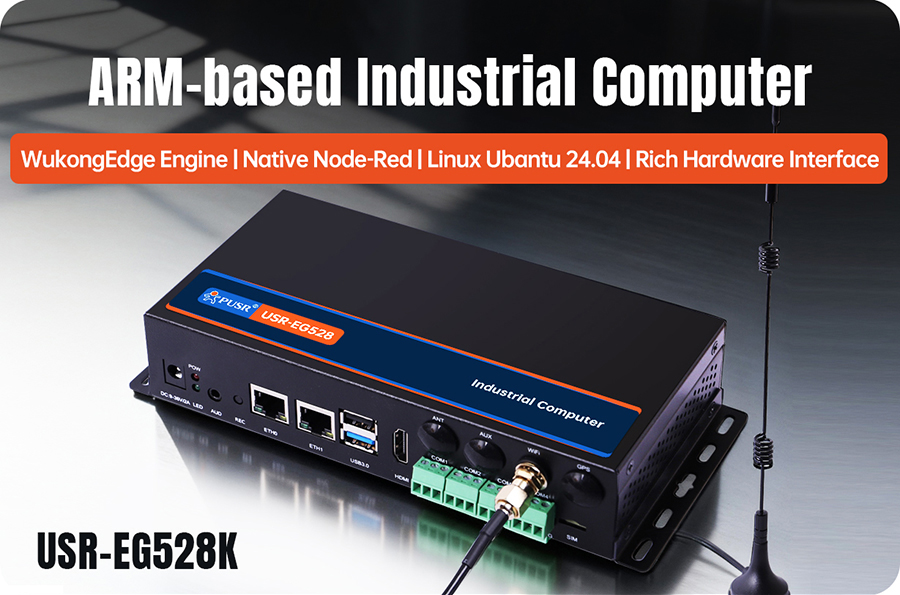
In the liquid level monitoring transformation of a new energy vehicle battery production line, the USR-EG528 demonstrates three core advantages:
Computing power guarantee: With 1.0 TOPS NPU computing power, it supports simultaneous operation of three 4K video stream analyses and 12-channel time-series data modeling, meeting the needs of complex scenarios such as electrolyte electrolyte filling and coolant circulation.
Environmental adaptability: With a wide temperature design of -20°C to 70°C and an IP65 protection rating, it has withstood a 50°C day-night temperature difference in a desert photovoltaic power plant.
Anti-interference capability: With three-level surge protection and low-ripple power supply design, it has operated stably for over 10,000 hours in an electric arc furnace workshop with a complex electromagnetic environment.
Pre-installed industry models: Built-in with over 10 pre-trained models such as liquid level recognition, foam detection, and leakage warning. A food enterprise completed production line deployment in just four hours.
Low-code development platform: Providing Python/C++ dual development environments and visual modeling tools. An automation engineer developed a customized abnormal detection algorithm in three days through a drag-and-drop interface.
Cloud collaboration management: Supporting connection with the U-cloud platform, enabling centralized monitoring and intelligent warnings of liquid level data from factories nationwide for a chain enterprise.
Cost optimization: Reducing the total cost of ownership (TCO) by 42% compared to traditional solutions. A chemical enterprise has saved over 20 million yuan in losses over five years by reducing unplanned shutdowns.
Efficiency improvement: After application in a semiconductor factory, the response time to liquid level-related abnormalities has been shortened from 15 minutes to 90 seconds, and capacity utilization has increased by 18%.
Widespread predictive maintenance: By 2028, 85% of industrial level gauges will have self-diagnosis capabilities, with fault prediction accuracy exceeding 95%.
Digital carbon management: Accurately calculating energy consumption through liquid level data to help enterprises reduce carbon emission costs by 10%-15%.
Autonomous decision-making systems: AI will deeply participate in the formulation of liquid level control strategies. A research institute predicts that intelligent liquid level management systems can improve process stability by up to 40%.
Value extension: By analyzing liquid level data to optimize production scheduling, a pharmaceutical enterprise has increased its overall equipment effectiveness (OEE) from 68% to 89%.
With the continuous evolution of AI technology, window-level monitoring will undergo three major transformations:
When the indicator light on the USR-EG528 ARM industrial PC illuminates in the control room of a smart factory, it not only signifies the startup of a device but also the beginning of an industry transformation. From manual inspections to AI recognition, from silent data to value explosion, this liquid level monitoring revolution driven by ARM industrial PCs is redefining the efficiency boundaries and safety bottom lines of industrial production. For enterprises still struggling in traditional modes, choosing AI is not a multiple-choice question but a must-answer question concerning survival and development—because in this era where data determines competitiveness, silent liquid level data will eventually devour the future of enterprises.