Rail Transit PIS System: How Can Cellular WiFi Router Ensure Real-Time Data Transmission for Train Operations?
In the wave of intelligent upgrades in rail transit, the Passenger Information System (PIS) has become a core carrier for enhancing service quality and operational efficiency. From real-time train arrival information and emergency evacuation guidance to in-car video surveillance and advertising delivery, the PIS system must ensure the real-time nature and reliability of data transmission under harsh conditions such as high-speed movement, strong electromagnetic interference, and complex tunnel environments. However, traditional network equipment often faces challenges like signal attenuation, link interruptions, and protocol incompatibility, leading to data delays or losses that directly impact passenger experience and operational safety. Cellular WiFi router, with their high stability, anti-interference capabilities, and intelligent networking technologies, are emerging as a key support for solving the real-time challenges of PIS systems.
The real-time requirements of PIS systems span the entire lifecycle of train operations. For instance, when a train arrives at a station, the system must push arrival times and transfer information to platform and in-car displays within 3 seconds. In emergencies, fire alarm signals must trigger full-car broadcasts and evacuation guidance within 1 second. In-car video surveillance must upload footage to the control center at a rate of 25 frames per second to ensure smooth monitoring without lag. These scenarios impose stringent requirements on network latency, bandwidth stability, and data integrity.
Traditional PIS systems often adopt a hybrid networking approach combining "wired + wireless APs," but they suffer from three major pain points:
Signal Coverage Blind Spots: Wireless signals severely attenuate in tunnels, leading to frequent "disconnections" when trains pass through at high speeds.
Insufficient Link Redundancy: Single-point failures can disrupt data transmission across the entire line, with recovery times extending to several minutes.
Poor Protocol Compatibility: Inconsistent device protocols from different manufacturers require additional gateways for data forwarding, increasing latency.
In one case, a city's subway experienced a 15-second delay in displaying train arrival information due to wireless AP switching delays, triggering passenger complaints. In another instance, electromagnetic interference in a tunnel caused video surveillance footage to be lost, hampering accident investigation efficiency. These cases highlight the inadequacies of traditional solutions in ensuring real-time performance.
By integrating technologies such as multi-mode communication, intelligent redundancy, and edge computing, cellular WiFi router establish an integrated "end-pipe-cloud" real-time transmission system that directly addresses the pain points of PIS systems.
Cellular WiFi router support "5G/4G + WiFi6 + wired" multi-mode access, dynamically switching to the optimal link based on the environment. For example, 5G private networks are used in tunnels to ensure basic bandwidth, WiFi6 enables high-speed device interconnection within cars, and wired networks serve as backup links in station areas. Field tests in a subway project showed that multi-mode switching delays were below 50ms, ensuring seamless signal transitions throughout the train's journey.
Cellular WiFi router employ "dual-link hot standby + ring networking" technologies to achieve second-level fault recovery:
Dual-Link Hot Standby: Both primary and backup links transmit data simultaneously. When the primary link fails, the backup link seamlessly takes over, ensuring zero business interruption.
Ring Networking: By forming self-healing ring networks using the MR-Ring protocol, the network can recover within 20ms in the event of a single-point failure, 100 times faster than traditional STP protocols.
After adopting ring networking, Shanghai Metro Line 1 reduced its annual failure rate from 12% to 0.3% and improved data transmission integrity to 99.99%.
Cellular WiFi router incorporate edge computing modules to perform local data preprocessing and protocol conversion. For example, they compress and encode video streams from multiple in-car cameras before uploading, reducing bandwidth usage by 30%. They also prioritize emergency alarm signals to ensure high-priority data is transmitted first. In a chemical park monitoring project, edge computing reduced data upload delays from 2 seconds to 200 milliseconds.
Cellular WiFi router feature metal casings, EMC Level 3 protection, and wide-temperature designs (-40℃ to 75℃), enabling them to withstand strong electromagnetic interference, vibration, and temperature fluctuations in tunnels. For instance, in a port container terminal project, routers operated fault-free for 2 years in a salt-spray environment, extending their lifespan by three times compared to traditional equipment.
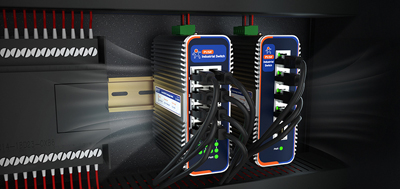
The USR-G809s cellular WiFi router is specifically designed for rail transit scenarios, with core features that closely align with the needs of PIS systems:
Five Network Ports + Dual Serial Ports: Supports 2 SFP optical ports, 8 RJ45 electrical ports, 1 RS232, and 1 RS485 interface, enabling simultaneous connection to onboard controllers, video servers, sensors, and other devices for "one-machine multi-collection."
Dual-SIM Dual-Mode: Supports 5G/4G networks from three major operators and can be configured with dual SIM cards for redundancy, ensuring automatic switching to a backup link if the public network fails.
LoRa Low-Power Wide-Area Network: Extends network coverage by transmitting critical data via LoRa to nearby base stations in areas without public network coverage.
MR-Ring Self-Healing Ring Network: Supports the formation of ring networks through any port, with self-healing times of less than 20ms, meeting the stringent fault recovery requirements of PIS systems.
VRRP Dual-Machine Hot Standby: Primary and backup routers synchronize configurations in real-time. If the primary device fails, the backup device seamlessly takes over, ensuring zero business interruption.
QoS Traffic Scheduling: Allocates dedicated bandwidth to high-priority data such as emergency alarms and train control signals, ensuring zero packet loss for critical services.
Python Secondary Development: Supports simple analyses such as data cleaning and threshold judgment at the router level. For example, when smoke sensor values in a car exceed the threshold, the router can trigger local alarm lights to flash and immediately upload alert information to the cloud.
Protocol Conversion Capabilities: Compatible with industrial protocols such as Modbus RTU/TCP, OPC UA, and PPI, enabling seamless integration with monitoring devices from different brands and avoiding delays caused by protocol incompatibility.
Three-Level Security Protection: Supports IPSec/OpenVPN encryption, firewalls, and access control lists (ACLs) to prevent data leaks or malicious attacks.
Industrial-Grade Design: Metal casing, IP65 protection rating, and EMC Level 3 certification, adapting to vibration, humidity, and strong electromagnetic environments in tunnels.
Wide Temperature and Voltage Range: Supports DC9-60V wide-voltage input and operates in temperatures ranging from -40℃ to 75℃, eliminating the need for additional temperature control equipment and reducing deployment costs.
Pain Points: The original system used wireless APs for networking, resulting in severe signal attenuation in tunnels. Video surveillance footage frequently lagged when trains passed through at high speeds, leading to a 15% passenger complaint rate.
Solutions:
Deployed USR-G809s cellular WiFi router, adopting "5G private network + WiFi6 + wired" multi-mode communication to ensure 5G signal coverage in tunnels.
Built an MR-Ring ring network, configuring cross-ring connections between switches at the front and rear of the train, reducing self-healing times from minutes to 20ms.
Enabled QoS policies to allocate dedicated bandwidth for video surveillance data, reducing frame lag rate to 0.5%.
Effects:
Data transmission integrity improved from 85% to 99.9%.
Annual operation and maintenance costs reduced by 40%, with fault response times shortened from 2 hours to 10 minutes.
The project passed acceptance by the Ministry of Transport and was awarded the title of "Smart Metro Demonstration Project."
Pain Points: The line traversed mountainous and riverine areas, making mains power access difficult. Solar power efficiency was low, leading to frequent device power outages. Traditional routers' high power consumption exacerbated energy pressures.
Solutions:
Selected USR-G809s cellular WiFi routers, supporting DC9-60V wide-voltage input and compatible with solar + lithium battery hybrid power supply systems.
Enabled low-power mode, reducing router power consumption by 30% compared to traditional products and extending battery life.
Monitored power status remotely via the USR Cloud platform to preemptively alert battery failures and avoid device downtime.
Effects:
Device battery life extended from 3 days to 7 days, reducing manual battery replacement frequency.
Data loss rate reduced from 20% to 1%, meeting the monitoring requirements of the Environmental Protection Bureau.
The project was awarded the title of "Green Rail Transit Innovation Case."
| Parameter | USR-G809s | Traditional Cellular WiFi Router |
| Communication Mode | 5G/4G + WiFi6 + wired multi-mode | Single-mode communication (e.g., 4G only) |
| Redundancy Mechanism | Dual-link hot standby + MR-Ring ring networking | Single-link, no self-healing capability |
| Edge Computing Capability | Python secondary development, supports local data processing | No development environment, only data forwarding |
| Environmental Adaptability | -40℃ to 75℃, EMC Level 3 protection | -20℃ to 60℃, EMC Level 2 protection |
| Interface Richness | 2 optical + 8 electrical ports + dual serial ports + dual SIM cards | 4 electrical ports + single serial port + single SIM card |
Tunnel Scenarios: Prioritize routers supporting MR-Ring ring networking and 5G private networks to address signal attenuation and link redundancy issues.
Extreme Temperature Areas: Choose routers with wide-temperature designs (-40℃ to 75℃) and dustproof/waterproof (IP65) ratings to adapt to harsh environments.
High Device Compatibility Requirements: Select routers supporting multi-protocol conversion (Modbus/OPC UA/PPI) to avoid delays caused by protocol incompatibility.
In the journey of intelligent transformation in rail transit, the real-time nature of PIS systems has become a core indicator for measuring service quality and operational efficiency. Cellular WiFi routers, through the integration of technologies such as multi-mode communication, intelligent redundancy, and edge computing, are evolving from mere "data channels" into "real-time transmission hubs," providing stable, efficient, and secure support for PIS systems. The USR-G809s cellular WiFi router, with its exceptional environmental adaptability, rich interface and protocol support, and powerful edge computing capabilities, has become the preferred solution for rail transit PIS systems.