Smart Port Container Scheduling: How Cellular Modems Support 5G+MEC Edge Computing Deployment
In today's era of accelerated global trade development, the core status of ports as logistics hubs has become increasingly prominent. However, traditional ports generally face three major pain points in container scheduling: communication delays leading to low operational efficiency, uncontrolled equipment collaboration causing safety accidents, and data silos restricting intelligent decision-making. These issues not only directly drive up operational costs but also serve as core obstacles to the ports' transformation towards intelligence. This article will provide an in-depth analysis of how cellular modems can offer a "low-latency, highly reliable, and strongly collaborative" solution for port container scheduling by supporting the deployment of 5G+MEC edge computing.
At a container terminal, a single quay crane needs to coordinate multiple unmanned container trucks, rail-mounted gantry cranes, and stackers simultaneously to complete loading and unloading operations. Under traditional Wi-Fi or 4G networks, communication delays between equipment are generally over 100ms, leading to frequent path planning conflicts. For example, an international hub port once experienced a collision of three container trucks at an intersection due to latency issues, resulting in direct economic losses exceeding RMB 2 million. More seriously, in automated terminals, a delay of 0.1 seconds can lead to a deviation of up to 1 meter in container grasping, causing equipment damage or even casualties.
Container scheduling involves the collaboration of multiple types of equipment and multiple business systems. In traditional architectures, data from video surveillance, PLC control, AGV scheduling, etc., needs to be transmitted through the core network to the cloud for processing, resulting in response delays of over 500ms for critical instructions. A port once attempted to deploy an intelligent tallying system, but due to data transmission lags, the AI recognition results were severely out of sync with the actual operational progress, and the system was ultimately forced to be discontinued. In addition, the lack of real-time data interaction between equipment results in the efficiency of multi-machine collaborative operations being less than 40% of the theoretical value.
Ports generate terabytes of data daily, but under traditional architectures, equipment data, business data, and environmental data are stored separately in different systems, forming "data silos." A port once invested tens of millions of yuan in building a digital twin platform, but due to its inability to obtain real-time equipment status data, the model's prediction accuracy was less than 60%, and the platform ultimately became a "demonstration project." More critically, data fragmentation makes it difficult for ports to achieve optimal resource allocation based on dynamic data, such as being unable to adjust yard layouts according to real-time cargo volumes, resulting in low space utilization.
Edge computing achieves localized data processing and decision-making by sinking computing capabilities to the network edge (e.g., cellular modems). In port scenarios, its core advantages are reflected in:
5G private networks provide critical support for edge computing:
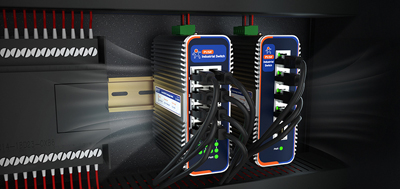
In the 5G+MEC architecture, cellular modems serve as the connection hub between equipment and the network, undertaking core functions such as data collection, protocol conversion, and edge computing. Taking the USR-G771 as an example, it supports port container scheduling through three major capabilities:
Port equipment protocols are complex and diverse, including Modbus RTU/TCP, OPC UA, Profinet, etc. The USR-G771 supports over 150 industrial protocols and can seamlessly connect with equipment such as quay cranes, AGVs, and sensors. For example, in an automated yard of a port, the USR-G771 converted the Modbus RTU protocol of a PLC to MQTT, enabling real-time interaction between equipment status data and the cloud platform, and reducing fault response time from 30 minutes to 3 minutes.
The USR-G771 has a built-in edge computing module that can run lightweight AI models to achieve localized data processing:
Ports have harsh environments and place extremely high demands on equipment stability. The USR-G771 adopts an industrial-grade design:
| Dimension | Traditional Solution | USR-G771+5G+MEC Solution |
| Latency | 100-500ms | ≤10ms |
| Collaboration Efficiency | Equipment operates independently, with 40% efficiency | Multi-machine collaboration, with 80% efficiency improvement |
| TCO | Maintenance costs exceed RMB 8 million over 5 years | Total costs reduced by 50% over 3 years |
Driven by the dual goals of Industry 4.0 and "carbon peaking and carbon neutrality," ports are shifting from "scale competition" to "efficiency competition." 5G+MEC edge computing reconstructs the communication architecture, enabling ports to possess core capabilities of "low latency, strong collaboration, and high intelligence." As a key node in this architecture, the cellular modem USR-G771 is helping ports achieve a leap from "experience-driven" to "data-driven."
Choosing the USR-G771 is not just choosing a cellular modem; it is choosing a future-oriented production method. It evolves container scheduling from "manual coordination" to "intelligent collaboration" and transforms port operations from "passive response" to "active optimization." At this moment, the gap between you and a smart port may be just one USR-G771 away.