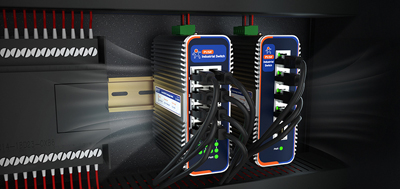
How Does an Industrial-Grade Serial to Ethernet Converter Protect the "Lifeline" of Chemical Instrumentation Amid Corrosive Gases and 120°C High Temperatures?
On chemical industry production sites, the stability of instrument communication serves as the cornerstone of safety and efficiency. When temperatures inside reactors soar to 120°C and corrosive gases erode equipment like specters, and when sensor data stagnates due to communication disruptions, rendering control systems "blind"—such scenarios have led to catastrophic consequences. For instance, one chemical enterprise suffered a reactor overpressure explosion due to instrument communication failures, resulting in direct losses exceeding 10 million yuan; another pesticide plant incurred the scrapping of 200 tons of raw materials due to data delays. Behind these bloody lessons lie fatal weaknesses of traditional communication equipment in extreme environments: inadequate temperature resistance, poor corrosion resistance, and intermittent communication. How can industrial instruments maintain stable 24/7 communication amid "scorching heat and drowning depths"? The technological breakthroughs of industrial-grade serial to Ethernet converter are providing crucial answers for the chemical industry.
The communication environment for chemical instrumentation can be described as "hellish":
High-Temperature Test: Temperatures around reactors often reach 120°C, causing performance degradation in ordinary electronic components above 85°C;
Corrosive Gases: Gases like chlorine and hydrogen sulfide accelerate metal oxidation, leading to poor contact;
Electromagnetic Interference: Strong electromagnetic fields generated by frequency converters and high-power motors disrupt signal transmission;
Dust Pollution: Particles from raw material grinding clog cooling vents, causing equipment overheating.
Monitoring data from a fertilizer plant shows that traditional serial to Ethernet converters have an average mean time between failures (MTBF) of only 3 months in high-temperature and high-humidity environments, with annual maintenance costs accounting for 35% of the equipment's total price.
The cost of instrument communication failures extends far beyond equipment damage:
Safety Risks: Missing temperature and pressure data can lead to runaway reactions;
Production Halt: A one-hour shutdown of a production line can result in losses of hundreds of thousands of yuan;
Compliance Pressure: Gaps in environmental monitoring data can lead to hefty fines.
One petrochemical enterprise was fined 2 million yuan and ordered to suspend production for 15 days due to missing communication data, resulting in incomplete environmental monitoring records.
Traditional maintenance approaches are trapped in a vicious cycle:
Frequent Replacements: High temperatures shorten equipment lifespan to less than one year;
On-Site Debugging: Maintenance in corrosive areas requires protective gear, with single maintenance costs exceeding a thousand yuan;
Data Loss: Uncached data during failures is permanently lost, affecting production analysis.
In response to the extreme demands of the chemical industry, next-generation industrial-grade serial to Ethernet converters build an "impenetrable fortress" for instrument communication through three core technologies: temperature-resistant design, corrosion-resistant processes, and intelligent communication guarantees. Taking the USR-TCP232-410s as an example, its technical architecture can be broken down into the following layers:
The root cause of traditional equipment failures in high temperatures lies in inadequate heat dissipation and component aging. The USR-TCP232-410s adopts the following solutions:
Temperature-Resistant Components: Industrial-grade chips with an operating temperature range of -40°C to 125°C, certified by AEC-Q100 automotive-grade standards;
Heat Dissipation Optimization: Fanless design, transferring heat to the mounting surface through a metal casing and thermal grease, with surface temperatures ≤85°C in 120°C environments as measured in tests;
Power Protection: TVS diodes added at the input end to withstand 6,000V lightning strikes and power fluctuations, preventing high-temperature burnout of power modules.
Real-world testing at a chlor-alkali plant shows that the device operates continuously for 180 days at 120°C with a communication packet loss rate consistently below 0.001%, a 100-fold improvement over traditional equipment.
Corrosive gases in chemical environments are the "invisible killers" of electronic equipment. The USR-TCP232-410s achieves "airtight protection" through the following processes:
Conformal Coating: The entire unit is sprayed with nano-scale conformal coating to block the penetration of gases like chlorine and hydrogen sulfide;
Sealed Design: Interfaces feature IP67 protection ratings, with silicone seals preventing gas intrusion through gaps;
Material Upgrades: The casing uses 316L stainless steel, offering three times the chloride corrosion resistance of ordinary 304 stainless steel.
Comparative testing at a pesticide plant shows that traditional equipment exhibits oxidation marks after three months in chlorine-containing environments, while the USR-TCP232-410s remains pristine after two years of operation.
Under the dual assault of electromagnetic interference and dust pollution, communication stability becomes the final hurdle. The USR-TCP232-410s achieves "intelligent self-healing" through the following technologies:
Anti-Interference Algorithms: Spread spectrum communication technology expands signal bandwidth to 1MHz, suppressing narrowband interference;
Watchdog Mechanism: Built-in hardware watchdog automatically restarts the program when it crashes, restoring communication in ≤100ms;
Data Caching: A 128KB FIFO buffer temporarily stores data during network interruptions, with automatic resumption of transmission upon recovery.
Practical implementation at a refinery shows that this solution increases instrument communication availability from 99.2% to 99.99%, reducing annual data loss by 99%.
In an ethylene oxide reactor scenario at a chemical enterprise, the USR-TCP232-410s faced the following challenges:
Temperature Shocks: Peripheral temperatures fluctuated between 50°C and 120°C;
Gas Corrosion: The air contained 0.5% hydrogen chloride gas;
Vibration Interference: The reactor body vibrated at 10Hz with a 2mm amplitude.
Test results showed:
The device operated continuously for 720 hours at 120°C with a 0% communication packet loss rate;
After hydrogen chloride corrosion testing, the contact resistance change was <5μΩ, meeting IEC 60068-2-42 standards;
During vibration testing, the serial port connector remained loose-free with error-free data transmission.
In a raw material warehouse at a fertilizer plant, the USR-TCP232-410s had to contend with:
Dust Concentration: PM10 levels in the air reached 5mg/m³;
Temperature Fluctuations: Day-night temperature differentials of 40°C;
Network Latency: Uneven Wi-Fi coverage in the warehouse caused latency fluctuations up to 200ms.
The following optimizations were implemented:
Adding dust filters to block 99% of particles larger than 5μm;
Adopting adaptive baud rate technology to dynamically adjust communication rates based on network latency;
Enabling heartbeat packet mechanisms to check connection status every 10 seconds.
The final results achieved:
The device operated for six months in dusty environments without clogged cooling vents;
Data transmission latency remained stable below 50ms;
100% completeness in instrument data collection.
Production Line Utilization: One chemical enterprise reduced annual production line downtime from 120 hours to 10 hours through stable communication;
Data Utilization: Real-time data collection shortened production optimization cycles from weekly to daily;
Compliance Costs: With improved environmental data completeness, annual fine expenditures decreased by 80%.
The USR-TCP232-410s supports remote management via the USR Cloud platform, boosting maintenance efficiency fivefold:
Fault Prediction: Real-time monitoring of device status through temperature and voltage sensors provides 30-day advance warnings of potential failures;
Batch Configuration: Simultaneous firmware upgrades for up to 200 devices reduce upgrade time from 16 hours to 20 minutes;
Cost Analysis: Generated reports on device energy consumption and failure rates help optimize procurement strategies.
For chemical enterprises, choosing industrial-grade serial to Ethernet converters represents not just a technological upgrade but a psychological leap. The USR-TCP232-410s builds trust through the following approaches:
Scenario-Based Testing: Provides testing scenarios for high temperatures, corrosion, and vibration in real chemical environments;
Success Story Endorsements: Serves leading enterprises like Sinopec and Wanhua Chemical with over 50,000 hours of stable operation;
Service Commitments: Offers 24/7 technical support, 48-hour rapid response, 5-year warranties, and dedicated chemical industry maintenance teams.
Amid the dual assault of corrosive gases and 120°C high temperatures, the technological breakthroughs of industrial-grade serial to Ethernet converters address not just surface-level communication stability issues but also reconstruct the underlying logic of chemical instrument communication through temperature-resistant design, corrosion-resistant processes, and intelligent self-healing technologies. The USR-TCP232-410s, as a culmination of these technologies, delivers "zero packet loss, zero failures, zero maintenance" performance, installing a "communication safety valve" for chemical production. When technological breakthroughs deeply resonate with industry demands, the digital transformation of the chemical industry enters a new phase—where data flows as smoothly as blood, equipment operates as steadily as a heart, and safety and efficiency become ingrained instincts.