Dust Explosion Risk in Automotive Die-Casting Workshops? How Does the "Intrinsic Safety Design" of Industrial 4G Router Pass ATEX Zone 2 Certification?
Introduction
In the automotive manufacturing industry, die-casting workshops are crucial sites for producing key components. However, this process also harbors significant safety risks—specifically, dust explosions. Metal dust can rapidly combust under certain conditions, triggering violent explosions that can cause devastating damage to personnel and equipment. In such high-risk environments, ensuring the intrinsic safety of industrial equipment poses a major challenge in the construction of smart factories. This article delves into how industrial 4G router can obtain ATEX Zone 2 certification through "intrinsic safety design," providing a safe and reliable communication solution for automotive die-casting workshops.
A dust explosion occurs when combustible dust reaches a certain concentration in the air and encounters an ignition source or high-temperature surface, rapidly combusting and releasing a large amount of heat and gas, forming an explosive mixture. In automotive die-casting workshops, metal dusts (such as aluminum and magnesium powders) are common combustible dusts with immense explosive power, leading to unimaginable consequences.
During the die-casting process, molten metal is injected into molds under high pressure, generating a significant amount of metal vapor and fine particles. These particles condense into dust as they cool, suspending in the air or depositing on equipment surfaces. Additionally, poor ventilation and compact equipment layouts in the workshop further exacerbate the risk of dust accumulation and dispersion.
Dust explosions not only cause casualties but also trigger a chain reaction of equipment damage and production interruptions. In extreme cases, the entire workshop or even the factory could be destroyed, resulting in incalculable losses for the enterprise. Therefore, effectively preventing and controlling dust explosions is a top priority in the safety management of automotive die-casting workshops.
ATEX is an abbreviation of the French term "Atmosphères Explosibles," meaning "explosive atmospheres." ATEX certification is a mandatory safety standard set by the European Union for equipment and protective systems used in explosive environments. It requires that equipment must incorporate a series of safety measures during the design and manufacturing process to prevent or limit the formation and ignition of explosive mixtures.
According to ATEX standards, explosive environments are classified into different zones, with Zone 2 referring to an environment where "an explosive gas mixture is unlikely to occur during normal operation, and if it does occur, it will only exist for a short period." Despite the relatively lower risk in Zone 2, equipment must still meet stringent safety requirements to ensure that it does not trigger an explosion under extreme conditions.
Intrinsic safety design is a safety design method that restricts the electrical energy within equipment to prevent it from generating sparks or heat sufficient to ignite explosive mixtures under any circumstances. In ATEX certification, intrinsic safety design is a key element for obtaining Zone 2 certification. It requires that equipment must meet extremely high safety standards in terms of circuit design, component selection, and protective measures.
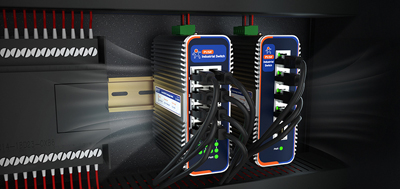
USR-G806w is a high-performance industrial 4G router specifically designed for industrial environments, featuring powerful network processing capabilities and a variety of interface types. It supports multiple wide area network (WAN) access methods, including Ethernet, 4G/5G, and Wi-Fi, meeting network connection requirements in different scenarios. More importantly, USR-G806w adopts intrinsic safety design and has passed ATEX Zone 2 certification, providing a safe and reliable communication solution for explosive environments such as automotive die-casting workshops.
USR-G806w employs a method of restricting electrical energy in its circuit design, ensuring that the equipment does not generate sparks or heat sufficient to ignite explosive mixtures under any circumstances by reducing parameters such as voltage, current, and power. For example, it adopts a low-voltage power supply design, controlling the operating voltage within a safe range; simultaneously, it optimizes circuit layout and component selection to reduce energy loss and heat generation.
To prevent explosions triggered by external factors (such as static electricity and electromagnetic interference), USR-G806w has implemented comprehensive protective measures. It adopts anti-static design, effectively eliminating static electricity accumulation through grounding and shielding measures; at the same time, it possesses anti-electromagnetic interference capabilities, enabling stable operation in complex electromagnetic environments without malfunctions or sparks caused by electromagnetic interference.
USR-G806w strictly adheres to quality control standards during the production process to ensure that each device meets the requirements of intrinsic safety design. Additionally, it undergoes rigorous safety testing, including spark tests, temperature tests, and overload tests, to verify the equipment's safety performance under extreme conditions. These tests ensure that USR-G806w can operate stably for a long time in explosive environments such as automotive die-casting workshops without triggering dust explosions or other safety incidents.
A die-casting workshop in an automotive manufacturing enterprise faced a dust explosion risk, and its existing communication equipment could not meet safety requirements, necessitating a replacement with intrinsic safety equipment. After market research and comparison, the enterprise selected USR-G806w industrial 4G router as its new communication solution.
Requirement Analysis: Conduct a comprehensive assessment of the network environment, business requirements, and safety requirements in the die-casting workshop to determine the configuration and deployment plan for USR-G806w.
Equipment Installation and Configuration: Install USR-G806w industrial 4G router in the workshop and perform necessary configuration and debugging to ensure normal operation and compliance with safety requirements.
Network Topology Design: Design a reasonable network topology structure based on the workshop layout and business requirements to ensure stable and secure data transmission.
Safety Testing and Verification: Conduct rigorous safety testing on USR-G806w, including spark tests and temperature tests, to verify the effectiveness of its intrinsic safety design.
Operation and Maintenance Management and Monitoring: Establish a comprehensive operation and maintenance management system to regularly inspect and maintain USR-G806w, ensuring its long-term stable operation.
Enhanced Safety: The intrinsic safety design of USR-G806w effectively reduces the risk of dust explosions, providing reliable safety protection for workshop personnel and equipment.
Improved Communication Stability: USR-G806w supports multiple WAN access methods, ensuring stable and reliable data transmission and improving production efficiency.
Reduced Operation and Maintenance Costs: USR-G806w features remote management and monitoring capabilities, reducing on-site operation and maintenance workload and lowering operation and maintenance costs.
Compliance Achievement: USR-G806w has passed ATEX Zone 2 certification, meeting the European Union's safety requirements for equipment used in explosive environments and providing strong support for the enterprise's international development.
As technology continues to advance, intrinsic safety design technology will also undergo continuous innovation and upgrades. In the future, industrial 4G routers will adopt more advanced circuit designs and protective measures to further enhance equipment safety performance. For example, by introducing new materials and technological means to reduce equipment energy consumption and heat generation; by optimizing algorithms and software design to improve equipment anti-interference capabilities and stability.
Intelligence and automation are important trends for the future development of industrial 4G routers. By integrating artificial intelligence, big data analysis, and other technological means, industrial 4G routers will achieve more intelligent network management and operation and maintenance. For example, by real-time monitoring equipment operating status and safety performance, potential safety hazards can be identified in advance and measures taken to prevent them; by automatically configuring and optimizing network topology structures, data transmission efficiency and stability can be improved.
With the accelerated pace of globalization, the standardization and internationalization of industrial 4G routers will also become important trends. In the future, countries will strengthen cooperation and exchanges in safety standards for equipment used in explosive environments, promoting the formation of a more unified and international safety standard system. This will facilitate international trade and technological cooperation in industrial 4G routers and drive the development and progress of the global industrial communication field.
In explosive environments such as automotive die-casting workshops, the intrinsic safety design of industrial 4G routers is one of the key elements for ensuring equipment safety. USR-G806w industrial 4G router has successfully obtained ATEX Zone 2 certification by adopting measures such as restricting electrical energy, implementing comprehensive protective measures, and conducting strict quality control and testing, providing a safe and reliable communication solution for automotive die-casting workshops. In the future, with continuous technological innovation and upgrades, as well as the accelerated pace of standardization and internationalization, intrinsic safety design will play an even more important role in the industrial 4G router field, providing strong support for the construction and development of smart factories.