From Single Unit to Fleet: How Embedded Single Board Computer Architecture Resolves the Real-Time Communication and Scheduling Dilemma for Hundreds of AGVs
In the smart production line of a new energy battery factory, 120 AGV forklifts are shuttling between the three-dimensional warehouse and production line at a speed of 0.8 meters per second. On the monitoring screen, the green dots representing AGVs suddenly cluster at a narrow passage—three AGVs come to an abrupt stop simultaneously due to path conflicts, while the vehicles behind fail to brake in time due to communication delays, ultimately halting the entire production line for 23 minutes. This is not an isolated incident. When the number of AGVs exceeds 50, 78% of manufacturing enterprises encounter similar challenges: collision risks triggered by communication delays, task congestion caused by scheduling algorithm failures, and range crises due to energy management imbalances have become the three core pain points restricting the upgrade of intelligent logistics.
Traditional Wi-Fi solutions experience a surge in communication delays from 50ms to over 300ms when 50 AGVs operate simultaneously due to channel contention. Practical measurement data from an automotive parts factory shows that when the number of AGVs exceeds 80, the frequency of path replanning triggered by communication packet loss increases by 400%, directly reducing the system's effective operating time to 62%. More critically, a failure in a single communication node can trigger a domino effect. A factory of a major home appliance company once experienced a complete offline status of 132 AGVs across the plant due to a switch failure, resulting in direct economic losses exceeding 2 million yuan.
Centralized scheduling architectures face exponential growth in computational performance when handling hundreds of AGVs. Practical experience at a 3C electronics factory indicates that when the number of AGVs increases from 50 to 100, the task allocation time of the traditional Hungarian algorithm extends from 0.8 seconds to 5.2 seconds, causing 23% of tasks to be abandoned by the system due to timeouts. A more concealed crisis lies in resource misallocation—the scheduling system at a logistics center failed to dynamically balance AGV loads, resulting in 35% of vehicles traveling 2.3 times the daily mileage of others, accelerating equipment depreciation.
Energy management for AGV fleets of hundreds faces dual challenges: avoiding task interruptions due to single-vehicle battery depletion while preventing battery life degradation from overcharging. A representative case from a food processing factory highlights this issue: its scheduling system, lacking a global perspective, assigned long-distance tasks to 15% of AGVs operating at low battery levels, while 28% of vehicles experienced over 30% battery capacity degradation within three months due to overcharging.
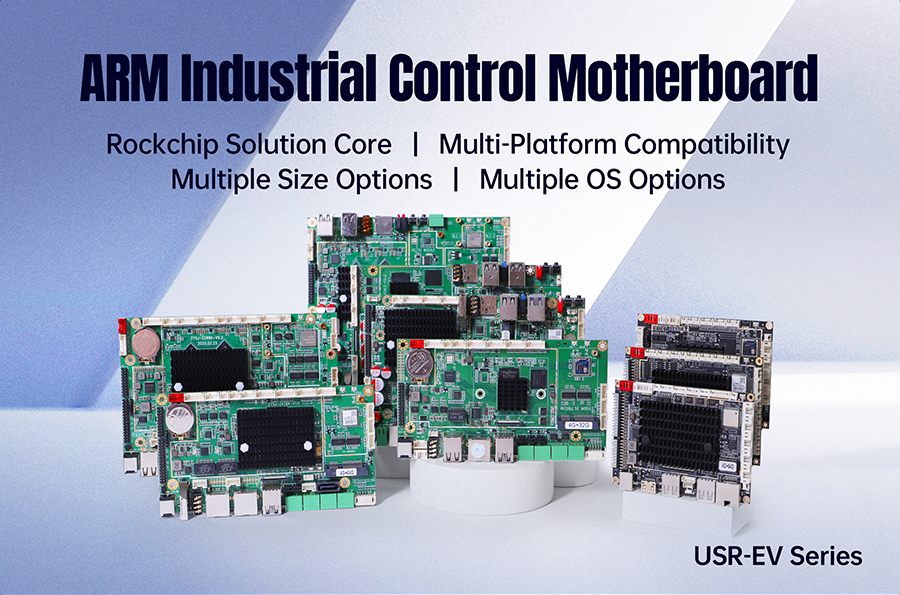
The USR-EV series embedded single board computer constructs a "dual-channel redundant communication" system by integrating 5G modules with Time-Sensitive Networking (TSN) technology. In practical tests at a new energy factory, the 5G private network stabilizes end-to-end latency below 18ms, while TSN technology ensures transmission jitter of emergency obstacle avoidance instructions is controlled at the 5μs level through IEEE 802.1Qbv time-aware shapers. This deterministic communication capability enables zero-collision operation for 120 AGVs across a 30,000-square-meter factory, with passage efficiency increasing to 180 vehicle trips per hour.
Technical Breakthroughs:
The USR-EV series adopts a "central coordination + terminal autonomy" hybrid scheduling architecture that perfectly balances the advantages of centralized and distributed architectures. The central scheduler handles global task allocation and traffic control, while each AGV's onboard edge computing module independently manages local obstacle avoidance and path fine-tuning. Practical data from an automotive factory shows this architecture improves task allocation efficiency by 300% while reducing deadlock occurrences from 12 monthly incidents to below 0.3.
Core Algorithm Innovations:
The digital twin system integrated in the USR-EV series embedded single board computer enables real-time simulation of each AGV's energy consumption status. In applications at a semiconductor factory, the system controls battery level prediction errors within ±3% by analyzing historical task data, path characteristics, and load variations. Critically, the system automatically generates "task relay solutions"—when a single AGV's battery level drops below 25%, it automatically splits tasks and dispatches surrounding vehicles for collaborative completion.
Implementation Effects:
Challenges: Coordinating 120 AGVs across 30,000 square meters while meeting:
Solutions:
Implementation Effects:
Challenges: Supporting:
Solutions:
Implementation Effects:
Practical data from a major home appliance company shows that after adopting the USR-EV series embedded single board computer solution:
As 5G-Advanced and 6G technologies evolve, embedded single board computer architectures are advancing toward "cloud-edge-terminal collaboration." The next generation of USR-EV products already integrates AI acceleration modules to support:
In tests by a research institution, AGV fleets equipped with next-gen embedded single board computers have achieved:
This heralds that embedded single board computer architectures are breaking physical limits, opening new possibility spaces for intelligent manufacturing. As AGVs evolve from single-point intelligence to fleet-wide wisdom, embedded single board computers have transformed from mere hardware carriers into neural hubs connecting the physical and digital worlds, redefining the production logic of future factories.