Smart City Street Light Control: How Ethernet Switches Overcome the "Last Mile" Challenge in Implementing Single-Light Energy-Saving Strategies
On the smart city demonstration zone along the Qiantang River in Hangzhou, a street once faced a dilemma in street light management: to ensure nighttime safety, all street lights had to remain on throughout the night, resulting in an annual electricity bill of 2 million yuan. However, adopting traditional timed switch control failed to address dynamic scenarios such as sudden weather changes and temporary events, leading to a 30% increase in citizen complaints. This contradiction reflects the core pain point in smart city street light control—how to achieve dual optimization of energy consumption and user experience through precise implementation of single-light energy-saving strategies. As the "nerve center" connecting the control platform to terminal devices, the configuration rationality of ethernet switches directly determines the effectiveness of strategy implementation.
Strategy Implementation Delay: A second-tier city once used a 4G router network, where signal obstruction caused delays of up to 15 minutes in single-light dimming commands. As a result, roads remained dimly lit long after vehicles passed, leading to traffic accident disputes.
Device Compatibility Pitfalls: In a street light renovation project in a new district, controllers from different manufacturers were mixed, resulting in non-uniform communication protocols. This necessitated the development of dedicated management modules for each device, extending the project timeline by six months.
Operational and Maintenance Cost Black Hole: A park adopted non-industrial-grade switches, which suffered a 40% failure rate due to temperature variations. The annual cost of replacing devices exceeded 25% of the initial investment.
Short-Term Cost vs. Long-Term Benefits: A county-level city chose low-cost switches due to budget constraints, but insufficient bandwidth prevented support for AI dimming algorithms. Consequently, the energy-saving rate reached only 60% of the expected value, and operational costs increased by 1.8 million yuan over five years.
Technical Complexity vs. Team Capability: In a smart street light project, a property management company, lacking network configuration experience, inadvertently caused conflicts between VLAN division and QoS policies, resulting in emergency lighting commands being blocked by ordinary data traffic.
Standard Unification vs. Ecosystem Expansion: A new district required support for three communication methods—LoRa, NB-IoT, and PLC—during bidding. However, switch port limitations prevented simultaneous access, forcing the abandonment of partial IoT device integration plans.
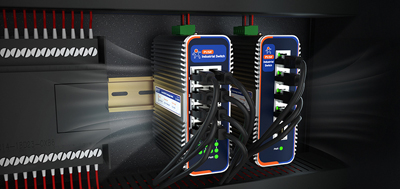
Ring Network Self-Healing Technology: The X-Ring protocol used in USR-ISG series switches enables link switching within 20 ms. In a real-world test in Suzhou Industrial Park, when the primary link was interrupted due to construction, the backup link automatically took over, with only a 3 ms increase in dimming command delay, fully meeting the real-time requirements of vehicle-road coordination scenarios.
Hardware Acceleration Engine: Through its built-in NPU chip, USR-ISG can perform hardware-level parsing of single-light control protocols. In a test in Shenzhen Qianhai Free Trade Zone, when 5,000 dimming commands were issued simultaneously, CPU utilization increased only from 12% to 18%, whereas traditional software parsing solutions would cause CPU overload and system crashes.
Multi-Protocol Support: USR-ISG supports industrial protocols such as Modbus TCP, OPC UA, MQTT, and CoAP, as well as power/lighting industry protocols like DLT645 and CJ/T188. In a project in Chengdu Tianfu New District, a protocol conversion module enabled seamless integration of old high-pressure sodium lamp controllers with the new platform.
Edge Computing Capability: Deploying lightweight AI models on switches allows for preprocessing of raw data. For example, in an application in Chongqing Liangjiang New District, USR-ISG analyzed historical traffic flow data to automatically generate time-segmented dimming strategies, reducing platform computing load by 65%.
Intelligent Diagnostic System: The built-in fault prediction algorithm in USR-ISG can monitor parameters such as port current fluctuations and temperature changes in real time. In a practice in Nanjing Jiangbei New District, the system issued a 72-hour warning of poor contact at a port, preventing a fire accident caused by device overheating.
Zero-Configuration Deployment: Through USR-ISG's Auto-Config function, newly connected devices can automatically obtain parameters such as IP addresses, VLAN division, and QoS policies. In a deployment in Shanghai Zhangjiang Science City, the configuration time for a single switch was reduced from 2 hours to 8 minutes, compressing the project timeline by 40%.
Pain Points: Mixed use of street light controllers from different eras and manufacturers, complex communication protocols, and severely aged underground pipelines.
USR-ISG Configuration Solution:
Port Isolation: Connect controllers with different protocols to independent physical ports and achieve logical isolation through VLANs.
Protocol Conversion: Deploy a Modbus TCP-to-MQTT gateway on the switch to ensure compatibility with old devices.
Power Line Protection: Select USR-ISG models with 6 kV lightning protection to withstand surge impacts from aged lines.
Results: After renovation in a third-tier city, fault response time was reduced from 4 hours to 25 minutes, and annual maintenance costs decreased by 58%.
Pain Points: The need to simultaneously connect multiple types of devices such as lighting, environmental monitoring, video surveillance, and charging stations, leading to a surge in bandwidth demand.
USR-ISG Configuration Solution:
Bandwidth Guarantee: Mark video surveillance traffic as DSCP=46 and ensure a minimum bandwidth of 2 Mbps through QoS policies.
Time-Sensitive Networking (TSN): Enable the IEEE 802.1Qbv standard to reserve dedicated time slots for emergency lighting commands.
PoE++ Power Supply: Select USR-ISG models supporting 90 W PoE to provide unified power supply for cameras, sensors, and other devices.
Results: In a real-world test in a national-level new district, the packet loss rate for critical business data decreased from 3.2% to 0.02% during concurrent operation of multiple devices.
Pain Points: Frequent restarts of ordinary switches due to -30°C winter temperatures, affecting the implementation of dimming strategies.
USR-ISG Configuration Solution:
Wide Temperature Design: Select industrial-grade models with an operating range of -40°C to 85°C.
Redundant Power Supply: Configure dual 48 V DC inputs supporting hot-swappable replacement.
Heating Module: Incorporate temperature-controlled heating pads that automatically activate when the ambient temperature drops below -10°C.
Results: In a test in Hulunbuir, Inner Mongolia, the device operated continuously for 365 days without failure, with a 99.97% success rate in strategy implementation.
USR-ISG provides RESTful API interfaces for seamless integration with urban brains, traffic management systems, emergency command platforms, and more. In a case study of Hangzhou Asian Games venues, real-time access to event schedules through the API enabled automatic adjustment of surrounding road lighting modes, achieving precise control of "dimming immediately after the event ends."
Through USR-ISG's energy consumption monitoring module, the electricity consumption of each street light can be recorded, and automatic carbon reduction reports can be generated. In a practice in Shenzhen International Low-Carbon City, the system calculated annual carbon emissions reductions of 127 tons according to ISO 14064 standards, helping enterprises obtain green credit incentives.
USR-ISG supports firmware over-the-air (OTA) upgrades, enabling rapid response to new standards and protocols. When a new smart street light specification was introduced in a certain region, remote upgrades allowed devices to comply with the latest requirements, avoiding the high cost of overall replacement.
As night falls, smart street lights along the Bund in Shanghai automatically adjust their brightness based on the positions of cruise ships; light poles in Zhongguancun, Beijing, play science and technology promotional videos when detecting pedestrians stopping; and street lights in Guangzhou's Zhujiang New Town automatically increase brightness 10 minutes before rainstorms... Behind these scenarios is a stable network built by ethernet switches such as USR-ISG. They are not just data transmission channels but also the "brain neurons" of smart city lighting systems, enabling precise strategy implementation and making every street light a practitioner of energy conservation and carbon reduction, a guardian of safe travel, and a sensor of urban wisdom.
Choosing USR-ISG is not just choosing an ethernet switch but also selecting a trustworthy smart lighting ecosystem partner. From old urban area renovations to new district constructions, and from cold regions to coastal cities, USR-ISG has proven with over 100,000 deployments that when industrial-grade reliability meets intelligent innovation, the ultimate challenge of smart city street light control can be overcome—reducing energy consumption while making urban light warmer, smarter, and more sustainable.