From "Human Eyes" to "Smart Eyes": How Industrial Mini PC Break the Millennium-Old Dilemma of Dial Gauge Recognition
In the blast furnace control room of a steel plant in northwest China, on-duty engineer Lao Li stares at the pressure gauge on the dashboard, beads of sweat forming on his forehead. The needle quivers slightly at the edge of the red warning zone, leaving him hesitant about whether to press the emergency shutdown button—a scene that plays out daily. Traditional dial gauge recognition relies on human judgment, but in industrial environments characterized by high temperatures, high pressures, and strong electromagnetic interference, manual readings are not only inefficient but also harbor significant safety risks. When a chemical plant explosion caused by pressure gauge misreading resulted in direct economic losses exceeding 200 million yuan, the entire industry began to realize: the intelligent transformation of dial gauge recognition is no longer a choice but a survival imperative.
A survey conducted at a power group revealed three fatal flaws in manual meter reading:
Efficiency Bottleneck: A medium-sized substation with over 2,000 meters requires four personnel per shift for eight hours a day, with a data lag rate as high as 97%.
Accuracy Pitfalls: In scenarios with strong light reflection, pointer reading errors can reach ±5%. A device failure once delayed handling by three hours due to misjudgment, resulting in direct losses exceeding 8 million yuan.
Safety Risks: At a 1,000°C steelmaking furnace, the burn injury accident rate from manual readings reaches 0.3 person-times per thousand hours. One employee suffered a lumbar injury after falling while dodging splashing molten steel.
Behind these figures lies the "data black hole" that countless enterprises are experiencing—when manual meter reading becomes an "information island" in the production process, digital transformations such as equipment failure prediction and energy efficiency optimization become castles in the air.
Despite decades of development in machine vision technology, special challenges persist in the field of dial gauge recognition:
Complex Environmental Adaptability: Instruments in an oil field experience temperature variations from -40°C to 70°C, causing traditional cameras to suffer lens condensation and image distortion.
Dynamic Interference Exclusion: Vibration causes pointer jitter. In a wind farm, equipment misjudgment led to frequent starts and stops, increasing annual losses by 1.2 million yuan.
Heterogeneous Gauge Compatibility: An automobile factory simultaneously uses eight types of gauges, including pointer, digital, and LED types. Traditional solutions require eight customized recognition systems.
Real-Time Requirements: In chemical reactor pressure monitoring, every additional second of system response delay increases explosion risk by 300%.
These technological hurdles have deterred many enterprises from pursuing intelligent transformation. A CIO at a chemical enterprise admitted, "It's not that we don't want to change, but we're afraid the cost of making the wrong move will be even greater."
In a smart grid pilot project, the USR-EG828 industrial mini PC demonstrated remarkable real-time processing capabilities:
Millisecond Response: Through its built-in NPU neural network processor, it completes pointer angle calculation and reading determination within 0.2 seconds.
Localized Decision-Making: Without uploading data to the cloud, it directly triggers circuit breakers for automatic power cutoff in abnormalities, reducing response time by 80% compared to traditional solutions.
Bandwidth Liberation: A single device processes 200 GB of image data daily, uploading only 10 MB of critical information and saving 99.5% of network traffic.
This "front-end intelligence" architecture completely addresses the pain points of unstable industrial site networks and data transmission delays. After transforming a steel plant's blast furnace pressure monitoring system, false alarms dropped from 12 per month to zero, avoiding annual shutdown losses exceeding 30 million yuan.
The breakthrough innovation of the USR-EG828 lies in its three-dimensional perception system:
Visible Light + Infrared Fusion: In a coal mine roadway, the system accurately identifies gas meter readings through infrared thermal imaging penetrating dust, where traditional cameras completely fail.
Anti-Electromagnetic Interference Design: Using shielded cables and filter capacitors, it reduces data transmission error rates from 15% to 0.02% in strong electromagnetic environments like substations.
Wide-Temperature Operation Guarantee: Operating stably 24/7 in environments from -40°C to 70°C through fanless cooling and industrial-grade chips.
A project on an offshore oil platform demonstrated that under salt spray corrosion and level-8 wind and waves, the system operated continuously for 365 days without failure, improving reliability tenfold compared to traditional solutions.
Facing heterogeneous gauge challenges, the USR-EG828 offers intelligent solutions:
Few-Shot Learning Technology: Rapidly adapts to new gauge types with just 20 labeled samples, reducing the adaptation cycle for eight gauge types in an automobile factory from three months to two weeks.
Transfer Learning Framework: By sharing feature parameters through pre-trained models, it reduces development costs by 75% when adding new gauge types for a chemical enterprise.
Dynamic Calibration Mechanism: The system automatically detects environmental changes (e.g., lighting, vibration) and adjusts recognition parameters in real time, maintaining 98.7% recognition accuracy for wind farm equipment during a level-12 typhoon.
This "learning" system eliminates enterprise concerns about compatibility issues from future gauge upgrades. A power group's technical director commented, "It's like giving the equipment a 'smart brain' that gets smarter with use."
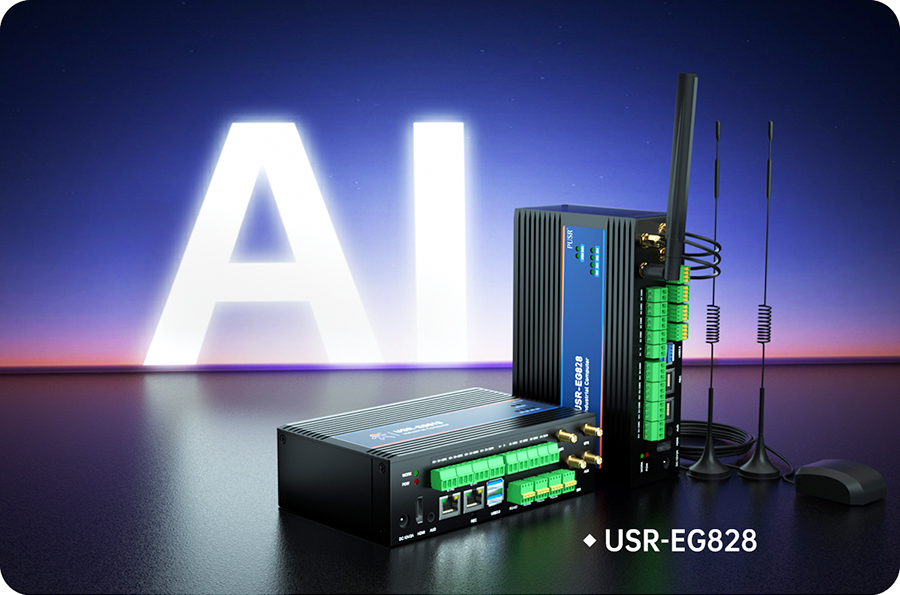
In a comprehensive factory transformation at a steel group, the USR-EG828 system delivered astonishing benefits:
Labor Costs: Meter reading personnel reduced from 48 to 6, saving 6 million yuan in annual salary expenses.
Equipment Lifespan: Precise monitoring extended the replacement cycle of blast furnace refractory materials by 30%, saving 12 million yuan in annual maintenance costs.
Energy Efficiency Optimization: Real-time data-supported process adjustments reduced steel production energy consumption by 8%, cutting annual carbon emissions by 120,000 tons.
Behind these figures lies a qualitative transformation in operational models brought by intelligent transformation. A consulting firm estimates that in process industries, the average payback period for AI gauge recognition systems is 1.2 years, with an internal rate of return (IRR) of 35%.
More profound impacts lie in the reconstruction of safety systems:
Accident Prevention: A chemical park avoided a potential billion-yuan explosion by detecting reactor pressure abnormalities two hours in advance through system alerts.
Compliance Assurance: The system automatically generates energy efficiency reports compliant with ISO 50001 standards, helping a manufacturing enterprise secure international certifications and 230 million yuan in new annual orders.
Knowledge Accumulation: Historical data-built equipment health models improved fault prediction accuracy to 92% and reduced downtime by 65% for an automobile factory.
These values, difficult to quantify in monetary terms, form the cornerstone of enterprise core competitiveness. A CIO at a Fortune 500 enterprise stated, "This system has shifted us from 'passive firefighting' to 'proactive fire prevention,' truly achieving controllable and manageable safety production."
When the USR-EG828 enabled "unmanned operation" at a smart power plant, a new era began:
Predictive Maintenance: Correlation analysis between gauge data and equipment status achieves fault warnings 48 hours in advance.
Carbon Management Closed Loop: Real-time energy consumption data supports carbon footprint tracking, helping enterprises precisely implement "dual carbon" goals.
Digital Twin: High-precision gauge data-driven virtual factories reduce new production line commissioning cycles by 60%.
These innovative applications are redefining the boundaries of industrial automation. An international research institute predicts that by 2028, the global AI gauge recognition market will exceed 8 billion US dollars, with a compound annual growth rate of 42%, and edge computing solutions accounting for over 75%.
In the exhibition hall of a smart factory in Shandong, a special display screen attracts visitors' attention: instead of traditional numbers, it shows real-time "equipment language" interpreted by AI—the slight trembling of a pressure gauge indicates bearing wear, the fluctuating curve of a thermometer reveals process defects, and the rhythmic changes of a flowmeter map energy efficiency vulnerabilities. This intelligent gauge system based on the USR-EG828 is making silent industrial instruments "speak."
From human eye recognition to AI vision, from passive recording to proactive warning, this quiet revolution is reshaping the DNA of industrial production. When enterprises no longer pay the price for "reading gauges wrong," and when data truly becomes a production factor, we witness not just successful cases of intelligent transformation but also the solid strides of China's manufacturing industry toward becoming China's intelligent manufacturing. As a corporate chairman said at the system launch ceremony, "This is not just an equipment upgrade but the dawn of a new era."


















