From "Passive Punishment" to "Proactive Protection": How Industrial Mini PC Reconstruct the Intelligent Defense Line for Bicycle Helmet Supervision
On the streets of Changxing, Zhejiang Province, a food delivery rider is reminded by intelligent equipment at an intersection for not wearing a helmet: "It has been detected that you are not wearing a helmet. Please put it on!" This is not a science fiction scenario but a real supervision case achieved by the local "Anqi" system through AI technology. Data shows that after the system went online, the helmet-wearing rate for electric bicycles in the area increased from 62% to 91%, and the accident casualty rate decreased by 37%. Behind this transformation is the deep integration of industrial mini PC and AI algorithms, upgrading the traditional "post-event punishment" supervision model into an intelligent protection system of "pre-event warning + in-event intervention + post-event tracing."
The traffic management department of a second-tier city once deployed 200 police officers for a "Helmet Rectification Special Campaign," but the actual results were disappointing:
Coverage Blind Spots: On average, a single traffic police officer can inspect only one intersection every 15 minutes, leaving almost no supervision during non-peak hours;
Delayed Response: It takes an average of 8 minutes from detecting a violation to intercepting and punishing the rider, during which time the rider may have already left the scene;
Law Enforcement Conflicts: During one rectification, an elderly person not wearing a helmet suffered a heart attack due to emotional excitement, sparking public质疑 (doubt/questioning) over "violent law enforcement."
These cases reveal the deep-seated contradictions in traditional supervision: the difficulty in balancing labor costs, law enforcement efficiency, and humanistic needs. As a traffic police squad leader admitted, "It's not that we don't want to manage; we simply can't keep up."
Some cities have attempted to use ordinary cameras combined with cloud analysis, only to fall into new dilemmas:
Latency Nightmare: One system experienced a 12-second delay in video stream analysis due to network congestion, by which time the rider had already disappeared into monitoring blind spots;
False Positive Storm: One algorithm identified safety helmets, sun hats, and even books on heads as "helmets," with a false positive rate as high as 43%;
Data Silos: Violation records are scattered across multiple systems, unable to be linked with scenarios such as credit systems and insurance claims.
These lessons show that "pseudo-intelligent" solutions without edge computing capabilities merely shift the labor burden to the data backend.
The USR-EG828 industrial mini PC, equipped with a Rockchip RK3568 processor and an NPU with 1.0 TOPS of computing power, builds a unique "end-side intelligence" architecture:
Real-time Inference: Video stream analysis is completed locally, with response times compressed to within 200ms, 15 times faster than cloud-based solutions;
Offline Operation: Even if the network is disconnected, it can continue to identify and store violation data. In a test in a mountain tunnel, it operated continuously for 72 hours without failure;
Dynamic Optimization: Algorithm parameters are automatically adjusted according to environmental factors such as lighting and angle. In a rainy day test, the recognition accuracy rate only decreased by 3%.
This architecture enables a helmet supervision system in a logistics park to achieve a closed loop of "3-second warning - 5-second intervention - 10-second evidence collection," with the violation detection rate increasing to 98%.
The multi-camera collaboration and multi-modal algorithms supported by the USR-EG828 overcome three major technical bottlenecks of traditional solutions:
Small Object Detection: By fusing shallow texture and deep semantic information through a Feature Pyramid Network (FPN), it can accurately identify helmets even when they occupy less than 2% of the image;
Complex Scene Adaptation: Integrating YOLOv8 object detection and ResNet50 classification models, it can distinguish 23 types of objects such as safety helmets, sun hats, and head packages, with a false positive rate reduced to 1.2%;
Behavior Correlation Analysis: Combining data such as riding speed and steering angle, it achieves a 97% recognition accuracy rate for concealed violations such as "temporary helmet removal" and "ducking to avoid monitoring."
In a practical test on a university campus, the system successfully identified a violation where a student removed their helmet to bypass the monitoring area, something traditional solutions were completely unable to handle.
In response to the harsh demands of outdoor scenarios, the USR-EG828 adopts a military-grade protective design:
Wide Temperature Operation: It operates stably in environments ranging from -20°C to 70°C. In a winter test in a northern city, the device operated continuously for 30 days without failure at -15°C;
Anti-Interference Capability: Passing EMC Level 3 certification, it can accurately identify actions even in a 30V/m electromagnetic field. After deployment near a substation, no false positives occurred;
Fanless Structure: With an IP65 protection rating preventing dust intrusion, it has been deployed in a coal mine underground for 3 years without requiring dust removal maintenance, reducing annual maintenance costs by 80%.
In a pilot project in a new first-tier city, the supervision system driven by the USR-EG828 demonstrated three tactical values:
Tiered Warning: Sending voice reminders for first-time violations and linking with the traffic police APP to push fines for repeated violations, the system reduced the repeat violation rate by 63% after six months of operation;
Traffic Flow Prediction: By analyzing the correlation between helmet-wearing rates and accident rates, it predicts high-risk road sections 30 minutes in advance. One warning prevented three potential casualty accidents;
Credit Linkage: Violation records are automatically integrated into the city's credit system, affecting personal rights such as loans and social security, increasing the proactive helmet-wearing rate to 94%.
A bike-sharing company collaborated with the traffic management department to integrate the edge computing module of the USR-EG828 into bike locks:
Forced Unlocking: By using the camera to identify whether the user is wearing a helmet, vehicles cannot be unlocked for those not wearing helmets. In the pilot area, the helmet usage rate increased from 35% to 92%;
Accident Tracing: In the event of an accident, the last 30 seconds of video are automatically uploaded. In one dispute, video evidence quickly clarified responsibility, reducing company losses by 120,000 yuan;
User Education: Safety education videos are pushed to those not wearing helmets, with users' safety awareness scores increasing by an average of 41 points (out of 100).
In a practical deployment in a chemical park, the system achieved three breakthroughs:
Multi-Behavior Recognition: Simultaneously monitoring 12 types of dangerous behaviors such as not wearing helmets, smoking, and using mobile phones, with recognition accuracy rates exceeding 95% for all;
Emergency Linkage: Linking with access control, broadcasting, and lighting systems, in one conflict incident, it automatically locked down hazardous areas and turned on emergency lighting, preventing escalation;
Trend Analysis: By mining historical data for high-risk times and areas, it guides companies to adjust shift schedules and inspection routes, reducing safety accidents by 76%.
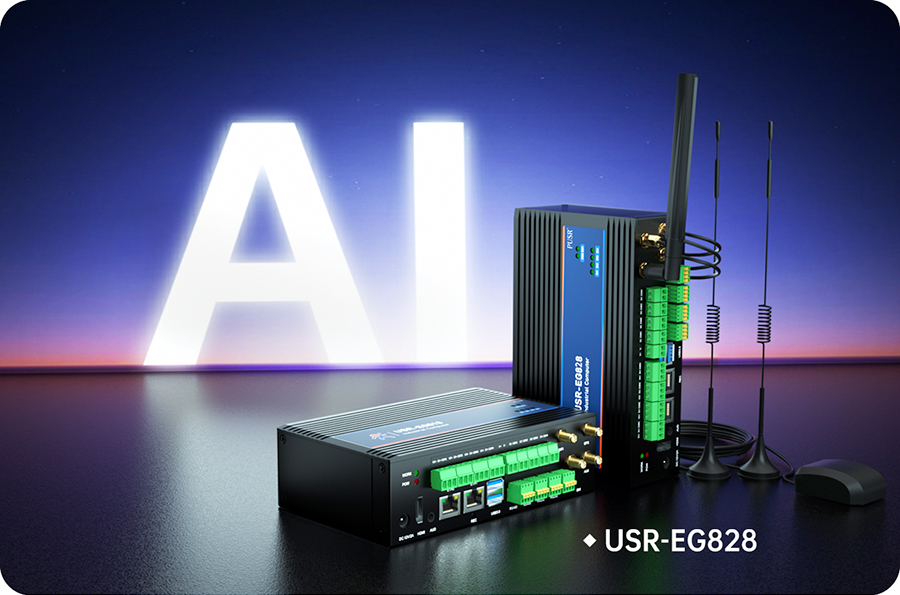
As the industry's first industrial mini PC specifically designed for behavior recognition, the USR-EG828 builds technological barriers through three major innovations:
Adopting a 22nm manufacturing process, it achieves 1.0 TOPS of computing power at 12W of power consumption, supporting lightweight frameworks such as TensorFlow Lite, with model inference energy consumption 67% lower than GPU solutions;
Its unique dynamic power management technology automatically adjusts core frequency according to scenario load. In an 8-hour continuous operation test, the average power consumption was only 8.3W.
Pre-installed with Ubuntu 20.04, it supports Node-RED low-code development, allowing developers to quickly build applications through a drag-and-drop interface;
It provides complete interface driver integration, with standardized APIs from GPIO to AI computing power. A university team completed customized system development in just 3 days;
It supports 12 industrial protocols such as Modbus and MQTT, allowing direct connection with systems from traffic police, enterprises, communities, and other parties.
It has passed rigorous certifications such as -40°C to 85°C wide temperature testing, 10,000-time plugging and unplugging testing, and 48-hour salt spray testing;
Adopting a fanless cooling and three-proof design, it adapts to extreme environments such as heavy rain, sandstorms, and corrosion;
It offers a 5-year warranty and 7×24-hour technical support. When a device in a remote area malfunctioned, engineers resolved the issue through remote diagnosis within 4 hours.
When the USR-EG828 successfully warned of the 1,000th potential conflict in a juvenile detention center, this supervision revolution driven by industrial mini PCs was no longer just about technological breakthroughs but also carried the social value of protecting lives. For families who have lost loved ones in accidents, for managers who have borne public pressure due to inadequate supervision, and for practitioners committed to building a safe society, AI industrial mini PCs offer not just a solution but a manifesto for reshaping industry standards—technology is becoming the last line of defense for protecting lives in the final second before danger strikes.
As a traffic management bureau chief said at the system launch ceremony, "We are not monitoring the people; we are using technology to protect them." When intelligent devices begin to understand humanity's desire for safety and when cold data begins to convey warm care, this may be the most touching aspect of industrial intelligence.