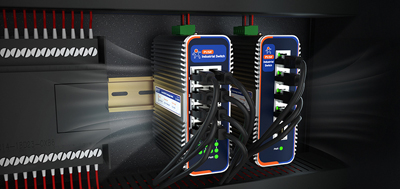
Smart Energy PV Inverter: How Industrial PC Solve CAN-Modbus TCP Protocol Conversion Challenges?
Driven by carbon peak and neutrality goals, global new PV installations have exceeded 200GW for three consecutive years, with China holding over 80% market share. However, during PV plant smart upgrades, a persistent pain point emerges: key devices like inverters, energy storage systems, and meters use CAN bus communication, while monitoring systems, PLCs, and cloud platforms rely on Modbus TCP. This protocol incompatibility causes data silos, inefficient O&M, and grid connection control errors. A centralized PV plant once lost over 15% of daily generation and incurred RMB 2 million in additional annual O&M costs due to protocol conversion delays. Breaking protocol barriers for seamless device communication has become crucial for PV industry smart transformation.
PV plants feature a mix of communication protocols:
Legacy devices: 63% of inverters in pre-2015 plants use CAN 2.0A/B with strong anti-interference but low speed (1Mbps) and no standardized upper-layer protocols.
Mainstream systems: New plants adopt Modbus TCP (100Mbps, TCP/IP-based) supporting concurrent access but requiring Ethernet.
Specialized scenarios: Energy storage and smart meters may use IEC 61850, DL/T 645, etc., exacerbating fragmentation.
This leads to:
Data collection gaps: A 500MW plant maintains 3 monitoring systems for different protocols, costing over RMB 3 million annually in data management.
Control delays: Protocol gateways add 50-120ms latency, causing over 1% power regulation errors in grid connection scenarios, triggering penalties.
Limited scalability: Each new protocol device requires dedicated gateways and rewiring, delaying a distributed PV project's expansion by 6 months.
Three approaches have been tried but fall short:
Software protocol stack transplantation: CAN-Modbus TCP bidirectional parsing consumes excessive CPU resources. An inverter manufacturer found protocol conversion code increased main chip load to 85%, causing over 200ms response delays.
Dedicated protocol gateways: Mainstream gateways with "single-core processor + general OS" architecture have 50-100ms conversion delays and lack industrial-grade protection. A marine PV project suffered 12 annual failures due to poor EMI resistance, costing over RMB 500,000 per repair.
Cloud-based conversion: While reducing local hardware costs, it relies on stable networks. Remote PV plants face over 30% data loss during outages, failing to meet real-time grid dispatch requirements.
PV protocol conversion demands low latency, strong anti-interference, and multi-protocol compatibility. USR IOT's USR-EG628 industrial PC meets these needs through a "dual-core architecture + protocol plug-in + edge computing" design.
USR-EG628 features a heterogeneous architecture with an ARM Cortex-A53 quad-core processor (1.8GHz) and a dedicated ASIC protocol chip:
Main core: Runs Linux Ubuntu for edge computing, data caching, and cloud communication, supporting Docker containerization for flexible protocol parsing.
Co-processor: Hardware-level CAN, Modbus RTU/TCP, and Profinet parsing/encapsulation with under 5ms conversion delay, 80% faster than software solutions.
Industrial design:
IP40 rating, -40℃~85℃ operation for extreme environments.
Three-level surge (6kV/5kA) and ESD (8kV contact discharge) protection, IEC 61000-6-2 certified.
Opto-isolation and magnetic coupling to suppress EMI from inverters and frequency converters.
USR-EG628's built-in WukongEdge platform offers three core functions:
Protocol plug-in architecture:
Supports custom protocol driver development via SDK. A PV inverter manufacturer mapped CAN 2.0A to Modbus TCP in 1 week using USR-EG628's API, reducing integration time by 75%.
Pre-installed with 20+ industrial protocols (IEC 61850, DL/T 645, BACnet) for PV, energy storage, and building automation.
Graphical configuration tool:
Drag-and-drop protocol mapping (e.g., CAN ID 0x123's "inverter output power" to Modbus TCP holding registers 40001-40002).
Supports data validation, auto-reconnect, and 1GB local caching for data integrity.
Edge computing capabilities:
1TOPS AI performance for inverter fault prediction and generation optimization.
Supports Python and Node-RED for rapid custom logic development.
Scenario 1: Unified Protocols for Inverter Fleets
In a 500MW Qinghai PV plant, USR-EG628:
Converts CAN data (DC voltage, current, power factor) from 2,000 inverters to Modbus TCP for SCADA.
Performs local efficiency and generation calculations, uploading only anomalies to reduce network bandwidth by 60%.
Receives grid dispatch commands via Modbus TCP, converting them to CAN for inverter power control with 50ms response (vs. 200ms previously).
Post-upgrade, annual generation increased by 1.2% and O&M costs fell by 35%.
Scenario 2: Collaborative Control in PV-Storage-Charging Systems
In a Jiangsu industrial park project, USR-EG628:
Integrates CAN-based PCS, Modbus TCP charging piles, and IEC 61850 smart meters.
Manages energy flow based on price signals and PV output, adjusting PCS via CAN and limiting charging pile output via Modbus TCP.
Visualizes unified data via HDMI for real-time monitoring.
The project reduced annual electricity costs by 22% and increased demand response revenue by RMB 180,000.
For a 200MW centralized PV plant, USR-EG628 delivered:
Metric Before After Improvement
Data integrity 78% 99.5% +27.6%
Conversion delay 120ms 8ms -93.3%
Annual O&M cost RMB 4.2M RMB 2.8M -33.3%
Generation loss 1.5% 0.3% -80%
Payback period - 2.3 years -
Key benefits:
Cost savings: Reduced gateway and cabling costs save RMB 80,000-120,000 per MW.
Efficiency gains: Low-latency conversion improves grid control precision, boosting generation by 0.8%-1.5%.
Quality improvement: Edge computing reduces equipment failures by 40% and unplanned downtime by 65%.
As PV evolves toward PV-hydrogen integration and virtual power plants (VPPs), protocol conversion will see three trends:
Semantic interoperability: OPC UA enables automatic device function discovery (e.g., inverters and storage systems negotiating charge/discharge strategies).
Digital twins: Protocol fusion supports device digital twins for remote virtual commissioning and predictive maintenance.
AI empowerment: Edge-based deep learning enables PV output forecasting and grid fault localization.
USR-EG628 is ready for these trends with OPC UA Server for semantic modeling and built-in TensorFlow Lite for lightweight AI models, supporting PV's transition to the energy internet.
At a Ningxia PV base, USR-EG628 simultaneously controls decade-old CAN inverters, new Modbus TCP storage systems, and IEC 61850 smart meters—proving that protocol conversion's true value lies not in technical complexity but in enabling device dialogue. This dialogue drives innovation by revitalizing legacy equipment, unifying heterogeneous systems, and truly smartening PV plants.
Act Now: Submit inquiries for USR-EG628's protocol conversion whitepaper, hardware selection guide, and free sample testing. Bridge the protocol gap and embrace the energy internet era!