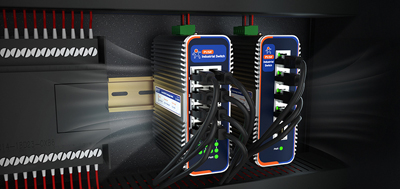
How Industrial Wireless Router Activates the Value of Existing Assets
The Imported Equipment You Spent 3 Million On Is "Quietly Turning to Scrap"
— A Factory Manager's 5-Year Headache, and the Solution of One Industrial Wireless Router
Old Zhou has been a workshop director for 28 years. Recently, he's developed a habit — arriving at the factory at 5:30 every morning, first walking three laps around that German-imported five-axis machining center.
Not inspecting. Just "taking a look."
That machine was bought from Germany in 2016 for 3.4 million yuan, with a precision of ±0.003mm. Back then, it was the entire group's "crown jewel." But now, its spindle bearing has started making abnormal noises, the guide rail lubrication is uneven, and the hydraulic system occasionally throws a code that nobody can read.
Old Zhou doesn't dare report it.
Because he knows what reporting leads to: line stop for inspection, at least two weeks; core component replacement, at least 800,000 yuan; approval process, at least three months.
And by year-end, the group's digital transformation KPIs have come down — overall equipment effectiveness OEE must go from 67% to 82%.
"If this machine goes down, my workshop's OEE drops straight below 50%. My reputation for this lifetime is finished."
Old Zhou is not an isolated case.
China's manufacturing sector has over 40 million units of old equipment that have been in service for more than 10 years. They have no network connection, no sensors, no data interfaces — like silent "information islands." You don't know when they'll break, but you have a vague feeling they're close.
This isn't a problem of equipment aging. This is a problem of assets that have "lost their memory."
Let me start with a counterintuitive fact.
A five-axis machining center from 10 years ago may still have its mechanical precision. But in today's factory, its value might be only 30% of its residual value.
Why?
Because the value logic of modern manufacturing has changed. Ten years ago, whether a piece of equipment was valuable depended on precision, on speed. Today, whether a piece of equipment is valuable depends on — can it be seen?
If it can be seen, it can be predicted, optimized, scheduled. If it can't be seen, you can only rely on people watching, experience guessing, and "it feels about right" to decide whether to shut down.
That's why your factory has decent equipment but can't improve efficiency. It's not that the machines are bad. It's that you know "nothing" about the machines.
Someone might say: so add sensors, deploy IoT, do predictive maintenance.
Easy to say.
Let me run the numbers for you, and you'll understand why 90% of old equipment retrofit projects die at step one.
An old Siemens S7-300 PLC has no Ethernet port, only an MPI interface. To connect data, you need a protocol converter. The converters available on the market vary wildly in stability. Once industrial site electromagnetic interference kicks in, the packet loss rate can hit 15%.
Take that Japanese Fanuc CNC system — its servo drives use a proprietary protocol. It doesn't speak standard Modbus, it doesn't speak OPC UA. You want to collect data? Either the OEM comes to do it, quoting 50,000–80,000 yuan per machine, or you crack it yourself and take the risk.
There's an even more practical problem: inside an old machine's electrical cabinet, space is already packed tight. You squeeze in a gateway, an edge computing box, a bundle of cables — what about heat dissipation? How do you route the wires? Who maintains it?
So most factories' "digital transformation" ends up being something done for new equipment. Old equipment? Forget it, wait until it breaks.
"Wait until it breaks" — those six words are the most expensive sentence in Chinese manufacturing.
Let me put it differently.
Why can the human body survive for decades? Not because every organ is perfect, but because there's a nervous system — constantly sensing, transmitting, warning. You know when your heartbeat speeds up. You know when your blood pressure rises. You know when something aches somewhere.
What old equipment lacks isn't a new spindle or new guide rails. It's this "nervous system."
You don't need to replace the heart of a 2016 machining center. You just need to connect its nerves.
This is the true role of the industrial wireless router in old equipment retrofit — not replacing equipment, not upgrading equipment, but installing a "translator" and a "sentry" for the equipment.
How does it work?
Step 1: Turn "mute equipment" into "equipment that can speak."
The PLCs, servo drives, and VFDs in old equipment aren't without data — the data just can't get out. One of the core capabilities of the industrial wireless router is protocol compatibility. Modbus RTU, Modbus TCP, Profibus, EtherNet/IP, OPC DA... these ancient industrial protocols, it handles them all. You don't need to replace the PLC, don't need to change the program. Just wire the router into the communication chain, and the data flows out.
It's like giving a person who can't speak Chinese a translator — suddenly, their thoughts can be heard.
Step 2: Turn "heard data" into "useful judgment."
Collecting data isn't enough. You need to know whether this equipment is "healthy."
That's where edge AI comes in. The router runs a lightweight anomaly detection model locally. It doesn't need to know the full mechanics of the equipment. It just needs to identify "something's wrong" patterns from current waveforms, vibration spectra, and temperature trends.
For example, if the spindle motor's current shows periodic spikes in a certain frequency band, that might mean the bearing inner race has pitting. The model doesn't need to know what "pitting" is. It just needs to know: I've seen this pattern in historical fault data. Last time I saw it, that equipment shut down within 72 hours.
This is the essence of predictive maintenance — not predicting "when it will break," but identifying "it's heading toward breaking."
Step 3: Turn "judgment" into "action."
After identifying an anomaly, what then? You can't have people staring at it 24/7.
The value of the industrial wireless router is that it is itself a communication device. It can push alerts directly to your phone via 4G/5G, sync status to your MES system via OPC UA, feed data to your digital twin platform via MQTT.
You don't need to build a separate communication network. The router itself is that network.
An injection molding factory in Zhejiang has 12 Haitian injection molding machines, the oldest of which has been running for 14 years. Last year, line yield suddenly dropped from 97% to 89%. They investigated for three months and found nothing.
Then they installed a vibration sensor on the injection machine's hydraulic station, collected data through a USR-G809s industrial wireless router, and ran the anomaly detection model at the edge. Two weeks later, the model fired an alert: Machine #3's hydraulic pump plunger was worn, causing the pressure fluctuation frequency to shift from the normal 50 Hz to 47.3 Hz.
They stopped the line and checked. The plunger was indeed worn. A replacement plunger cost 800 yuan. If they'd waited another week, the entire hydraulic pump would have been scrapped — 28,000 yuan.
800 yuan vs. 28,000 yuan. What's in between isn't money. It's an "unknown" you didn't know you had.
A steel mill in Hebei has a roller conveyor from 1998, carrying red-hot steel at 1,100°C. One night at 2 AM, the drive motor suddenly overloaded and tripped. The entire line stopped for 40 minutes. The red steel cooled on the rollers, scrapping 17 tons of billet.
Post-mortem: a shaft in the reducer had broken.
If edge monitoring had been in place, the precursors — the slow rise in motor current, the gradual increase in reducer vibration — would have been captured 72 hours before the trip.
17 tons of billet, at 3,200 yuan per ton: 54,400 yuan. Plus the production loss from 40 minutes of downtime: total loss exceeded 120,000 yuan.
One industrial wireless router costs less than a rounding error of that number.
A dairy company was audited by the FDA and found to have incomplete running temperature records for cold storage compressors. The reason: the old temperature control system had no data export function. Someone had to manually log readings every two hours.
After installing an industrial wireless router, temperature data is collected every second, automatically uploaded to the cloud, and tamper-proof. At the next audit, the auditor glanced at the data curve and said: "Very good. More standardized than I expected."
Compliance isn't a cost. It's a ticket. And sometimes, that ticket only requires one router.
Let me say something from the heart here.
I've met too many factories. It's not that they don't know the old equipment has problems. They're just used to "making do."
"This machine still works. Leave it for now."
"Retrofitting is too much trouble. Wait for the next overhaul."
"The budget won't get approved. Let's talk next year."
Next year after next year. How many next years are there?
By the time the equipment actually goes down, you realize: the overhaul cost is enough to buy half a new machine; the downtime loss is enough to buy one new machine; the lost customers and lost orders — those intangible losses are enough to buy ten new machines.
Old equipment isn't a liability. It's a wasted asset.
A five-axis machining center whose precision is still intact — if it can be monitored in real time, intelligently scheduled, and predictively maintained — its effective lifespan can extend from 10 to 15 years, and its OEE can go from 67% to 85%.
This isn't science fiction. This is happening right now.
And the cost to make it happen might be just one industrial wireless router, a few sensors, and one afternoon of willingness to get started.
I don't want to convince you with specs for an industrial wireless router like the USR-G809s.
You only need to know three things: it can connect to those "ancient protocol" data lines on your old equipment; it can run AI locally, so you don't need to buy another server; it can survive in the electromagnetic environment of a substation, unafraid of heat or vibration.
That's enough.
What's left is whether you're willing to give that old machine of yours — silent for ten years — one chance to "speak up."
It's been waiting for that chance longer than you've been waiting for the budget.
Old Zhou's German machining center didn't survive last winter's shutdown after all. The spindle bearing shattered. Replacement: 110,000 yuan. Downtime: 23 days. OEE dropped from 67% to 41%.
He told me: if I'd known to spend a few thousand yuan on a router to watch it, that 110,000 would have been enough to install a hundred of them.
A hundred.
When he said those three words, the cigarette in his hand trembled.