Welding Robot "Lost Connection" Production Shutdown Crisis? How RS232 to Ethernet Converter Uses "Dual-Link Redundancy" to Ensure 24-Hour Stable Monitoring
Everyone who works in welding automation has shared the same nightmare—
Woken up in the middle of the night by a phone call. On the other end, the shift supervisor's voice, barely suppressing the panic: "Robot #3 dropped offline again. The whole line is stopped. The client's shipment goes out tomorrow morning."
You get up. Drive forty minutes to the plant. The corridor lights are painfully white. The workshop is eerily quiet—the machines are stopped, but the emergency stop wasn't pressed, the safety light curtains didn't trigger. Everything looks "normal." Except one thing: the status light on that welding robot is off.
You crouch down to inspect. The serial port connector is loose. Probably shaken by a forklift during the day shift. You reseat it, verify the parameters, and the robot comes back. But you glance at the clock—two and a half hours have passed.
Two and a half hours. How much production loss is that? You don't calculate it. Because you're afraid to.
This scene probably isn't the first time in your plant. And it won't be the last.
Most people's understanding of serial communication stops at "as long as it works."
During commissioning, the baud rate is right, data flows, the project sign-off is done. And then? Then that cable is handed over to the production line—handed over to time, to forklifts, to vibration, to heat, and to every accident you could never have predicted.
Have you ever asked yourself: Why does your line monitoring system never dare promise "zero downtime"?
It's not that the technology can't do it. It's that the solution you're using was designed with only one road from the start.
A traditional serial-to-Ethernet converter: one device, one port, one cable. When that road is open, everything is fine. But when that road breaks—whether the connector loosens, the cable gets crushed, or the switch port burns out—the data vanishes completely. No backup. No failover. No second chance.
Your MES system receives nothing. The robot icon on your dashboard turns gray. Your production report has a blank gap. Then your client calls: Why is the delivery delayed again?
You can't explain. Because even you don't know what the robot went through during those two and a half hours.
This isn't a communication problem. This is an architecture problem.
Let me be clear about what dual-link redundancy actually means.
Simply put: two independent communication paths, working simultaneously, backing each other up. One breaks, the other takes over within milliseconds. The upper-level system doesn't even feel the switch.
Sounds like a data center solution? Exactly. Finance, power, telecom—they've used it for years. But in welding production environments, most factories still haven't adopted it.
Why? Because older RS232 to Ethernet converter didn't support it.
Early serial-to-Ethernet devices had a simple design logic: serial in, TCP out. One port, one path. To build redundancy, you had to wire two external devices, run two cables, and write your own failover logic. High cost, complex configuration, and maintenance was a nightmare. The electrical engineers on the floor would take one look and shake their heads: "We can't manage this."
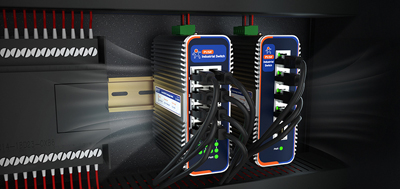
But that's changed now. Products like the USR-TCP232-302 have dual-port redundancy built into the hardware. Two independent Ethernet ports—you can connect to two separate switches, or run primary and backup to the same switch. Inside the device, there's a link detection mechanism. The moment the primary link exceeds the packet loss threshold, it automatically switches to the backup. You don't write a single line of code. You don't reconfigure a single parameter. You don't even need to know it happened.
The only thing you'll notice is that the status light stays green.
Let's do the math. Not device cost. Downtime cost.
An auto parts factory. Two welding lines. Six robots per line. All connected to MES through RS232 to Ethernet converter. The original setup used single-port converters. Last year, communication-related unplanned shutdowns: 17 incidents. Average downtime per incident: 1 hour 40 minutes.
Seventeen times 1 hour 40 minutes, multiplied by the hourly output value of the line—this is a number the production director didn't dare put on the PPT at the annual meeting.
Then they switched to the dual-port solution. The devices cost less than two thousand dollars more in total. But the first-year data: communication-caused downtime—zero.
Not because cables stopped loosening. Not because connectors stopped vibrating. Because when they did, the data went the other way, and the line never stopped.
You tell me—is that two thousand dollars worth it?
Your answer might be more compelling than my PPT.
"I get the concept, but my line has been running for three years. Swapping devices means downtime and rewiring. Not worth it."
"Our robots are eight years old. The serial parameters are fixed. Will a new device even be compatible?"
"Dual-link sounds great, but our IT team is two people. Who maintains it?"
These concerns. I know them intimately. Because almost every client who comes to us brings exactly these three questions.
Question one: No major rewiring needed. A device like the USR-TCP232-302 is compact, DIN-rail mountable. You pull out the old RS232 to Ethernet converter, plug in the new one—same wiring, same RS-232/485 pinout. No new cables. No PLC program changes. A skilled electrician swaps it in half an hour.
Question two: Compatibility. Industrial RS232 to Ethernet converters support baud rates from 1200 to 115200. Data bits, stop bits, parity—all configurable. Whether your robot is from 2010 or 2024, as long as it speaks standard serial, it connects. And it supports Modbus RTU master/slave mode—your PLC protocol, your robot protocol, it understands both.
Question three: Maintenance. Dual-port RS232 to Ethernet converters are configured through a web browser. IP address, serial parameters, redundancy mode—all graphical interface. Firmware updates are OTA. Your IT people don't need to understand underlying communication protocols. A few clicks, done. The device itself is fanless, IP30 rated, mounted inside the control cabinet—basically, install and forget.
Bottom line: every hassle you're worried about was already solved at the design stage. The only decision you need to make is whether you want your line to stop because of one cable—starting today.
After years in industrial communication, I've noticed something interesting:
Factories running single-link setups always have a row of gray icons on their monitoring dashboard. Engineers say, "Normal, it drops occasionally." But how often is "occasionally"? Nobody tracks it. Because tracking it doesn't help—it dropped, so you fix it.
After switching to dual-link, the biggest change isn't "no more dropouts." It's that the engineers start trusting the system. They dare to put real-time welding parameter curves on the big screen. They let clients view the line remotely. They point at the data in the morning meeting and say, "Robot #3 had an abnormal current waveform yesterday—we already handled it."
The value of data isn't that it exists. It's that you dare to make decisions based on it.
And the precondition for daring to use it is believing it won't break.
Dual-link redundancy doesn't just solve a technical problem. It solves a trust problem.
If your plant gets that call again tomorrow at 2 AM—
Do you want your reaction to be: get out of bed, drive forty minutes, crouch in the workshop reseating a connector?
Or: roll over, glance at the monitoring app on your phone—green, all normal—and go back to sleep?
The answer is in your hands.
RS232 to Ethernet converter USR-TCP232-302. Dual ports. Link redundancy. Hardware-level failover. Web configuration. DIN-rail mount. It's not black magic. It's just turning the one cable you fear most into two.
Two cables. One breaks, the other holds.
The line keeps running. You keep sleeping.
No matter how you count it, that's a deal worth making.