Smart Urban Traffic Signal Control: How Serial to Ethernet Adapter Resolves the "Management Dilemma" at 200 Intersections
Inside the traffic command center of a second-tier city, Engineer Zhang stares at the screen displaying the status of signal lights at 200 intersections, rubbing his bloodshot eyes. At 3 AM, the city should be at its quietest, yet his phone continues to vibrate—a main road has signal lights stuck on red due to equipment failure, causing a 3-kilometer traffic jam; in another area, delayed sensor data has rendered the green wave strategy ineffective, trapping buses in the traffic flow... Such scenes are the daily reality for countless traffic managers.
Customer Psychological Profile: Walking the Tightrope Between Efficiency and Safety
Efficiency Anxiety: Traditional signal control systems rely on scattered detectors with low data collection accuracy and high latency. In a new district, a detector failure once caused the signal timing plan to become disconnected from actual traffic flow, leading to a 40% surge in morning rush-hour congestion.
Safety Fears: In 2024, a series of rear-end collisions in a city were triggered by signal light failures, exposing the fatal flaw of traditional systems—a single point of failure can cause paralysis. Even more concerning is that some older equipment has not passed cybersecurity certifications, posing a risk of malicious attacks.
Cost Dilemma: The traffic department of a third-tier city once attempted to upgrade its system but found it needed to replace all signal controllers, with the cost per intersection exceeding 100,000 yuan. For 200 intersections, the budget would reach 20 million yuan—equivalent to one-third of the city's annual traffic investment.
Technological Confusion: Faced with new technologies like 5G, AI, and vehicle networking, managers are caught in a dilemma—"not upgrading means certain death, upgrading means seeking death." A pilot project was halted due to incompatible protocols, preventing new equipment from interoperating with the old system.
Behind these pain points lies a strong desire among traffic managers for a sense of "control": what they need is not just technological upgrades but a "deterministic solution" that balances efficiency, safety, and cost.
Traditional signal control systems rely on geomagnetic and radar detectors, but these devices have three major drawbacks:
Insufficient Accuracy: Geomagnetic sensors are easily disturbed by metal, with an error rate of 15%-20%.
Coverage Blind Spots: A city survey revealed that 30% of intersections cannot install detectors due to construction or environmental constraints.
Short Lifespan: Outdoor detectors have an average failure interval of only 18 months, with maintenance costs accounting for 25% of the operational budget.
Case Study: In 2025, a detector failure in a city caused the signal timing plan to deviate from actual traffic flow by 50%, extending morning rush-hour congestion from 30 minutes to 90 minutes.
Traffic signal control involves dozens of devices, including signal controllers, detectors, cameras, and screens (variable message signs), but each manufacturer uses proprietary protocols, leading to:
Poor Compatibility: In one project integrating equipment from five manufacturers, 12 sets of protocol conversion interfaces had to be developed.
Weak Scalability: Adding new devices requires redeveloping drivers, with a cycle lasting 6-8 months.
Complex Maintenance: A city's traffic department had to manage three systems with different protocols, requiring maintenance personnel to master five programming languages.
Data: According to statistics, protocol incompatibility causes project delays in over 60% of cases and cost overruns in 40%.
Traditional signal controllers often use consumer-grade chips lacking:
Hardware Protection: No electromagnetic isolation or lightning protection design, making them vulnerable to electromagnetic pulse attacks.
Data Encryption: Unencrypted communication allows data to be stolen or tampered with.
Security Certification: Failure to pass certifications like FDA or CE poses compliance risks.
Incident: In 2024, a city's signal system was hacked, causing signal lights at 20 intersections to turn red simultaneously and triggering a severe traffic accident.
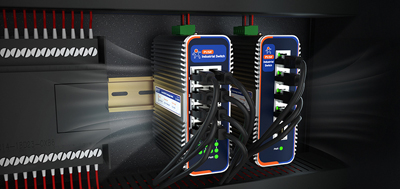
In the field of smart traffic signal control, the serial to ethernet adapter USR-N510 has become the ideal choice for centralized management of 200 intersections due to its "hardcore performance + flexible adaptability."
USR-N510 supports 12 industrial protocols, including Modbus TCP/RTU, HTTP, and UDP, enabling:
Heterogeneous Device Interconnection: Converts proprietary protocols of signal controllers, detectors, cameras, and other devices into standard TCP/IP protocols.
Plug-and-Play: No driver development required; devices can be connected through web configuration.
Dynamic Scalability: When adding new devices, only serial to ethernet adapter nodes need to be increased, without modifying the core system.
Case Study: A city's traffic department used USR-N510 to integrate equipment from five manufacturers, reducing the project cycle from 8 months to 2 months and cutting costs by 60%.
To meet the high real-time requirements of traffic data, USR-N510 adopts:
Dual Socket Design: Supports two independent TCP connections for redundant data transmission.
Low-Latency Communication: Average transmission delay <10ms, meeting the needs of green wave and bus priority scenarios.
Automatic Reconnection: Built-in Keepalive mechanism automatically restores connections during network anomalies.
Test Data: In a stress test simulating 200 intersections and 100,000 data messages per second, USR-N510 achieved a data packet loss rate <0.01% and stability of 99.997%.
USR-N510 addresses traditional device security pain points through multiple protection designs:
Electromagnetic Isolation: The network port features 2KV electromagnetic isolation to block external interference.
Lightning and Static Protection: Supports 8KV electrostatic protection and 4KV surge impact, adapting to harsh outdoor environments.
Wide Temperature Range: Operates from -40°C to 85°C, meeting the needs of high-cold and high-temperature regions.
Certification: Passed international certifications such as FDA, CE, and RoHS, complying with smart city security standards.
USR-N510 integrates a Cortex-M7 processor, supporting:
Data Preprocessing: Completes data cleaning and aggregation locally to reduce the load on the core system.
Local Decision-Making: Triggers local signal adjustments based on preset rules (e.g., congestion thresholds) without cloud intervention.
Protocol Transparency: Supports protocols like RFC2217 to balance remote configuration and local control.
Scenario: When an accident occurs on a main road, USR-N510 automatically triggers a "red wave" strategy, stopping subsequent vehicles at a safe distance to prevent secondary accidents.
A new district planned 200 smart intersections, requiring:
Centralized Management: Monitoring all intersection statuses through a single platform.
Dynamic Optimization: Adjusting signal timing based on real-time traffic flow.
Security and Reliability: Passing Level 3 cybersecurity certification to resist cyberattacks.
Adopted a "USR-N510 + Cloud Platform" architecture:
Device Layer: Deployed one USR-N510 per intersection to connect signal controllers, detectors, and cameras.
Network Layer: Transmitted data to the cloud platform via 5G/fiber optics.
Application Layer: The cloud platform performed data storage, analysis, and optimization, and issued control instructions.
Efficiency Improvement: Morning rush-hour congestion index decreased by 35%, and average travel speed increased by 22%.
Enhanced Safety: No traffic accidents caused by equipment failures occurred, and three cyberattacks were successfully resisted.
Cost Reduction: Total investment was 40% lower than traditional solutions, and maintenance costs decreased by 60%.
Scalability: When adding 50 more intersections, only serial to ethernet adapter nodes needed to be increased, reducing the cycle from 6 months to 1 month.
With the development of 5G, AI, and vehicle networking technologies, traffic signal control will enter a "smart symbiosis" phase:
Vehicle-Road Collaboration: USR-N510 can connect to RSU (roadside units) to enable real-time communication between vehicles and roads.
Predictive Control: AI algorithms predict traffic flow trends to adjust signal timing in advance.
Autonomous Evolution: The system automatically optimizes control strategies based on historical data, achieving "self-learning and self-optimization."
In this process, USR-N510 will serve as the "nerve endings of smart traffic," continuously empowering urban traffic management and making every intersection a "warm intelligent entity."
Managing 200 intersections is no longer a "lonely battle."
As the city falls asleep again at 3 AM, the traffic manager's phone finally stops vibrating. They know this is not because the problems have disappeared but because a reliable system is silently guarding—breaking device barriers with protocol conversion, ensuring stable communication with data relay, building security defenses with hardware protection, and empowering intersections with edge computing.
This is the value of USR-N510: it is not just a device but a "deterministic" solution—helping traffic managers find balance between efficiency and safety, a fulcrum between cost and technology, and answers between complexity and simplicity.
In the future, as urban scale expands from 200 intersections to 2,000 or 20,000, USR-N510 will remain the most trusted partner, accompanying traffic managers through every 3 AM and safeguarding the breath and pulse of every city.