-10°C to 60°C Extreme Environments: How a Cellular IoT Gateway Ensures Stable Communication for Precision Machining Equipment
"Engineer Zhang, the five-axis machining center in Workshop No. 3 has stopped again. This time it's not the spindle—it's a communication module error. The PLC can't read the encoder signal. The system flagged 'axis coordinate lost' and initiated an emergency stop. We spent three hours troubleshooting, swapped two cables, and finally found the cellular IoT gateway's comm port had a packet loss rate spiking to 30% under high temperature. This machine has been down for 11 straight hours. Delivery is the day after tomorrow. Figure it out."
Forty-seven times. From different factories, different industries—but almost the same opening: "stopped again."
I developed a habit: when I got an email like this, I wouldn't send a technical solution right away. I'd ask one question first: where is your cellular IoT gateway installed?
The answer was almost always the same: next to the machine tool, inside an iron box, no air conditioning. Summer hits 50-something degrees. Winter, the workshop has no heating—minus ten degrees.
Then I knew where the problem was.
It wasn't the protocol. It wasn't the cables. It wasn't a PLC bug. It was that "industrial cellular IoT gateway"—it never should have been in that spot from day one.
People in precision machining have an almost obsessive understanding of the word "precision."
Five-axis synchronization, positioning accuracy ±0.003mm, surface roughness Ra0.4. Behind these numbers: a spindle running smoothly at 24,000 RPM, servo axes feeding back position every 0.1 millisecond, and every link—CNC to PLC, PLC to drive, drive to encoder—must be error-free down to the last byte.
But when most people select equipment, they spend 90% of their energy on "what protocol" and "how many ports," leaving just 10% for the most basic question:
Can this device survive in my workshop?
What does "survive" mean?
Go look at a CNC workshop in an auto parts factory. Summer: cutting fluid mist, spindle heat, radiation heat from the injection molder next door—local temperature easily breaks 55°C. Winter: northern factories have no central heating. When you power on in the morning, the cold-machine ambient temperature can be -8°C. And your cellular IoT gateway? Wedged in that palm-sized gap between the machine's electrical cabinet and the tool magazine. Passive cooling. No fan room. No AC airflow.
You ask a commercial cellular IoT gateway rated 0–50°C to handle this environment. It's not that it's not trying—it's that physics won't allow it.
Capacitor ESR spikes at low temperatures. Communication chip clock drift. Ethernet PHY layer signal integrity collapses. These problems won't appear on page one of the product manual—because if they did, you wouldn't buy it.
But they'll appear in your downtime report.
Most people still think of a "cellular IoT gateway" as "just a serial-to-Ethernet box."
In precision machining, it does far more than that.
Layer one: protocol translation. On one production line, Fanuc's Focas, Siemens' S7, Mitsubishi's MC Protocol, Fanuc's DNC—all coexisting. The cellular IoT gateway unifies these disparate protocols into OPC UA or MQTT, feeding the upper MES or digital twin system.
Layer two: data preprocessing. Encoder signals, spindle load, feed axis current, tool life—these don't just go straight up. The cellular IoT gateway does filtering, denoising, feature extraction, even local anomaly detection. For example: spindle load spikes 15% suddenly. The cellular IoT gateway judges locally—"possible tool chipping"—triggers an alert. Not wait for data to reach the cloud, get computed, and come back. By then, the damage is done.
Layer three: real-time control loop. In some scenarios, the cellular IoT gateway doesn't just "read" data—it "manages" it. AGV dispatch commands, robot coordinate sync, multi-machine collaborative machining—these demand millisecond-level latency. Cloud? Forget it. 4G jitter alone is 20–50ms. Your machining precision can't wait.
They mean this cellular IoT gateway isn't a "nice-to-have" device. It's the production line's nervous system. Cut the nerve—the whole line goes paralyzed.
So when you look back at that email—"Workshop No. 3 stopped again"—you realize this isn't an ordinary equipment failure. This is a production line's nervous system sending an SOS from an environment that swings between -10°C and 60°C.
The Selection Trap: Are You Paying for the "Spec Sheet" or for the "Workshop"?
I've seen too many selection processes like this:
Procurement sends a requirements sheet: "Supports Modbus TCP/RTU, OPC UA, MQTT, 4x RS-485, 2x Gigabit Ethernet, operating temp 0–50°C."
Three suppliers quote. Lowest price wins.
Equipment arrives. Installed. Week one: fine. Week two: summer hits, packets drop. Week three: swap to another unit, still dropping packets. Week four: workshop director says, "just use it for now, replace it when it breaks."
Six months later, unplanned downtime on that line due to communication issues: over 200 hours cumulative.
Have you calculated the cost of 200 hours of downtime? A five-axis machining line: comprehensive hourly cost (labor, depreciation, energy, delivery penalty) is roughly 3,000 to 8,000 RMB. 200 hours = 600,000 to 1,600,000 RMB.
The "lowest-bid" cellular IoT gateway? Purchase price maybe 3,000 RMB.
You saved 2,000 RMB on equipment. You lost a million in downtime.
This isn't a joke. This is a real ledger I've seen repeatedly over the past three years, in machine shops across the Yangtze and Pearl River deltas.
Where's the problem? In the selection logic.
Most people selecting an industrial cellular IoT gateway are selecting "specs." But the precision machining environment tells you: what you should really be selecting is "survivability."
What Kind of Cellular IoT Gateway Deserves to Live in Your Workshop
I've condensed years of lessons learned on the production floor into five rules. Not specs—lessons.
Rated -40 to 75°C and actually running 72 hours straight at 60°C with zero packet loss are two different things. Some products' temperature ranges are "chip-level"—meaning the chip survives, but the surrounding capacitors, crystals, and connectors don't. What's truly reliable is system-level thermal testing, preferably under vibration and EMI conditions—because your workshop isn't a lab.
A fan is one of the biggest enemies in a precision machining environment. Not because it fails—though it does—but because it sucks in cutting fluid mist, metal dust, iron chips. These get in, clog the heatsink fins, temperature spikes, thermal protection kicks in, then shutdown. Worse: some dust is conductive. Lands on the PCB—instant short circuit.
Passive cooling, fully sealed, metal casing—not a "premium feature." It's the admission ticket to surviving in your workshop.
IP40 is fine in an office. In a CNC workshop, you need at least IP40 system-level protection, with ESD protection and surge suppression on serial ports. Because your workshop has inverters, servo drives, welders—the EMI environment is beyond imagination. One surge hits, the cellular IoT gateway's RS-485 port fries, and every encoder signal on the line goes dead.
Fourth: edge computing can't be "runs, good enough."
You need local data filtering, anomaly detection, protocol parsing—all of which eat compute. If the cellular IoT gateway's CPU hits full load on data preprocessing and communication tasks start dropping packets—then "edge computing" is a lie. A truly usable cellular IoT gateway needs a dedicated communication co-processor chip, offloading protocol parsing and data forwarding from the main CPU so the CPU can focus on computation.
Fifth—and most overlooked: lifecycle.
Your line runs ten years. Your machine tools last fifteen. But if your cellular IoT gateway only has a three-year supply guarantee and gets discontinued after three years—what then? Swap it? Retune it? Revalidate it? In precision machining, any equipment swap means at least one week of line validation.
So when you select, don't just look at today's specs. Look at three years from now, five years, ten years—will this product still exist?
The Workshop That Didn't Stop at -8°C
Last winter, I went to an aviation blade factory in Suzhou for a technical exchange.
Their workshop: thirty-two five-axis machining centers, all networked, data to MES, tool life calculated locally by cellular IoT gateway.
The day I visited, Suzhou had a cold snap. Outdoors: -6°C. The workshop had no heating. Morning startup: ambient -8°C.
I asked workshop director Lao Zhou: "The cellular IoT gateways okay?"
Lao Zhou pointed to the row of little gray boxes next to the electrical cabinets. "Those? Swapped last November. Three months now. Coldest day was -8°C. All thirty-two machines booted normally. Not a single data point lost."
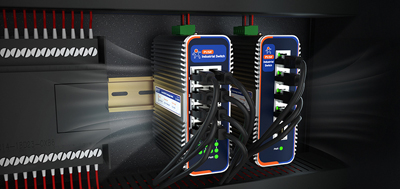
I looked at the device. Metal casing. No fan. DIN rail mounted on the side of the cabinet. All green LEDs.
I asked the brand. Lao Zhou said a name. I wrote it down—USR-M300.
Not because it had the strongest specs. Because Lao Zhou said something I thought was worth more than any spec sheet:
"I don't care what chip it uses or what OS it runs. I just know—on the coldest day last winter, the cellular IoT gateway at the factory next door froze to death. My line didn't stop. That's enough."
Your Workshop Doesn't Lack Good Equipment—It Lacks Equipment That Survives
I'm not writing this to sell any product.
I'm writing this because I know that feeling too well—3 a.m., line down, phone rings, you throw on a coat and rush to the factory, wind cutting your face like a knife. You know it's not a big problem—it's just that cellular IoT gateway couldn't take it again.
You get to the workshop. Swap it out. Reboot. Rewire. Debug. Two hours pass. Dawn breaks.
You stand next to the machine tool, watching cutting fluid drip onto iron chips, and it suddenly feels absurd—you spent millions on a five-axis machining center, and it's bottlenecked by a 3,000-RMB cellular IoT gateway.
Not that the equipment isn't good enough. You paired it with the wrong "nerve."
In your workshop, temperature changes, humidity changes, EMI changes, dust changes. But your line can't change. Your delivery date can't change. Your precision can't change.
You don't need a cellular IoT gateway with "pretty specs." You need one that cold-starts at -10°C, doesn't drop packets at 60°C, doesn't crash in a fog of oil mist and iron chips, and will still be there ten years from now when you need it.
Such cellular IoT gateways aren't common. But they exist.
Like the USR-M300. Like a few other manufacturers that have actually done system-level thermal validation.
You don't need the most expensive. You need the one in your workshop that gives you the least trouble.
People in precision machining spend their whole lives fighting for "precision."
0.003mm positioning accuracy, 0.4μm surface roughness—behind these numbers are countless days and nights of tuning, tool setting, compensation.
But what many don't know: the precision you poured the most sweat into protecting can be quietly destroyed by a wrongly chosen cellular IoT gateway, on a morning you weren't even watching.
Not because it wasn't trying hard enough. Because from the start, it never should have been in that temperature, that humidity, that EMI environment.
Next time you select, don't check the protocol first. Ask yourself:
"At -8°C in winter, will it boot?"
Yes—buy it. No—no matter how pretty the specs, don't touch it.
Your production line deserves a device that truly survives.
Not because of compliance. Not because of specs. Because that 3 a.m. phone call—you really don't want to answer it again.