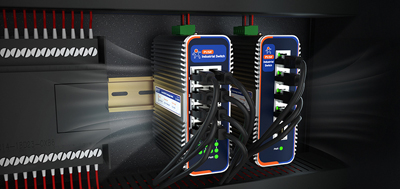
The "Nerve Center" of Multi-Axis Synchronous Machining: How an Industrial IoT Gateway Coordinates 50+ Servo Motors for Precision
Anyone who does five-axis synchronized machining dreads hearing one sentence:
"Tolerance exceeded."
0.003 millimeters—roughly one-twentieth the diameter of a human hair. Your spindle spins at 24,000 RPM, feed axes move 300mm per second, five axes moving simultaneously, each axis's position error must not exceed this number.
This isn't a problem that "high precision" alone can solve. This is a system-level synchronization problem.
Have you ever wondered—when five servo drives receive commands simultaneously, fifty-plus encoders return position data simultaneously, a dozen safety signals trigger simultaneously—who is coordinating these data streams?
The PLC? Yes, the PLC sends commands. But the communication link between the PLC and servos, the data exchange between the PLC and HMI, the status reporting between the PLC and the upper MES—the stability, real-time performance, and consistency of these links are what determines whether that 0.003mm holds.
And the device responsible for holding that link together is often one everyone overlooks:
The industrial IoT gateway.
Let me start with a real scenario.
An auto parts factory—one flexible machining line equipped with six five-axis machining centers, eight servo axes per machine, plus auxiliary axes, tool magazine axes, chip conveyor axes. Total: 54 servo motors on the line.
The challenge isn't "is each machine precise enough?" The challenge is—when six machines machine simultaneously, change tools simultaneously, and coordinate with AGVs for loading and unloading—every axis's motion rhythm must be seamless.
AGV arrival signal triggers → machine safety door opens → spindle starts → Z-axis rapid descent → five-axis sync begins → machining complete → Z-axis retracts → safety door closes → AGV picks up part.
This entire sequence involves over 200 I/O signals, three communication protocols running together—Profinet, EtherCAT, Modbus TCP—and the shortest data refresh cycle is just 1 millisecond.
Their engineer said something to me that I still remember:
"We're not afraid that one axis isn't precise enough. We're afraid that all axes are precise—but they're not synchronized. Like an orchestra where every musician is skilled, but the conductor's baton dropped."
The conductor's baton is the industrial IoT gateway.
Most factories designing multi-axis sync systems spend 80% of their budget and effort on the servo system itself—what brand of drive, what resolution encoder, what bus protocol.
That's not wrong. Servos are muscles—they matter.
But have you noticed something?
You installed the best servo drives, the highest-precision linear encoders, a top-tier controller—but the machined parts still occasionally exceed tolerance.
Where's the problem?
I've dissected the communication architectures of many production lines and found one common issue:
Everyone optimizes the "muscles." Nobody optimizes the "nerves."
What are "nerves"?
The communication bus from PLC to servo. The line where servo encoder data returns. The path from the emergency stop button to the servo enable. The hop from the AGV arrival signal on the wireless network to the PLC input point.
What are the characteristics of these "nerves"?
Numerous. Diverse. Must not break.
A 50-axis line can have over a hundred communication links. The latency, jitter, and packet loss rate of each link ultimately accumulate into a "system-level error."
This error, the servo drive can't fix on its own. The PLC can't fix it either. Because the data they see is already "late," "incomplete," "corrupted by interference."
You gave the muscles the best commands—but the commands warped on the way.
That's why, when many factory engineers troubleshoot precision issues, they check servo parameters for three days—only to discover a gateway port dropped a few packets under high load.
A few packets. 0.003 millimeters.
In a multi-axis sync architecture, the industrial IoT gateway isn't an "optional accessory." What it does breaks down into three layers:
Layer one: protocol unification—turning the Tower of Babel into Mandarin.
On an advanced production line, you'll see various protocols fighting each other.
Servos use EtherCAT or Profinet IRT, demanding 1ms cycle times. HMI uses Modbus TCP—100ms refresh is fine. AGVs send status over WiFi or 5G—latency swings between 10 and 50ms. Safety PLCs use PROFIsafe, requiring deterministic response.
These protocols speak different "languages"—different timing requirements, different data formats, different priorities.
The first thing the industrial IoT gateway does is act as translator.
It packs EtherCAT real-time data into OPC UA, maps Modbus registers into MQTT topics, converts AGV status signals into digital values the PLC recognizes. All data undergoes format unification and timestamp alignment inside the gateway before distribution.
Sounds simple. But in a scenario with 50 axes, 200 I/Os, and three protocols running together, any single packet with a misaligned timestamp can cause two axes to act out of sync.
Layer two: real-time preprocessing—filtering noise before the data even arrives.
Position data returned by servo encoders isn't "clean."
Electromagnetic interference, mechanical vibration, cable bending—all of these superimpose noise on the encoder signal. If this noise goes straight to the controller, the controller makes wrong compensation moves—resulting in surface chatter and profile deviation.
The industrial IoT gateway performs signal filtering and anomaly detection locally. It knows what noise is normal (e.g., micro-vibration from spindle imbalance) and what noise is abnormal (e.g., pulse loss from a loose cable connector).
Normal noise: filtered out, not reported. Abnormal noise: flagged, triggers a warning, or even triggers a safety stop directly.
This ability to "judge locally" determines whether your system is "reactive" or "preventive."
Reactive: stop after the problem occurs—a batch of material is already scrapped.
Preventive: cut it off before the problem spreads—product saved, delivery date saved.
Layer three: deterministic forwarding—this is the hardest, and the most valuable.
In multi-axis sync, not all data is equally important.
Servo position data: must arrive within 1ms. Safety signals: must arrive within 10ms. HMI status: 100ms is fine. AGV dispatch: acceptable within 500ms.
What the industrial IoT gateway must do is tag every data stream with a priority label, then forward according to a deterministic schedule.
This isn't simple "first come, first served." It's a traffic-control-like scheduling mechanism—ambulance goes first, truck pulls over, bicycle waits.
Fail at this, and you get a classic problem: safety signals and servo data queue at the same port. The safety signal gets "blocked" by servo data. Emergency stop button pressed—motor stops 20ms late.
20ms. On a 24,000 RPM spindle—that's a disaster.
The sentence I dread most from clients:
"Our equipment hasn't stopped—it's just that precision is occasionally unstable."
No downtime, but unstable precision—that's worse than downtime.
Downtime you know to investigate. Unstable precision—you don't know where to look.
You check servo parameters—fine. Machine geometric accuracy—fine. Tooling—fine. Workpiece clamping—fine.
You check everything—and finally discover a gateway serial port occasionally drops one byte under high temperature.
One byte. The position value your PLC reads is off by one LSB. On a 20-bit encoder, one LSB could be 0.001mm. Five axes compounding—that's 0.005mm. Your tolerance is 0.003mm.
Exceeded. But you can't find the cause. Because you never suspected that little gray box.
What's the cost of this "chronic precision loss"?
3% more scrap parts every month. Customers start complaining "this batch has oversized tolerance." Your quality manager starts writing 8D reports. Your profit, bit by bit, eaten by a device you never noticed.
I won't list a spec sheet. Go to the website for that.
I'll give five points—lessons I learned on the production floor.
First: it must survive your workshop's temperature.
Not rated -20 to 70°C on paper. I mean: inside your machine's electrical cabinet, measured 62°C in summer, running continuously for 72 hours, all communication ports with zero packet loss.
Because your gateway will most likely sit inside that cabinet, packed next to inverters and servo drives. That temperature is far higher than you think.
Second: it must not have a fan.
I'll say it again: no fan.
A fan sucks in metal dust and coolant mist. After three months, heatsink fins clog, temperature spikes, the gateway starts dropping packets. You think it's a communication problem—it's actually a cooling problem.
Passive cooling, fully sealed, metal casing—not a bonus feature. It's the baseline.
Third: its communication ports must have independent hardware scheduling.
Not CPU-based software queuing—independent communication co-processing chips. Because when data from 50 axes floods in simultaneously, the CPU is already busy with edge computing, protocol parsing, and safety judgment. If communication forwarding also eats CPU cycles, packets will drop.
Fourth: its software stack must support a real-time operating system.
Running Linux doesn't make it real-time. You need deterministic task scheduling, microsecond-level interrupt response, configurable priority queues. These aren't "it runs, good enough" features. They're "one microsecond off and something breaks" features.
Fifth—and most easily overlooked—it must outlast your machine.
Your five-axis machining center will run for 15 years. Your servo drives for 10 years. But if your gateway only has a 3-year supply cycle—and it's discontinued after 3 years—try swapping it.
New gateway firmware to adapt. Communication parameters to retune. Safety certifications to redo. In precision machining, any equipment swap means at least two weeks of validation.
So when you choose a gateway, don't just look at today's performance. Look at five years from now, ten years from now—is this model still available? Is the firmware still maintained?
Last year I visited a medical device factory. Their workshop had eight four-axis machining centers, dedicated to machining titanium alloy bone nails.
The coaxiality requirement for the bone nails: 0.002mm. Their quality director told me—with the previous gateway, every summer one machine's coaxiality would drift to 0.004mm. They investigated for six months, found nothing.
Then they swapped to an industrial IoT gateway—USR-M300—metal casing, fanless, independent communication scheduling chip.
The first summer after the swap—Suzhou, 38°C. He told me:
"All eight machines, coaxiality stable within 0.0015mm. I've done quality for ten years—first time I felt summer wasn't scary."
I asked him how much the gateway cost.
He told me a number. I calculated—it was roughly one-tenth of the cost of titanium alloy bar stock they used to scrap every six months due to out-of-tolerance precision.
One-tenth.
He said it calmly. But I knew how many sleepless nights he'd had that half-year, staring at those outliers on the SPC chart, not knowing where the problem was.
People who do multi-axis synchronous machining spend their whole lives fighting "synchronization."
Five axes must sync. Six machines must sync. Machines and AGVs must sync. Machining rhythm and logistics rhythm must sync.
You spent millions on machines, hundreds of thousands on servos, tens of thousands on PLCs—and saved a few thousand on the gateway.
Result: that few-thousand-RMB gateway became the biggest uncertainty factor on the entire line.
Your 50 servo motors—each one an elite soldier. But if the "nerve center" commanding them is trembling inside a 60°C electrical cabinet, even the best soldiers can't win the battle.
Next time you pick a gateway, don't ask "what protocols does it support?" first.
Ask yourself first:
"At 60°C in summer, can it keep my 50 axes synchronized to within one hair's width?"
If yes—you found the right one.