How Much Money Does an Auto Parts Factory Lose per Hour of Downtime? How an IoT Router Brings Your "Downtime Anxiety" to Zero
The moment you got that phone call, your heartbeat was surely faster than the ringtone.
3:17 a.m. Line three in the final assembly workshop suddenly went completely dead. The AGV froze mid-aisle. The robotic arm stuck halfway up. Gearbox housings lined up on the conveyor belt like a row of silent question marks. On your way to the factory, jacket thrown on, only one number was spinning in your head—per hour of downtime, how much money is burning?
No factory director wants to calculate this seriously. But we did it for you.
A mid-sized auto parts factory, single line, per hour of comprehensive loss: direct labor cost about 12,000 RMB, equipment depreciation amortization about 8,000 RMB, penalty fees for undelivered orders plus expedited logistics averaging 30,000 RMB, plus cascading delays from the disrupted production schedule—conservatively, one hour of downtime costs between 80,000 and 150,000 RMB. If it's the main assembly line or paint line—core processes—the number doubles.
Scarier than this hour isn't the money. It's knowing exactly where the problem is and being powerless to fix it.
After talking with IT directors and equipment supervisors at over a hundred auto parts factories, we found a counterintuitive truth: the root cause of line stoppages is rarely a piece of equipment suddenly failing. In most cases, it's a "connection" problem.
The AGV loses communication with the central dispatch system—it stops in place. At best, it blocks the aisle. At worst, the vehicle behind it rear-ends it. The welding robot's remote monitoring signal drops packets, the quality system receives no data, and the entire line triggers a safety interlock—everything stops and waits. Even more insidious: a sensor's data transmission is delayed by a few hundred milliseconds, the edge AI system misjudges, the robotic arm makes a wrong move, and the line emergency-stops.
You might say: we have WiFi—full factory coverage.
That's exactly where the problem lies. The auto parts factory environment is WiFi's "hell-tier dungeon"—metal walls, electromagnetic interference from large stamping presses, smoke and fume in welding shops, corrosive chemical gases in paint booths. A standard AP in this environment easily hits 15%+ packet loss and 200ms latency jitter. What does AGV dispatch require? Under 50ms latency, ideally under 20ms.
The issue isn't that WiFi is bad. It's that you're using the wrong tool.
Many factories do this: line stops, swap the IoT router first. So IT buys a few enterprise APs—or even home routers—swaps them in, it's fine for two days, then the problem returns.
This isn't an IoT router problem. It's a problem with how you choose an IoT router.
Consumer-grade and standard enterprise network devices are designed for "office scenarios"—constant temperature, low EMI, low device density. They can't handle the three mountains of an auto parts factory:
Mountain one: temperature. Stamping workshop floor temperature hits 60°C in summer. A standard IoT router's upper limit is 45°C. It doesn't "degrade"—it triggers thermal protection and shuts down.
Mountain two: vibration. The stamping press hits dozens of times per minute—the whole building trembles. The fan inside a standard IoT router is the most fragile component—blades collect dust, bearings wear, single point of failure. It can quit in a month. And the fan is literally the only moving part in a standard network device.
Mountain three: electromagnetic interference. The electromagnetic pulse when a welder fires can cause a standard IoT router's wireless module to lose communication for seconds. For an AGV, seconds of lost connection means "out of control."
So you don't need a "more expensive IoT router." You need something with a fundamentally different design philosophy from the ground up—an industrial-grade IoT router, built for this environment.
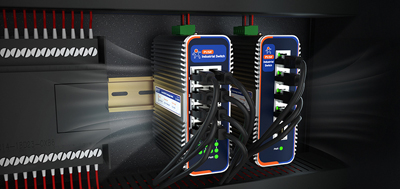
A real IoT router doesn't even look like what you picture. No fan. No fragile external antennas. Aluminum die-cast housing, sealed to IP30 or higher. But that's just the surface. The real difference is invisible.
First: "always on" architecture. The IoT router uses passive cooling—no fan means no mechanical failure point. More critically, its system design follows "zero single point of failure" principles—redundant power modules, dual communication link backups, watchdog monitoring in real time. Just like the industrial computer design philosophy in the reference material: fans are common failure points, single point of failure vulnerability must be eliminated. The IoT router applies this logic to network equipment.
Second: "tough enough" hardware selection. Industrial-grade components operate from -40°C to 75°C, far beyond consumer-grade 0–40°C. Circuit boards get conformal coating. Connectors are aviation-grade. This isn't for looks—it's so that in your stamping workshop, welding station, and paint booth, it survives—and stays stable.
Third: "speaks industrial" protocol support. A standard IoT router only speaks TCP/IP. An industrial IoT router natively supports CAN Bus, Modbus, Profinet, and other industrial protocols. That means it doesn't just "get online"—it talks directly to your PLCs, AGV dispatch systems, and sensor networks. When an AGV approaches, the IoT router identifies its ID, reads its battery and position data, prioritizes bandwidth for it. This isn't one router working—it's the production line's "nerve node" working.
Back to the opening question. 100,000 RMB lost per hour of downtime. If network issues cause 10 stoppages a year—that's one million RMB gone. Not counting potential safety incident compensation, long-term customer loss.
One IoT router—something like the USR-G806W—costs a few thousand RMB. What do you get?
7×24 uninterrupted operation, designed lifespan over 10 years—retires with your production line.
Wide temp, wide voltage input: 9–60V DC, connects directly to factory industrial power—unfazed by voltage swings.
5G/4G/WiFi6 multi-link redundancy—one link drops, auto-switch to the next. AGVs never stop mid-aisle because of "no network."
Edge computing—processes AGV path planning data locally. No need to round-trip to the cloud and wait for commands. Latency crushed to single-digit milliseconds.
Remote OOB management—IT can reboot, diagnose, and upgrade from the office. No need to get up at midnight and go to the workshop.
A few thousand RMB doesn't buy you a router. It buys you a "no-downtime insurance policy" worth 100,000 RMB per hour.
People in manufacturing fear "uncontrollability" more than competitors. Raw material price hikes—you negotiate. Fewer orders—you find new ones. But when the line suddenly stops, you just stand there watching. That helplessness hurts worse than losing money.
We've seen too many scenes like this: the factory director slams the table in the meeting—"the network problem MUST be solved." The IT manager spends three days flipping through selection guides, then still buys something "close enough." It's not that he doesn't want the right one—there are too few products on the market that truly understand industrial environments. Too much noise.
So if you're struggling with this—AGVs keep dropping, lines stop for no reason, WiFi might as well not exist in the workshop—start by checking the network link. Often, the distance between you and "zero downtime anxiety" is just one IoT router that truly understands your factory.
Something like the USR-G806W—IoT router, wide temp, shock-proof, multi-link redundancy, designed specifically for AGVs and line automation. No major network overhaul needed—mount it by the line, and many old problems ease the same day. Of course, selection depends on your workshop environment, device count, and communication protocols. Get a professional to help you evaluate—don't guess alone on your own. After all, your production line can't wait.
You can calculate the cost of downtime. But the value of connectivity—you only know it when you use the right tool.